
Observing the Progress of Industry: Mary Wollstonecraft as Industrial Traveller
Catherine Packham, University of Sussex
We don’t immediately think of the late eighteenth-century feminist Mary Wollstonecraft as an industrial traveller, nor of aesthetic discourse and terminology as offering an obvious means of reflecting on economic progress. Nevertheless, Wollstonecraft’s Letters Written During A Short Residence in Sweden, Norway and Denmark (1796), which draw on her travels in Scandinavia the preceding summer, show her doing both these things. The text’s persona presents herself as an Enlightenment observer of civilisational progress, evidently familiar with a narrative of economic activity and human improvement derived from Adam Smith, author of The Wealth of Nations (1776) and the foremost late eighteenth-century theorist of industry. But Short Residence doesn’t simply present the prosaic details of industrial scenes visited by Wollstonecraft, such as the ironworks at Larvik, Norway, or the saltworks near Tonsberg. Rather, her aesthetic sensibility moves beyond mere visual consumption of industrial landscapes to meditate on the implications of such scenes and the industrial progress they exemplify, not simply for the natural world, but for human happiness and futurity more broadly.
When Wollstonecraft visits Trollhätten in Sweden, for example, to see the famous cascade and ‘observe the progress of the stupendous attempt to form a canal through the rocks, to the extent of an English mile and a half,’ she notes that this major feat of engineering was expected to take five years and employs 900 men per day, but her account is dominated by a description which draws on the contemporary aesthetic of the sublime (pp. 189–92).
Although, unpromisingly, it initially appears that this ‘grand proof of human industry … was not calculated to warm the fancy,’ having ‘wandered about’ somewhat, and viewed the ‘conflux of the various cataracts rushing from different falls, struggling with the huge masses of rock,’ the speaker admits that it ‘was indeed a grand object.’ A fir-covered island dividing the ‘torrent’ renders the scene still more ‘picturesque’; further details—an ‘impending rock’, ‘horrific crags’, the cascade itself— all contribute to what now emerges as a ‘noble scene.’
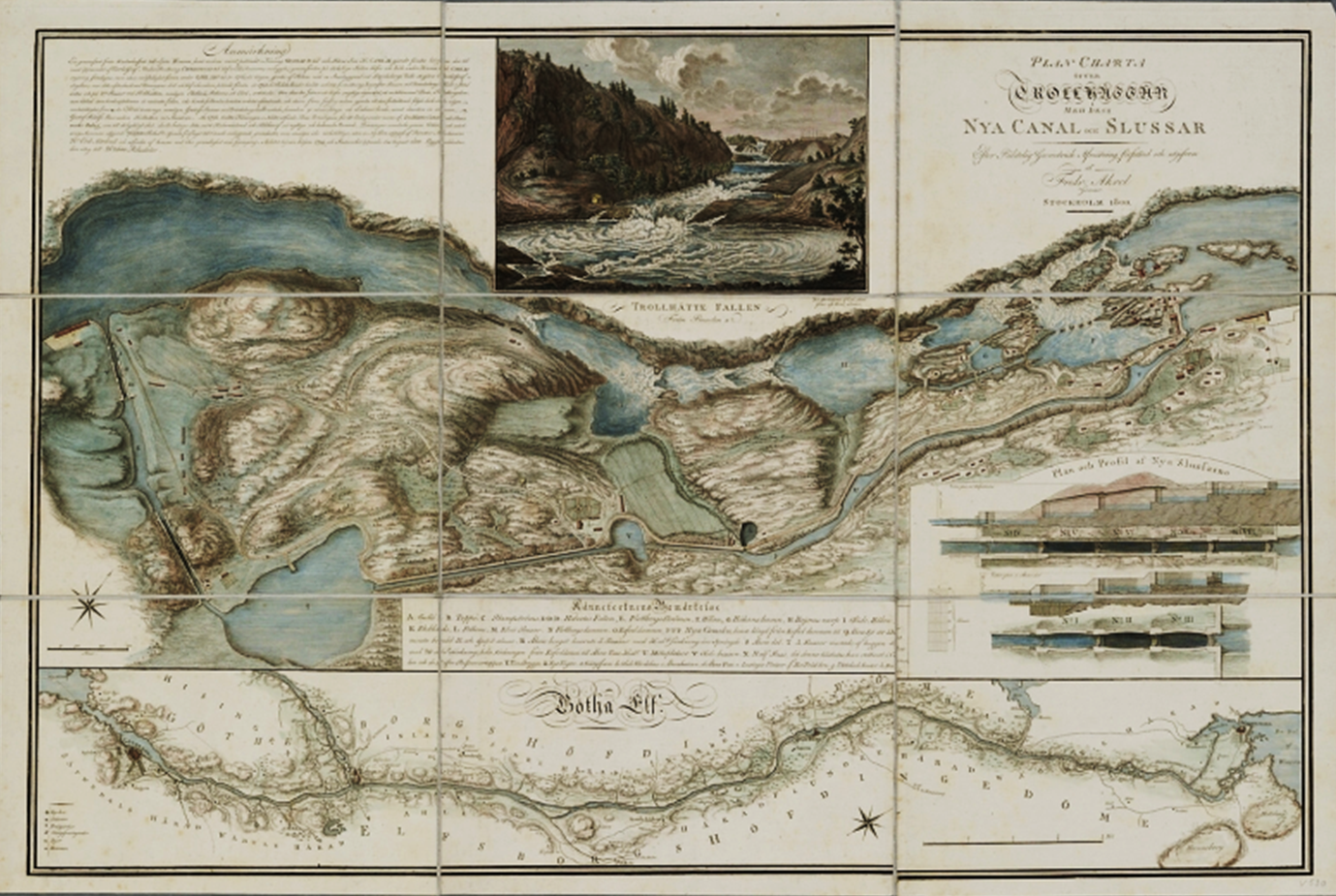
Fredrik Akrel, Map of the Trollhättan Falls. Vasa Collection.
The combination of ‘human instruments … the bustle of workmen ... the blowing up of rocks’ and the grandeur of original nature eventually render the scene ‘sublime.’ In this aesthetic rendering of industrial effect, the doubly grand spectacles of original nature and human industry complement but also disturb each other: a tension which describes their potential mutual improvement but also the capacity for one to destroy the other. Describing the canal work’s ‘dreadful convulsion of nature’ via an aesthetic of fragmentation, chaos, tearing and splitting, this exemplary site of emergent industrial modernity is presented as a sublime schism, which, given its effect on the observer, is perhaps experienced as much within the psychic interiority of human nature as it is externalised on the landscape.
Wollstonecraft’s text as a whole is also deeply split: it is caught, on the one hand, between repeating a conventional narrative about the beneficial role of industry in human progress, whilst, on the other, manifesting deep ambivalence about where all this might end. We might understand this problem as encapsulated in the shifting meanings of the word ‘industry’ itself. Originally connoting enterprise, skill and labour, which Wollstonecraft wants to code positively as a means for human improvement, by 1801, some 5 years after Short Residence appeared, a new sense of ‘industry’ emerges: as organised, conglomerated, amassed and collectivised.
In this shift from one kind of industry (individual labour) to another (collective, organised and, increasingly, mechanised), a concept at the heart of Smith’s Wealth of Nations is central: the division of labour. As described by Smith, the division of labour maximises the output of labour by making it more efficient; and it does this by the paradoxical but magical means of subdividing tasks into smaller units of work which, performed repeatedly and thus more efficiently, achieve heightened output, productivity and profit. What I am terming a paradox here is the way in which making acts of labour smaller—dividing and subdividing it into parts and subparts—produces, in a dizzying but compelling logic, significantly larger effects. We can perhaps see an echo of this conjunction of increasingly miniaturised, diminished human labour with its collective, sublime effects, in visual representations of industrial scenes:
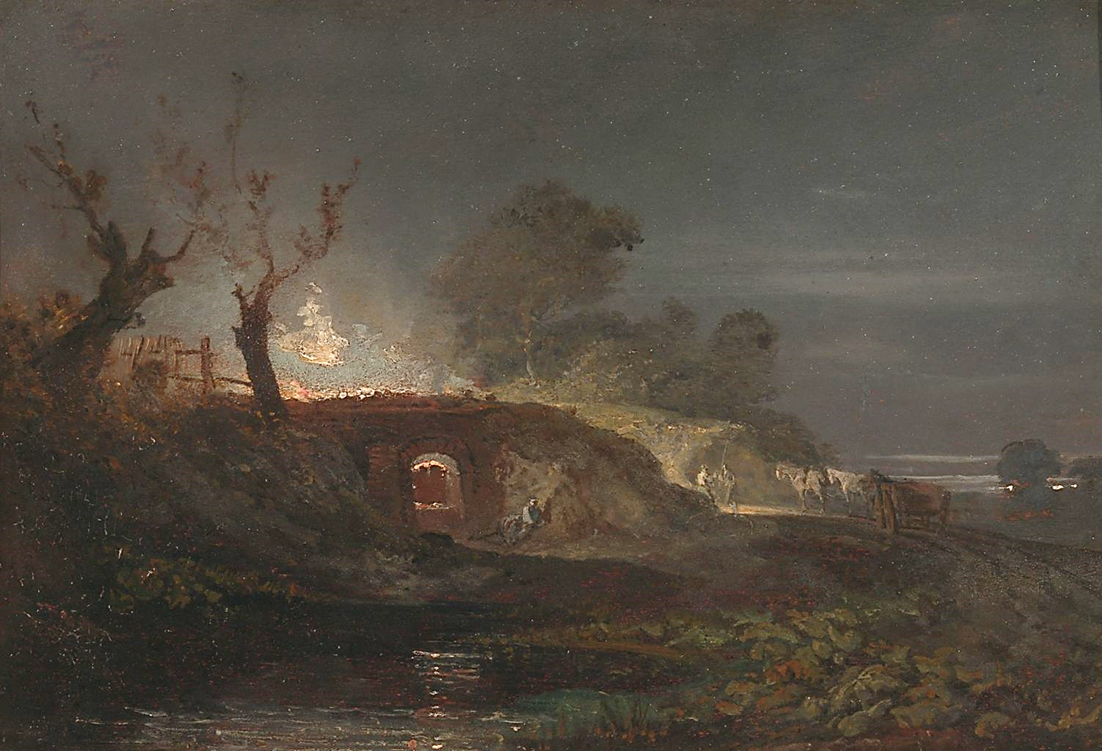
JMW Turner, A Limekiln (c. 1795–96). Yale Center for British Art.
We might see it too in the way Wollstonecraft also plays with scale to reduce the ‘bustle of workman’ at Trollhatten to the ‘insignificant sport of children.’
According to Smith (p. 11), the productive effects of the division of labour are possible because they reduce or eliminate wasted time. A country workman who changes his tools for new tasks ‘every half hour’ acquires a ‘habit of sauntering,’ and is even ‘slothful,’ ‘lazy,’ and ‘incapable of any vigorous application.’ For Smith, sauntering is a wasteful practice which must be abandoned on the road to productivity and wealth.
But in a work published the year before her Scandinavian travels, Wollstonecraft defended such leisured moments as ‘the very time that preserves the man from degenerating into a brute’: ‘every one must have observed how much more intelligent are the blacksmith, carpenters, and masons in the country, than the journeymen in great towns’ she asserts (p. 519). Although Short Residence shows that Wollstonecraft is happy to join Smith on industry’s road to improvement, for her an element of leisure, reflection and saunter is evidently worth preserving.
Sauntering, indeed, could describe the form of progress made by the Wollstonecraftian persona in Short Residence: both in her meandering, ‘desultory’ style of writing, and also in her self-presentation as a Rousseauvian wanderer, engaging in reveries which might be understood as imaginative ‘saunters.’ The ‘sauntering’ nature of her text is crucial, in fact, in enabling not just the repetition of supposed rock-like facts of nature, the so-called ‘axioms’ of political economy, but also to work around, across and between them, like the water at the Trollhättan works, which powerfully finds its way around such obstacles on its route downstream. In particular, it enables her to circle around the recurring problem encountered on her traveller’s progress: that the conglomerated effects of ‘industry,’ the ingenuity, enterprise and skill to which Wollstonecraft wants to give moral and economic value as a means of improvement, at best do not ‘warm the fancy’, and at worst are alienating, degrading and inhumane.
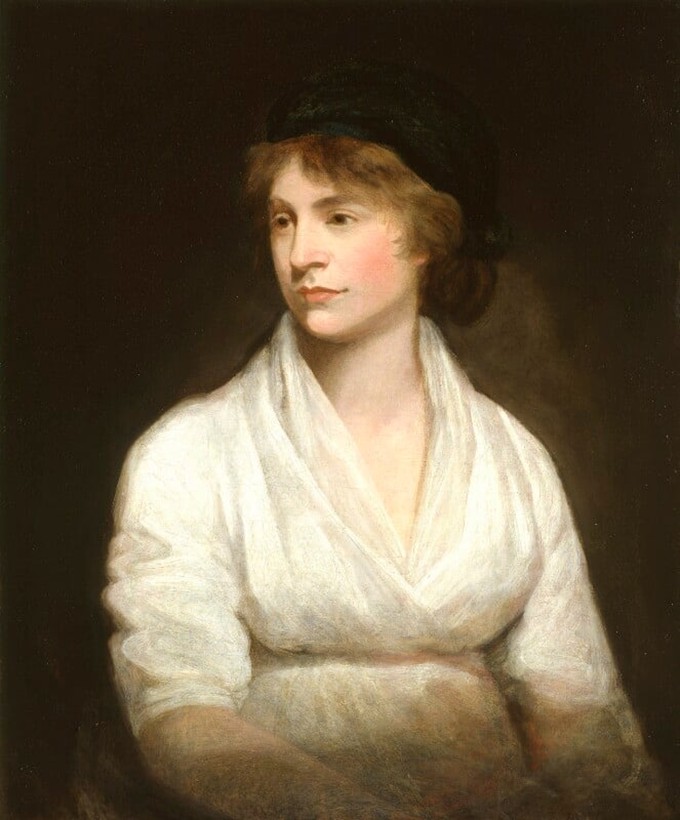
John Opie, Mary Wollstonecraft (c. 1797). © National Portrait Gallery, London.
This is a problem which arguably impedes the progression of Wollstonecraft’s political economic thinking in this text, and which diverts it from the intended direction which might be intuited when she lands on the shores of Sweden in the opening letter. Instead, this Enlightenment traveller is caused to turn back on herself, to question the relation between improvement and happiness, to uncover self-interest as the often distasteful motivation behind industry, and to trace industry’s more repellent manifestations, as much in moral ugliness as in the physical degradations of landscape.
The problems presented by human industry are not resolved in Short Residence. But Wollstonecraft’s sauntering text finds a way to speak them, especially by presenting aesthetic experience alongside, and equally weighted with, an exploration of political, economic and social aspects of human experience. Aesthetic experience and aesthetic value, Short Residence in effect asserts, partake of the same axiomatic quality—unquestionable, actual, self-evident and possessive of some order of the factual—as the political economic or philosophical reportage which is also offered in the text. Thus when, as at Trollhättan, Wollstonecraft’s speaker responds to the scene of industry through the frame of aesthetic experience, she is not simply offering an appreciation of the material environment. She is using an aesthetic register to point to what is otherwise unrepresentable, and perhaps unknowable: industry’s effects not simply on the natural landscape, but also on humanity and its future.
It is not simply that a scene of natural beauty has been destroyed or desecrated (although it is that). It is, further, that such a scene of transformation, perhaps destruction, speaks beyond itself, metonymically, to larger forces of destruction and change, the mobilising of which the scene makes evident. At the same time, her sauntering eye is able to attend to telling details which resist the torrent. Within Trollhättan’s sublime scene of ‘chaos’ and ‘sterility,’ one still, calm, leisured particular catches her eye: a ‘boy, half obscured by the sparkling foam, fishing under the impending rock.’ However much the canal works speak to industry’s transformation of nature into an industrial sublime, something resistant in human nature still, it appears, persists.
Further reading
- Catherine Packham, Mary Wollstonecraft and Political Economy: The Feminist Critique of Commercial Modernity (Cambridge UP, 2024)
- Pamela Perkins, ‘Travel Writing,’ in Mary Wollstonecraft in Context, Nancy E. Johnson and Paul Keen (Cambridge UP, 2020), pp. 297–304