
Slavery and the British Industrialising Economy
Pat Hudson, Cardiff University and Maxine Berg, University of Warwick

In the summer of 2020, when the Colston statue was toppled and Black Lives Matter protests were in full swing, the absence of an up-to-date, accessible study of the place of slavery in British economic history became glaringly apparent. We attempted in our book Slavery, Capitalism and the Industrial Revolution to remedy that absence. The forces set in motion by the products and profits of slavery affected almost every aspect of the British economy and society for almost three centuries but especially during the process of industrialisation in England, Wales and Scotland. We concentrate on the story of British exploitation of the Caribbean, using African slave labour, and upon tobacco, rice and sugar plantations, alongside those devoted to cotton.
The densest sites of early industrialisation—Ironbridge Gorge, the Swansea valley, the west side of the Dee estuary at Greenfield, the Black Country, the textile Pennines—so compelling to curious travellers, literary figures, artists and vernacular poets, were all deeply imbricated in the stimulus provided by the expanding slave trade and the many products and markets that developed in its wake. Beyond its close links to Lancashire and Scottish cotton manufacture, slavery was formative in the making of the earliest great capital-intensive sites of heavy industry: the North and South Wales copper and iron industries and the great iron works of Shropshire and the West Midlands.
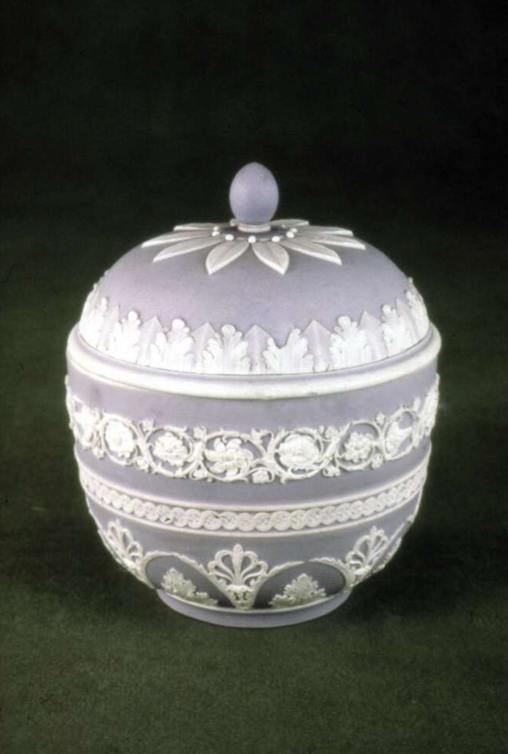
Wedgwood jasperware sugar bowl, c. 1790. British Museum.
British manufacturing benefited from the expansion of the slave trade and slavery from an early stage. The iron and copper industries of the midlands, north, Scotland and south Wales developed new technologies and diversified in response to American and African markets. Travel accounts of the eighteenth century conveyed images of the unprecedented size, labour forces and mechanization of these sites of copper and iron manufacture. But they contain little, if any, reference to the Atlantic stimulus, based upon enslavement, that propelled them. At the same time, slave-grown sugar drove changes in manufacturing and retailing. Sugar was by far the most important British import of the eighteenth century. It revolutionised tastes and consumer culture, wholesaling, retailing and wholesale trading practices, and stimulated new refining and manufacturing industries. It was the first globally important commodity, long before cotton. Other manufactures—glass wares, porcelain, silverwares, ceramics—developed to serve new tastes for sweetened hot beverages and alcoholic drinks made with sugar. The new tastes and goods of this consumer revolution stimulated capitalist development as much as changes in production. These are reflected in the art and literature of the eighteenth century but again the role of slavery in their genesis, operating on distant shores, is rarely invoked.
The same is true of the many contemporary descriptions of the precocious industrialization of the textile north-west. Soft long-stapled slave-grown cotton from the Caribbean facilitated the important Lancashire spinning inventions of the mid- and late eighteenth century, long before the coarser US plantation cotton came on stream after 1800. But only in the nineteenth century, with the abolitionist movement gathering pace, did contemporaries start to invoke the spectre of slavery in their accounts of regional industrial transformations.
The slave trade of the seventeenth and eighteenth centuries did not exist in isolation, as contemporaries recognised. It was the foundation stone of new multilateral global trading that linked the Indian and Atlantic oceans, Europe, north America and south America, as well as the Caribbean colonies. African peoples were enslaved in exchange for colourful cottons imported from India and cowrie shells from the Maldives, as well as manufactured goods, including textiles, metal wares and guns from Britain and Europe. The Holywell copper works first produced copper rods and manillas marketed across the Dee Estuary to Liverpool slave traders who then used them as their currency or trade goods in exchange for slaves bought on the West Coast of Africa.

British-made manilla, recovered from the 1843 wreck of the Douro. British Museum.
Britain’s Atlantic colonies became uniquely populous and prosperous providing a key source of demand for new British manufactured goods of all kinds: lighter and brighter, checked, striped and printed textiles that emulated fabrics from Asia as well as basic cloths to clothe enslaved workers. The famous ‘Welsh plains’ are a case in point: domestically produced woollens from Wales were traded to the Caribbean and North America, along with Kendal cloths, Penistones from Yorkshire and Scottish linens, for use on plantations. Specialised tools and equipment also found major markets in the Atlantic colonies, including copper stills and steam engines, for the refining and processing of crops, and specialised hoes, scythes, rakes, and spades for plantation agriculture. British North American colonies traded fish, timber and plantation supplies to the Caribbean, earning the income to spend on further British manufactures.
Slave plantations were fully a part of Britain’s agricultural and industrial revolutions. New forms of labour- and capital-intensive agri-business in the Caribbean brought managerial and accounting innovation as well as new sugar-processing technologies. Plantations utilised seeds and plants, labour, capital, skills and knowledge from across the globe and were a central force in the rise of a trans-national knowledge economy that included the skills and expertise of Amerindians and enslaved Africans. Historians of Britain’s industrial revolution have failed to incorporate British colonial possessions into their accounts of economic and technological change. It is also the case that literary historians have failed fully to integrate art and writings from the Caribbean and the pre-1770s North American colonies into their studies of the travelogues of industrialising Britain.

JMW Turner, Harewood House from the South-West (c. 1797). Wikimedia Commons. (On Harewood House and slavery, see here.)

Slavery was not just a source of profits for traders and plantation owners. Their wealth improved agricultural and urban estates, built grand country houses, and developed canals, railways and manufacturing. But the livelihoods of millions of Britons also depended upon slavery through the many stages of importing, processing and retailing slave-grown crops; in running plantations; in building, operating and defending Atlantic shipping; in commercial finance, credit, mortgage-lending and marine insurance; and in manufacturing and using slave-grown raw materials, especially sugar and cotton. Most of the populations of Britain, and in the rest of Western Europe, also benefitted from new cheap consumer goods that were the product of enslaved labour: tobacco, sugared tea, coffee, chocolate, ginger, rice, and the Atlantic dyes and raw cotton that produced colourful mass-produced clothing. The social commentary of industrialising Britain rarely recognised that so many aspects of change in the everyday lives of the mass of the population owed their origin to slavery.
It is no accident that the structural change and rapid population growth fundamental to industrialisation occurred first in the large manufacturing hinterlands of Bristol, Liverpool/Manchester and Glasgow. This brought a geographical reorientation of the industrialising economy much remarked upon by commentators and travellers. The refining, manufacturing, banking, credit dealings, insurance, broking, shipping, commercial intelligence and new transport infrastructures that served the plantation trades spilled over into all aspects of the regional transformation of the north and west.
Slave-based Atlantic commerce also spawned innovations in the national debt, in multilateral payments systems, in long distance investments, insurance, stock trading and stock broking. It extended the fiscal capacity of the state and raised the rate of return on investment across the board. Slavery thus bolstered London’s growing role as a centre for global finance as the City developed insurance, financial trading and mortgage markets to promote distant and risky investments in enslaved people.
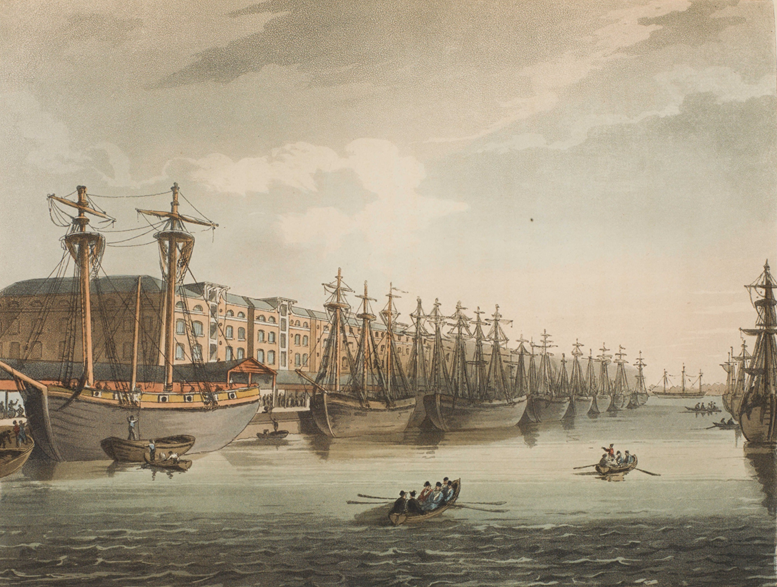
Thomas Rowlandson and Auguste Charles Pugin (engraved by John Bluck), West India Docks, in Ackermann’s Microcosm of London (1808–10). Romantic London.
Slavery was foundational to the trajectory of the British economy and society well beyond emancipation in the 1830s. Profits from slavery promoted an elite of colonial rentiers and initiated a polarisation of wealth that was reinforced by the proceeds of later imperial investments and ventures. Slavery also influenced regional and race-based inequalities in Britain over the long term. The industrial conurbations of the north-west and the midlands, set in motion at the time of slavery, deindustrialised in the twentieth century as manufacturing was increasingly outsourced. These areas now contain many industrial heritage sites, earlier depicted by romantic writers and artists. Once again they are a focus of travel and tourism, but now embedded in current regional and racial inequality.
Further reading
- Maxine Berg and Pat Hudson, Slavery, Capitalism and the Industrial Revolution (Polity Press, 2023)
- Eric Williams, Capitalism and Slavery (Penguin, 2022)