
‘You at Once Tremble and Admire’: The Carron Ironworks in Romantic Travel Accounts
Nigel Leask, University of Glasgow
The founding of the Carron Ironworks in 1759 initiated Scotland’s era of heavy industry. Carron was hailed as ‘the greatest arsenal in Britain.’ It pioneered both the use of local ironstone ‘from the carboniferous forests of Central Scotland,’ and the process of smelting iron with coal in Scotland. Previous Scottish ironworks had been situated in the Highlands where there was sufficient woodland for producing charcoal, such as Bunawe and Goatfield in Argyll, Invergarry in Invernesshire, and Abernethy in Strathspey: its estimated that 10 charcoal blast furnaces were operative in these Highland locations.
In the words of economic historian Henry Hamilton, ‘the iron industry…[had fled] to the wilderness in search of wood,’ with ore being shipped from England ‘to be smelted with the woods of the Highlands.’ But with the outbreak of the Seven Years War in 1756, a booming munitions industry and a rise in iron prices saw the construction of new coal-powered blast furnaces in England and Wales, providing the immediate stimulus for the establishment of Carron in Scotland’s central belt in 1759. Situated on the Firth of Forth, but within easy reach of Glasgow, Carron was close to seams of ironstone and coal, the key conditions for blast furnaces and foundries.
Combining Scottish capital and resources with English technological expertise, Carron was founded by a partnership comprising Birmingham industrialist Samuel Garbett, industrial chemist Dr John Roebuck, and Scottish entrepreneurs William Cadell and sons. Taking iron ore from Bo’ness and water from the river Carron, they employed the new method pioneered by Abraham Darby at Coalbrookdale, using coke from coal mines in the vicinity as fuel rather than the usual charcoal. Experienced furnacemen and builders were brought from Shropshire to assist in the construction of the new iron works, as well as metal workers from Sheffield and Birmingham. The site on the north bank of the Carron under the Kilsyth Hills (between Larbert and the modern Grangemouth refinery) ensured a plentiful water supply, with easy access to the Firth of Forth, and later, the Forth and Clyde canal. After a shaky start, in 1769 Carron’s fortunes improved when it came under the management of Charles Gascoigne, who pioneered Carron’s most distinctive product, the ‘Carronade’ (originally known as the ‘Gasconade’), a small cannon used on the upper decks of warships, greatly enhancing their firepower at close range.
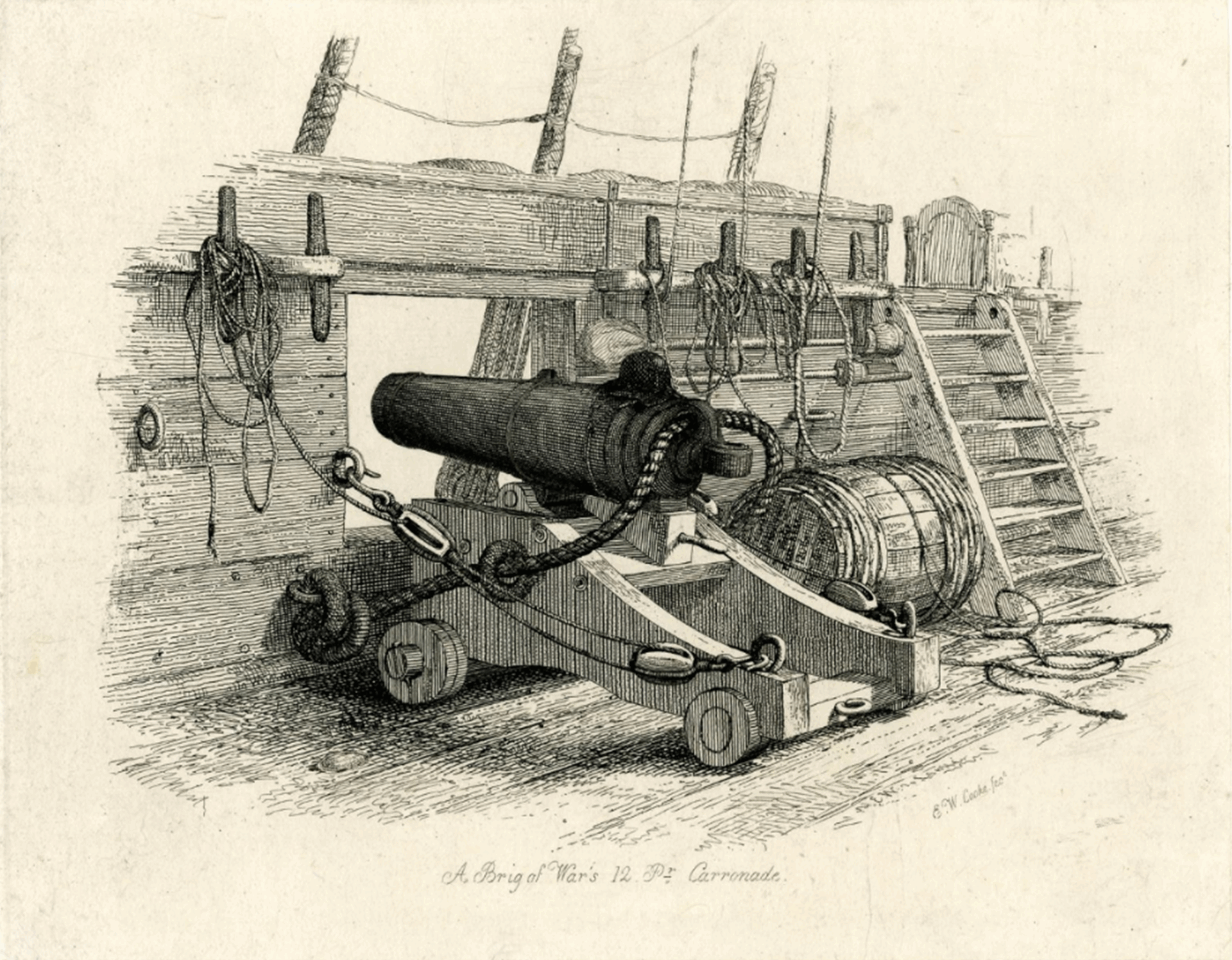
Edward William Cooke, A Brig of War's 12 Pounder Carronade (1829). British Museum.
The international reputation of its artillery ordinance and other products, including steam engines, ensured that by 1814, the Carron Company was the largest iron works in Europe, employing over 2,000 workers. It attracted many innovators, even if the Scottish coal and iron industry of this period was still dwarfed by linen and cotton production. While the total output of Scotland’s blast furnaces in 1796 was 16,640 tons, valued at £108,160, linen cloth production in the same year was valued at £906,202. The Carron Company continued production for 223 years, becoming insolvent in 1982: the brand survives today as ‘Carron Phoenix,’ which manufactures high quality kitchen sinks on the same site. A nice emblem of the changing fortunes of British heavy industry.
‘Carron iron works lie about a mile from Falkirk, and are the greatest of the kind in Europe,’ wrote Thomas Pennant in his Tour in Scotland 1769 (published in 1771), the first traveller to describe the site. Pennant noted that the works had been founded eight years earlier, ‘before which there was not a single house, and the country a mere moor. At present, the buildings of all sorts are of vast extent, and about 1200 men are employed. The iron is smelted from the stone, then cast into cannon, pots, and all sorts of utensils made in founderies.’ Characteristically, Pennant proceeded to describe the nearby antiquities, including the Roman terminal temple known as ‘Arthur’s O’on,’ recently destroyed by the local landowner (the ‘gothic knight’ Sir Michael Bruce of Stenhouse, whose land was leased to the Carron Company) in a fit of wanton vandalism, and the nearby vallum and ditches of Antonine’s Wall.
Six years later, another traveller, Rev. William Gilpin, offered a more aesthetically orientated account of Carron’s industrial landscape: ‘In the neighbourhood of the new canal are the great forges of the Carron-works; which exhibit a set of the most infernal ideas. In one place, where coal is converted into coke by discharging it of sulphur, and the fire spread of course over a large surface; the volumes of smoke, the spiry flames, and the suffocating heat of the glimmering air, are wonderfully affecting. How vast the fire is, we may conceive, when we are told, it consumes often a hundred tons of coal a day. At night its glare is inconceivably grand.’ But Gilpin’s admiration for the industrial sublime was tempered with horror: ‘Among the horrid ideas of this place, it is not the least, that you see every where, black, sooty figures, wheeling about, in iron wheelbarrows, molten metal, glowing hot.’
Between them, Pennant and Gilpin established Carron as a tourist destination on the Scottish ‘petit tour’ in the later decades of the eighteenth century, underlining the importance of industrial sites as well as antiquities and picturesque scenery in the romantic period. As a buttress of Britain’s military-industrial complex, Carron was often closed to visitors, especially foreigners. The ‘prudential reserve, which is necessary in time of war, renders it difficult for a stranger to gain admission,’ wrote John Stoddart in 1799, having himself been denied entry. Nevertheless, like Gilpin he marvelled at its sublime effect seen from a distance, especially ‘its lurid light, with which the atmosphere is illuminated, in the darkest nights…an object of no less admiration than surprise.’
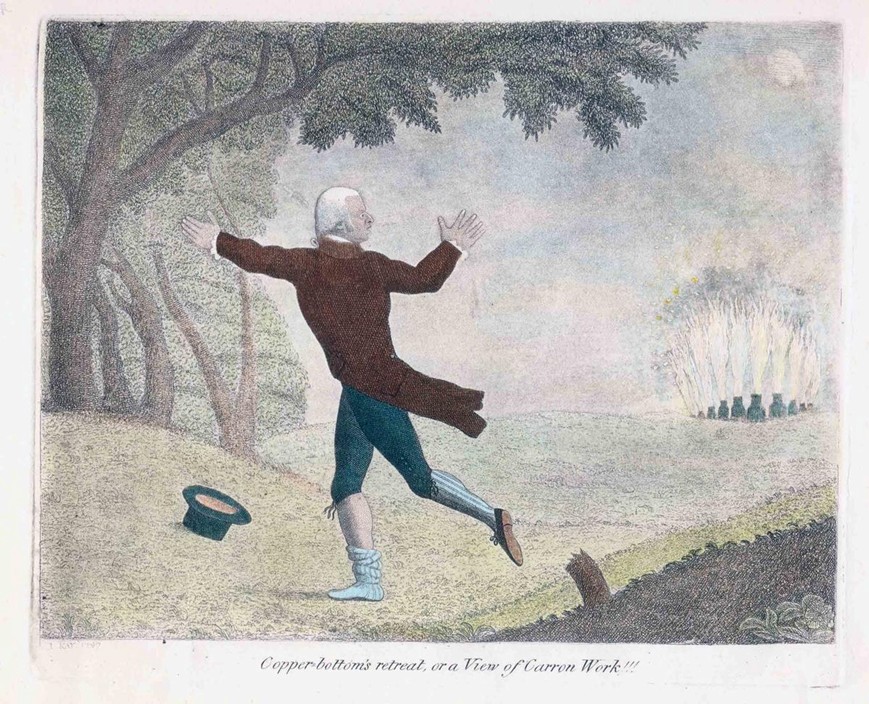
John Kay, Copper-bottom's retreat, or a View of Carron Work!!! (1797)
Two of the best travellers’ accounts of the Carron Iron Works date from the early 1780s. The first, dated 1780, is the work of an Edinburgh University medical student Jacob Pattisson: it remained in manuscript until recently, when it was edited by Dr Alex Deans and published on the Curious Travellers website. Paying lip service to Carron’s aesthetic qualities (‘one of the noblest, & most sublime works of art’), Pattisson gives a superb technical account of the working of the cylinders that supported the blast furnaces, which in the previous five years had forged iron for over 9000 cannon: ‘water Air & Fire, combined to melt the hardest part of Earth, & performing it with a majesty & ease that confounds — & you at once tremble & admire….’
Pattisson’s admiration was however tempered by moral scruples: ‘it is almost impossible to conceive how much an assemblage of Machines, calculated for the greatest variety of purposes, & of bulk, & weight the most immense, could be so placed, & preserved as to execute their great offices with ease, & facility — & yet to reflect upon all this noble workmanship being much more for the destruction, than the advantage of mankind, palls the satisfaction it is otherwise fitted to give, & you detest that ambition which has led modern Heroes to inventions, replete with devastation, & death.’
Moreover, working conditions for the Carron workers were appalling: ‘the appearance of those within are truly diabolic, most of them half naked, & as black as the region that they live in — they are said not to be very long lived — this is little to be wonder’d at, as most of them seem half parched. The Country around Carron is populous — but women & children, houses, & fields, have the same unnatural smoky appearance.’ The diabolical associations conjured up here by Pattisson anticipated the reaction of a more celebrated visitor, the Ayrshire poet Robert Burns, who, having been turned away by Carron’s porter on Sunday 26th August, 1787, inscribed the following squib on a window pane at a neighbouring inn:
We cam na here to view your warks,
In hopes to be mair wise,
But only, lest we gang to hell,
It may be nae surprise:
But when we tirl’d at your door,
Your porter dought na bear us;
Sae may, shou’d we to hell’s yetts [gates] come,
Your billy Satan sair us!
Another outstanding early account of Carron occurs in Faujas Saint Fond’s Travels describing a British tour made in 1784, when the French geologist was King Louis XVI’s Commissioner of Mines. Saint Fond’s professional interests focused on the subterranean world of caves, coal mines and volcanic convulsions, and he visited collieries in Newcastle, Fife and elsewhere on his tour north to his final destination, Fingal’s Cave on the basaltic Hebridean island of Staffa. An enthusiastic advocate for fossil fuel, he praised the environmental benefits of coal (‘this useful mineral’) in halting deforestation, in a footnote added in 1798 to the original text berating the French revolutionary government for having stalled the import of ‘purified coal’ to Paris so ‘the trees of our fine forests are daily reduced to ashes.’ Quoting Benjamin Franklin, he insisted that Britain’s industrial superiority was based on the availability of cheap coal, which also kept its workers warm and dry, while their French counterparts shivered with cold, unable to pay the high prices for timber fuel, victims of what he called the French ‘prejudice against coal.’

Sugar pan from Carron Ironworks. Callendar House, Falkirk.
Visiting Carron, Saint Fond had an opportunity to marvel at the carbon-fuelled industrial sublime in action. Although as a French national he was prohibited from certain zones of production, his party were ushered into a gigantic hall full of ‘the machines of war’: ‘cannons, mortars, bombs, balls, and those large pieces which bear the name of carronades.’ They visited a warehouse laden with manufactured articles, including ‘coppers of five feet diameter for the making of sugar in the West-Indies,’ and ‘hoes for cultivating the sugar-cane,’ servicing exploited African labour in Britain’s Caribbean slave colonies. Next they toured the ‘burning gulphs’ of the ore smelting works where ‘four furnaces...devoured both night and day enormous masses of coals and metal,’ evoking in Saint Fond a ‘sensation of terror.’
Amongst the specimens of ore, the French geologist noted prismatic geodes which were exact miniatures of ‘those fine basaltic colonnades, commonly known by the name of the Giant’s Causeway’ (similar, as he later discovered, to those in Fingal’s Cave). The burning stacks for coke manufacture, their flames darting into the sky and the ‘noise of weighty hammers striking upon resounding anvils’ suggested to him ‘a volcano in actual eruption’: he wished for the artistic gifts of ‘Volair, the painter of Vesuvius’ to exercise his pencil on this ‘artificial volcano.’
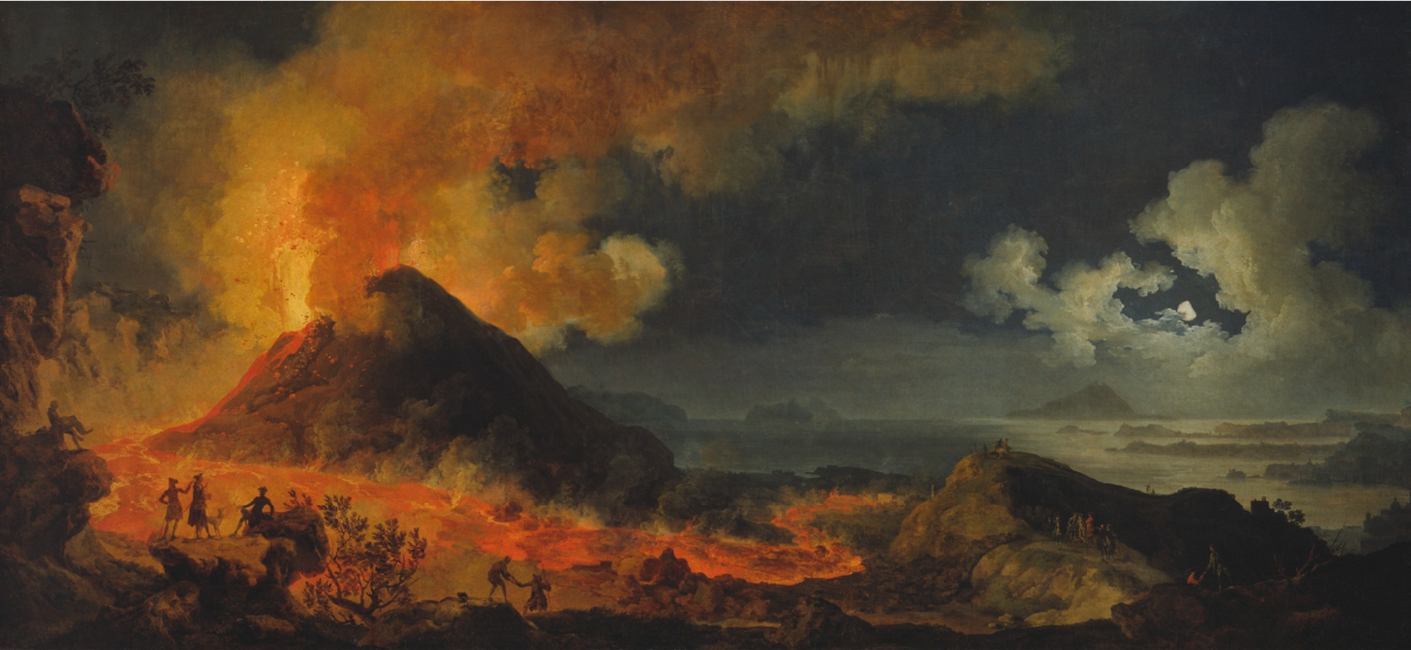
Pierre-Jacques Volaire, The Eruption of Vesuvius (1771). Art Institute of Chicago.
Carron’s industrial sublime provided a fit portal for Saint Fond’s entry into the volcanic Highlands, the hills of which ‘appear to have been heaped one above another by terrible convulsions, and by the action of the two elements of fire and water, in constant opposition to each other.’ In his climactic account of visiting Fingal’s Cave, the discourses of volcanic convulsion, industrial sublimity, and Ossianic legend are wonderfully entangled. Penetrating the inner recesses of the cave, Saint Fond was deafened by the force of the waves colliding with a detached boulder lodged in a small cavity: ‘the shock was so violent that it was heard at some distance, and the whole cavern seemed to shake with it.’
The action of ocean tide on rock was here described in language befitting the clamour of industrial processes. If the prismatic geodes of iron ore Saint Fond had viewed in Carron Ironworks seemed like miniatures of the ‘fine basaltic colonnades’ of the Giant’s Causeway, the deafening sound in Fingal’s Cave of this ‘terrible collision,’ the ‘broken rock, driven by the violent impetuosity of the surge against its sides,’ evoked the industrial ‘noise of weighty hammers striking upon resounding anvils’ in the iron foundry. Heavy industry provided a clue to the cataclysmic agencies at work in forming the earth, just as its energy was supplied by fossilised plant matter from the Carboniferous era, a term coined by British geologists William Conybeart and William Phillips in 1822.
Given Saint-Fond’s enthusiasm for Macpherson’s Poems of Ossian, it is strange that he made no mention of the fact that just three years after the establishment of the Carron Iron Works, the river Carron was the setting of two short Ossian poems, ‘Comala: A Dramatic Poem’ and ‘The War of Caros,’ ‘translated’ from Gaelic by James Macpherson, and published along with Fingal: An Epic in 1762. ‘O Carun of the streams! Why do I behold thy waters rolling in blood? Has the noise of battle been heard on thy banks; and sleeps the king of Morvern?’ Bardic poetry commemorating iron age battles against the Romans was highly appropriate on the banks of the Carron, where Europe’s largest arsenal forged iron weapons of human destruction, a different sense of the word ‘forged’ from that employed by Macpherson’s detractors when they attacked his influential poems.
In his crazy 1875 compendium Ossian and the Clyde, Rev. Peter Hately Waddell described his discovery of Comala’s fort beside the Carron Ironworks: ‘you recognise it without difficulty, even on a distant survey, by features in the landscape, which all the changes occasioned by agriculture, coal-mining, canal and railway operations...have not obliterated…Looking back through the haze of night, and the smoke of kilns or the dull red glare of coke furnaces, which now take the place of oaks that once “burned to the wind” in camps, you see “the ghosts of Ardven” pass through the beam.’ As Eric Gidal has noted in Ossianic Unconformities, geological, Ossianic, and industrial temporalities overlap wonderfully in this primitivistic evocation of Carron’s industrial sublime, and the hellish purposes to which many of its products were dedicated.
Further Reading
- Barthélemy Faujais de Saint-Fond, Travels in England, Scotland, and the Hebrides, 2 vols (London, 1799)
- Henry Hamilton, ‘The Founding of Carron Ironworks,’ Scottish Historical Review 25, no. 99 (1928), 185–93
- Nigel Leask, Stepping Westward: Writing the Highland Tour, c. 1720–1830 (Oxford UP, 2020)