
Trade, Family and Faith in Northern English Towns
Hannah Barker, University of Manchester
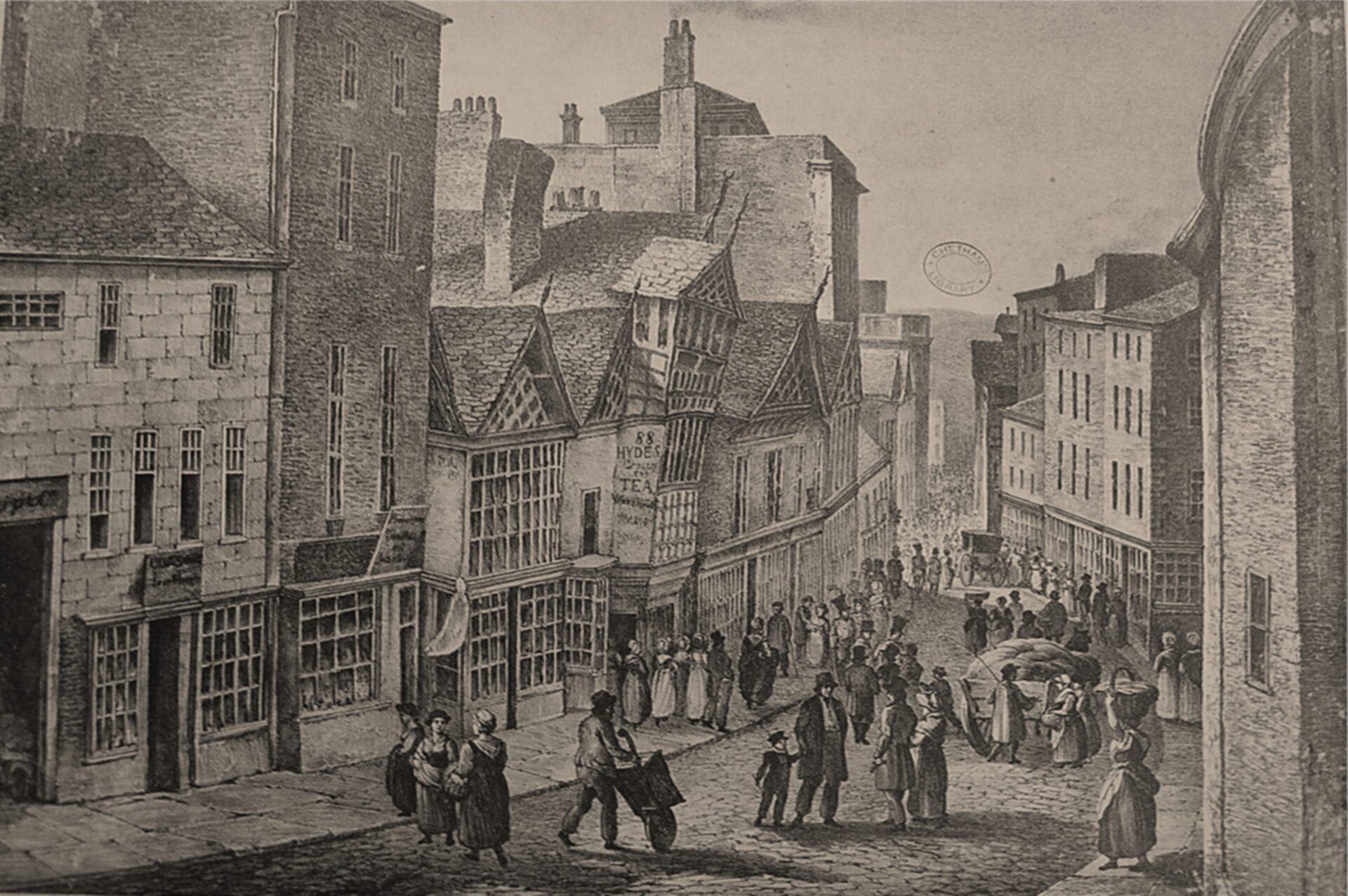
John Ralston, Views of the Ancient Buildings in Manchester (1823–25). Reproduced by kind permission of Chetham’s Library.
In the early 1820s the artist John Ralston began sketching some of the streetscapes and buildings of Manchester that were threatened by a wave of new building. This view of Manchester’s Market Street in 1821 shows the distinctive timber-framed, jettied and gabled structure of William Hyde’s grocery shop: at the centre of the picture on the left hand side of the street, with its porch leaning at a rather drunken angle. Next to Hyde’s shop (moving towards the foreground) was the cheese monger and provision dealer Charles Pollitt’s premises, in another timbered building. In the more modern four-storey brick building adjacent to that, John Hemingway, silversmith and watchmaker operated, with Clough and Hill, ironmongers, next to it and closest to the viewer. On the other side of Hyde’s shop was Mary Walker’s ironmongers, and next to her, Catherine Crossley’s toy warehouse, then an ‘exhibition of ancient and modern paintings,’ the premises of John Wickstead, umbrella maker, and the Red Lion public house.
Across the street were shops and workshops variously run by a druggist, a boot and shoemaker, a hosier, a linen draper, another cheese monger, a straw hat maker, a cutler and surgeon’s instrument maker, a milliner and a tea dealer. This eclectic mix of small manufacturers, shopkeepers and service providers was replicated both in other Manchester streets, and in other towns, across the north of England during the long eighteenth century. Whereas shop-workers today in these same streets commute into town centres to sell goods produced elsewhere, in the late eighteenth and early nineteenth centuries, these buildings were generally inhabited day and night by individuals who both lived and worked in them, and who constituted anything from 20-60% of the urban population.
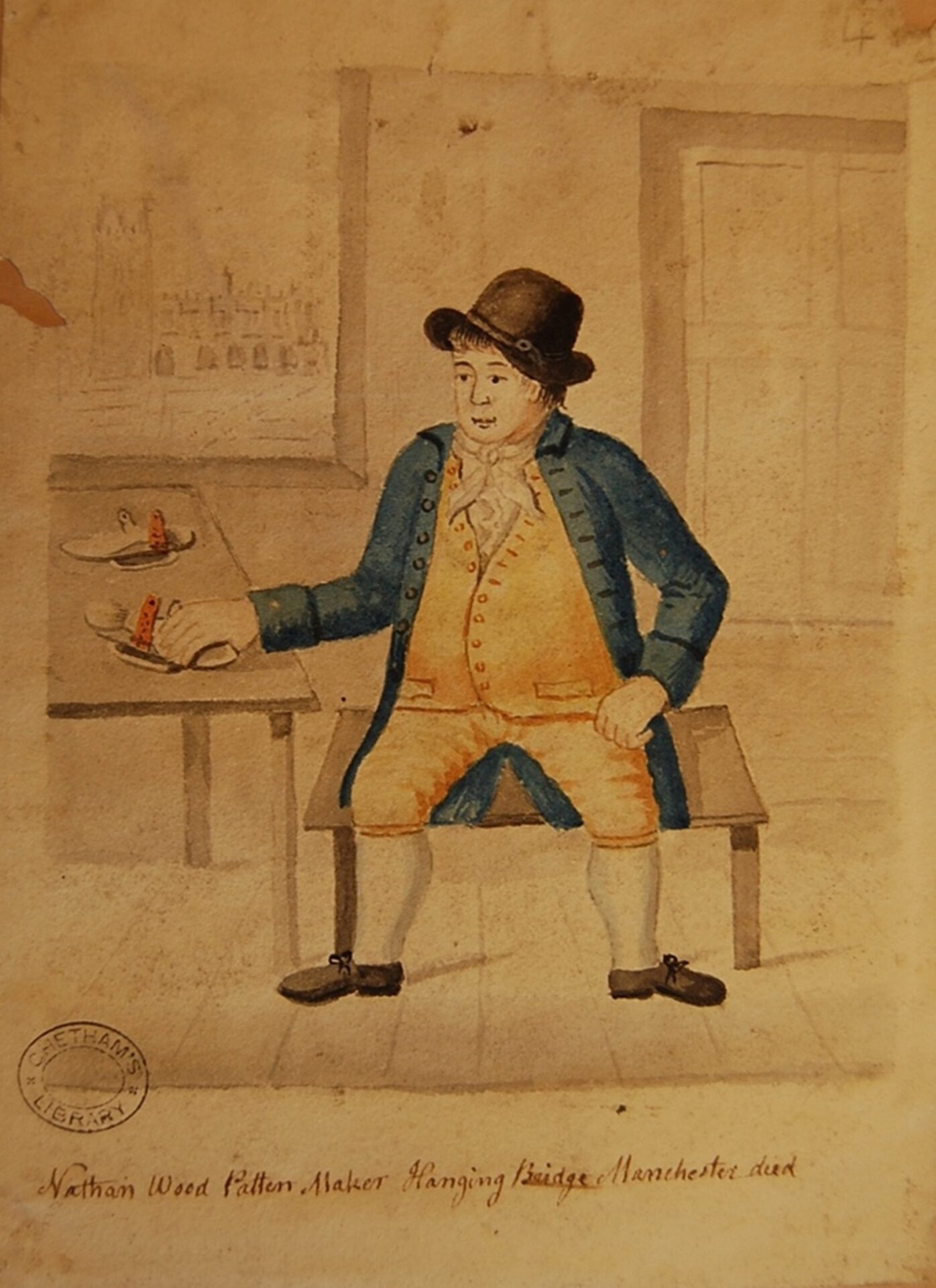
Thomas Barritt, Portrait of Nathan Wood, Pattern Maker (1800–5). Chetham’s Library, Manchester Scrapbook, fo. 4. Reproduced by kind permission of Chetham’s Library.
The businesses that dominated the streetscape of towns were central to the economic growth and urban transformation that characterized the early industrial revolution in Britain, yet relatively little research has been undertaken either on these enterprises, or on the people who ran them. Our view of the commercial world in this period tends to be dominated by narratives of particularly big and successful businesses, and those involved in new and large-scale modes of production. Yet in places such as Manchester, Liverpool, Leeds and Newcastle, it was not great factories and mills that altered the urban and economic landscape—at least not before the 1820s—but rather the proliferation of small businesses. As Maxine Berg has argued, the transformation of towns and regions was achieved ‘on the backs of a myriad of smaller and medium-scale producers, and not on the spectacular but isolated successes of small numbers of giant industrialists and financial elites.’ Moreover, it was not just men who worked in and managed small businesses: women also played crucial roles in these enterprises, often heading their own firms.

Detail of Mary Walker’s ironmonger’s shop, 92 Market Street, Manchester, from Ralston, Views of the Ancient Buildings in Manchester. Reproduced by kind permission of Chetham’s Library.
The majority of tradesmen and women in northern towns could be defined as a subset of the middle class(es)—the ‘petit bourgeoisie’ or lower middle class—with the addition or inclusion of skilled artisans, which in the past some historians have termed the ‘labour aristocracy,’ and also taking in rather wealthy members of the middle or even upper middle classes, consisting of those who had been particularly successful in business. But to describe them thus appears to shoehorn these men and women into categories that have far more meaning for modern historians than they would have had for those at the time. Instead, it seems more useful to describe these people in a way which would have made sense both to the individuals concerned, and to their contemporaries: namely as being traders, by which is meant the buyers and sellers of goods, those involved in small-scale manufacturing or skilled handicrafts, and the providers of allied services.
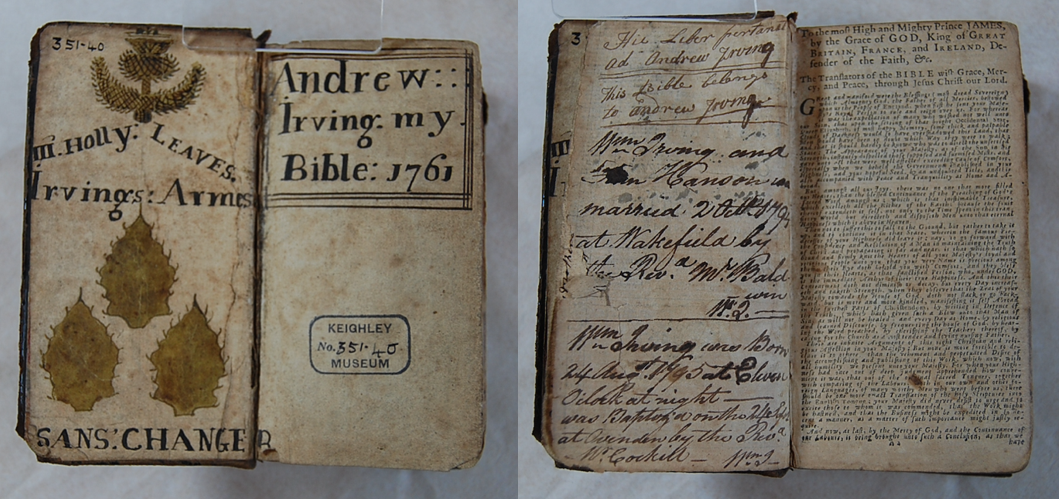
Andrew Irving’s copy of the Holy Bible (Edinburgh, 1736). Reproduced by kind permission of Cliffe Castle Museum, Bradford.
The principal concerns of northern tradesmen and women centred on their families, on making a living and on their religious faith. The faith of northern town dwellers as a whole, incorporating not just traders but also members of the urban elite and the poor, is the focus of a recent research project undertaken by myself, Jeremy Gregory, Carys Brown and Kate Gibson, Faith in the Town: Lay Religion in Northern England, 1740-1830. Taking a broad social history methodological approach, our research draws upon a diverse range of source materials including life writings such as letters and diaries, maps and other depictions of urban landscapes, and domestic objects including books, samplers and pottery. We argue that religious faith remained a major part of the lived experience of urban inhabitants during the eighteenth and early nineteenth centuries in northern England. Rather than abandoning their faith, town dwellers across the social and denominational spectrum commonly understood their relationships with their families, households and the world within a framework of religious duty and virtue that they practised with a view to salvation.
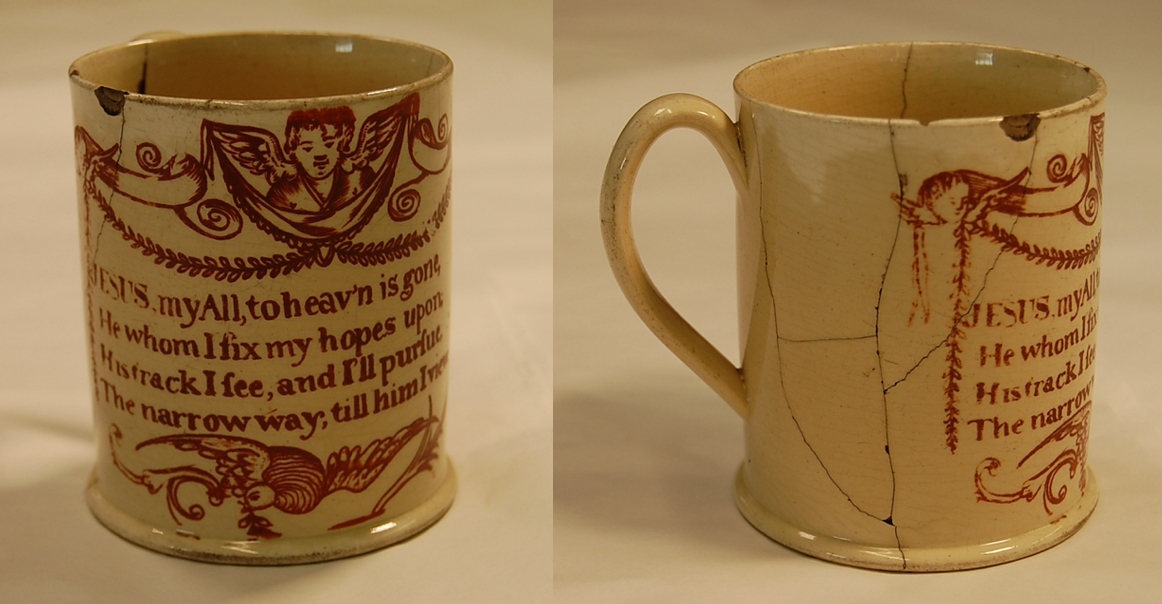
Painted creamware mug (c. 1750–70). National Museums Liverpool, Walker Art Gallery, Decorative Art Collection, 54.171.473.
Urban middling and labouring individuals incorporated piety into their everyday lives. This meant that religious practice and the influence of faith was not limited to time spent in church, chapel or synagogue but extended into all areas of activity and experience: the workplace, the streets and other public spaces, and the home. Towns were thus sites of religious vitality and incubators of religious sensibility, so that rather than being inimical to religion, they were places of opportunity for religious influence and growth. The importance of religious faith in the lives of town dwellers was not something that existed in spite of change. Rather, religious faith was promoted by the new conditions of urban life and urban centres were themselves influenced by faith. The continued centrality of faith for urban society sits uneasily with some older historical accounts of religion in the eighteenth and early nineteenth centuries that described a decline of lay religious belief – and particularly in towns – and supports more recent work that downplays the link between urbanization and secularization.

Hannah Exelby’s sampler, 19 x 54.8 cm. Image courtesy of York Museums Trust, https://yorkmuseumstrust.org.uk, YORCM:TCP 288. CC BY-SA 4.0.
Within the busy, complex, risky and opportunity-rich environment of northern towns, religious belief provided a way to understand the new urban world in which individuals found themselves. It helped make sense of success and failure, marked the passage of time, and could provide a feeling of belonging and purpose that would otherwise have been missing. But whilst the new conditions of urban living helped shaped religious faith, faith also acted to influence the development of towns. Faith was not just an internal disposition, but it altered the ways in which individuals acted in the world. Faith in the Town shows how civic identities, understandings of urban space and conceptions of social hierarchies were all affected by the religious faith of individual men, women and children. In addition, faith helped shape business practices and understandings of the commercial world—including a widespread belief in providentialism amongst people in business—as well as influencing behaviour in the spheres of work, home and family life.
Further reading
- Hannah Barker, Carys Brown, Kate Gibson, and Jeremy Gregory, Faith in the Town: Lay Religion in Northern England, 1740–1830 (Oxford UP, 2025)
- Hannah Barker, Family and Business During the Industrial Revolution (Oxford UP, 2017)
- Maxine Berg, ‘Small producer capitalism in 18th-century England,’ Business History 35 (1993), 17–39