
The Industrial Revolution and the 'Progress of Agriculture'
Jeremy Davies, University of Leeds
What’s the relationship between the Industrial Revolution and agricultural improvement, between factories and farms? That question has always been important to studies of the Industrial Revolution. A common answer has been that increasing labour productivity in eighteenth-century agriculture released workers from the fields. With less farm employment available, rural populations made for the cities, where they provided the workforce for the early factories. Hence, contemporary agricultural improvements were what made urban industrial society on a large scale possible.
Research by the Cambridge Group for the History of Population and Social Structure (Campop) has poured cold water on that story. Their findings are summarised in this graph. It was in the seventeenth century that the share of male English and Welsh workers in agriculture fell and the share working in the secondary (manufacturing) sector rose. In the eighteenth century, by contrast, the share of workers in those two sectors remained almost static.
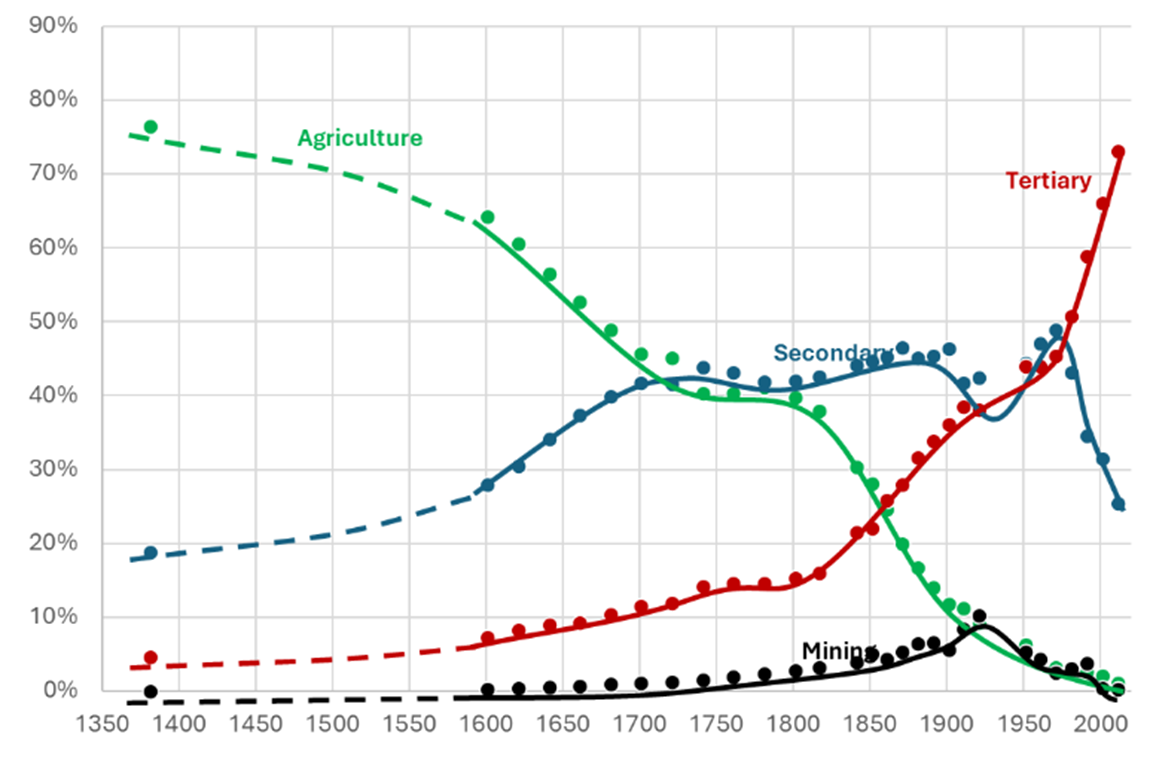
The male occupational structure of England and Wales, 1381–2011, courtesy of the Cambridge Group for the History of Population and Social Structure
Campop’s surprising discoveries fit with other studies that put the main gains in English agricultural productivity in and around the seventeenth century, not in the late eighteenth. But in light of these findings, how should we think about the writings of the agricultural improvers during the ‘classic’ period of the Industrial Revolution after about 1770?
In those decades, writers such as Arthur Young claimed that they were witnessing, and indeed contributing to, a radical and unprecedented modernisation of British agriculture. They wrote about the supersession of backward, traditional ways of doing things by enlightened modern farming. So do the agricultural improvers’ writings reveal events on the ground that aren’t visible in the bird’s-eye view of Campop’s aggregate data? Or were they exaggerating, or mistaken? Are the improvers best understood as propagandists for contemporary landlords and farmers, who might have enhanced their own social and legal position at the expense of rural labourers without really increasing overall productivity? Or might these texts tell us something about the germs of nineteenth-century agricultural transformation, the steep fall in Campop’s green line that begins after about 1820?

William Ward the Elder, after Thomas Weaver, The Earl of Leicester inspecting some of his South-down sheep with Mr. Walton and the Holkham Shepherds (1808). National Trust.
Studies like Campop’s invite us to look again at the rhetoric and ideology of the literature of agricultural improvement. Ongoing debates about how Britain evolved into the world’s first industrial economy both give us a motive for reading those texts—they might tell us something crucial about the beginnings of the modern world—and inform how we might read them. Complexities in economic and agricultural history illuminate the ambiguities and tensions that we find in the literature itself.
Those tensions are on full display in Thomas Bachelor’s poem The Progress of Agriculture, written in 1801 and published in 1804. Bachelor was a farmer who was deeply immersed in the culture of agricultural improvement. The first two thirds of his poem are full of praise for the triumphs of modern Britain’s agriculture, in contrast to the benighted era that came before:
Calm are thy seasons, fruitful is thy soil,
Yet much to art is due and manual toil.
…………………………………………
Thy herds and flocks a thousand meads adorn,
Oaks clothe thy hills, thy valleys golden corn:
…………………………………………
And farms and cottages, on ev’ry hand,
Pour forth their rural groups to dress the fertile land.
Yet I have seen, nor long elaps’d the day,
When yon rich vale in rude disorder lay;
Each scanty farm dispread o’er many a mile,
The fences few, ill-cultur’d half the soil;
Seen rushy slips contiguous roods divide,
Mid worthless commons boundless stretching wide
…………………………………………
In vain the culturer, in this anarch state,
Employs his skill, all share a common fate.
These lines (pp. 68-70) survey a valley that was once farmed on an open-field basis, and has since undergone enclosure. The improved, enclosed landscape is both productive and pleasing to the eye. Bachelor is one of a class of agricultural writers who are ‘willing to identify a beautiful landscape with one which is well-farmed.’ He equates beauty with utility because he views the present scene historically.

Thomas Gainsborough, Mr and Mrs Andrews (detail) (c. 1750). National Gallery.
In this respect, The Progress of Agriculture makes for a bracing contrast with the environmental sensibilities associated with the poets we call ‘Romantic.’ John Clare remembers ‘Moors loosing from the sight far smooth and blea,’ bounded only by ‘the circling sky.’ That sounds a lot like Bachelor’s unfenced ‘commons boundless stretching wide’—‘ground, that far extends, / Till heaven’s blue concave on its verge descends’ (p. 71). But Clare freighted scenes like those with socio-spiritual significance. For Bachelor that same open-field agriculture is an ‘anarch state’ in need of redemption by enclosure. In the Guide to the Lakes Wordsworth fulminates against ‘larch and fir plantations…thrusting every other tree out of the way.’ Bachelor, however, is glad to see that ‘e’en where steep the rocky heights arose, / The verdant fir, the larch aspiring grows’ (p. 77). In his view, the larches are as admirably aspirational as the planters themselves.
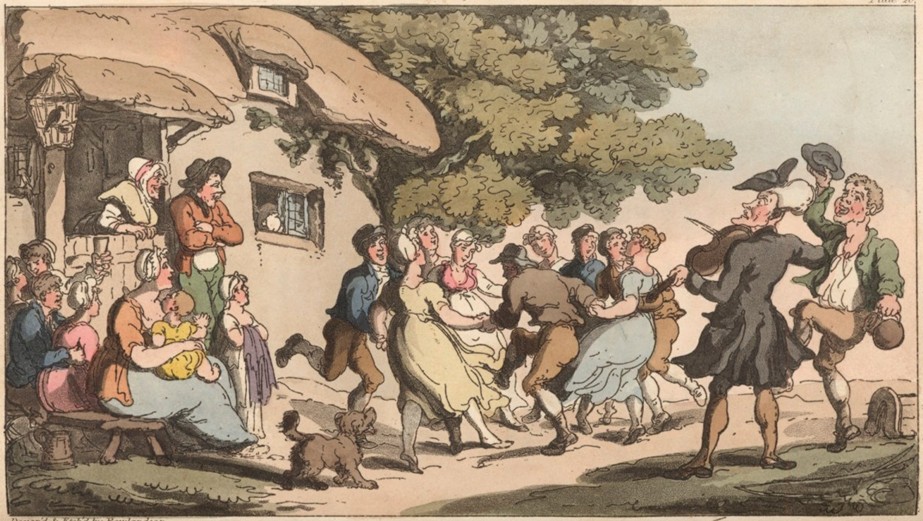
Thomas Rowlandson, Rural Sport, in The Tour of Doctor Syntax in search of the Picturesque (1812). Royal Academy.
Bachelor’s poem is especially concerned with the same debates about agricultural employment and rural population that still exercise researchers like the Campop group. At the start of the nineteenth century, it was widely alleged that enclosure and the consolidation of small farms into large ones were depopulating the countryside. The Progress of Agriculture rejects that complaint. This is what’s at stake in its vision of the labourers who ‘pour forth’ from ‘farms and cottages, on ev’ry hand.’ Enclosure seems to have made these ‘rural groups’ more, not less, animated by collective purpose, since the open fields are no longer parcelized inefficiently into individual strips (‘roods’). In the world of Bachelor’s poem, the rural population is healthily increasing: ‘Farms and cottages innumerous rise, / With recent churches pointing to the skies’ (p. 76).
Unless it isn’t. The final third of The Progress of Agriculture sounds, as Bachelor puts it, ‘far other notes’ (p. 88). It gives what he calls in his preface ‘a fair statement of the numerous evils complained of by the peasantry of this country.’
I ask not Science to withdraw her hand,
Nor hoary Custom still to rule the land;
Prais’d be the scene when ev’ry hill and plain
Exulting owns fair Cultivation’s reign;
When verdant fences o’er each field extend,
Limits define, and property defend:
………………………………………
—But say, ye great! who bid o’er all the isle,
Green pastures spread where harvests wont to smile,
Who change, for herds, the life-supporting grain,
With woolly tribes displace the reaper train,
Who build a palace for the wealthier few,
But drive to squallid huts the ruin’d crew;
Shall not those wretched sons of Want repine?
Yes—helpless myriads mix their sighs with mine!
The accusation here (p. 90) is about the social consequences of landowners converting arable land to permanent pasture. The ‘reaper train’ is the large body of workers needed for the grain harvest, the most labour-intensive part of the agricultural year. The problem is that sheep farms—‘green pastures’—provide much less employment.
Bachelor later elaborated this argument in the second General View of the County of Bedford for the Board of Agriculture’s series of county reports. Livestock farming, he argues there, is being given preferential treatment compared to grain cultivation. Plough horses are taxed too heavily. ‘The luxurious appetite of modern times’ for ‘butchers’ meat’ discourages tillage (p. 64). England is increasingly reliant upon imported wheat. The consequence is that the nation’s staple food supply is becoming insecure, and the threat of famine is growing.
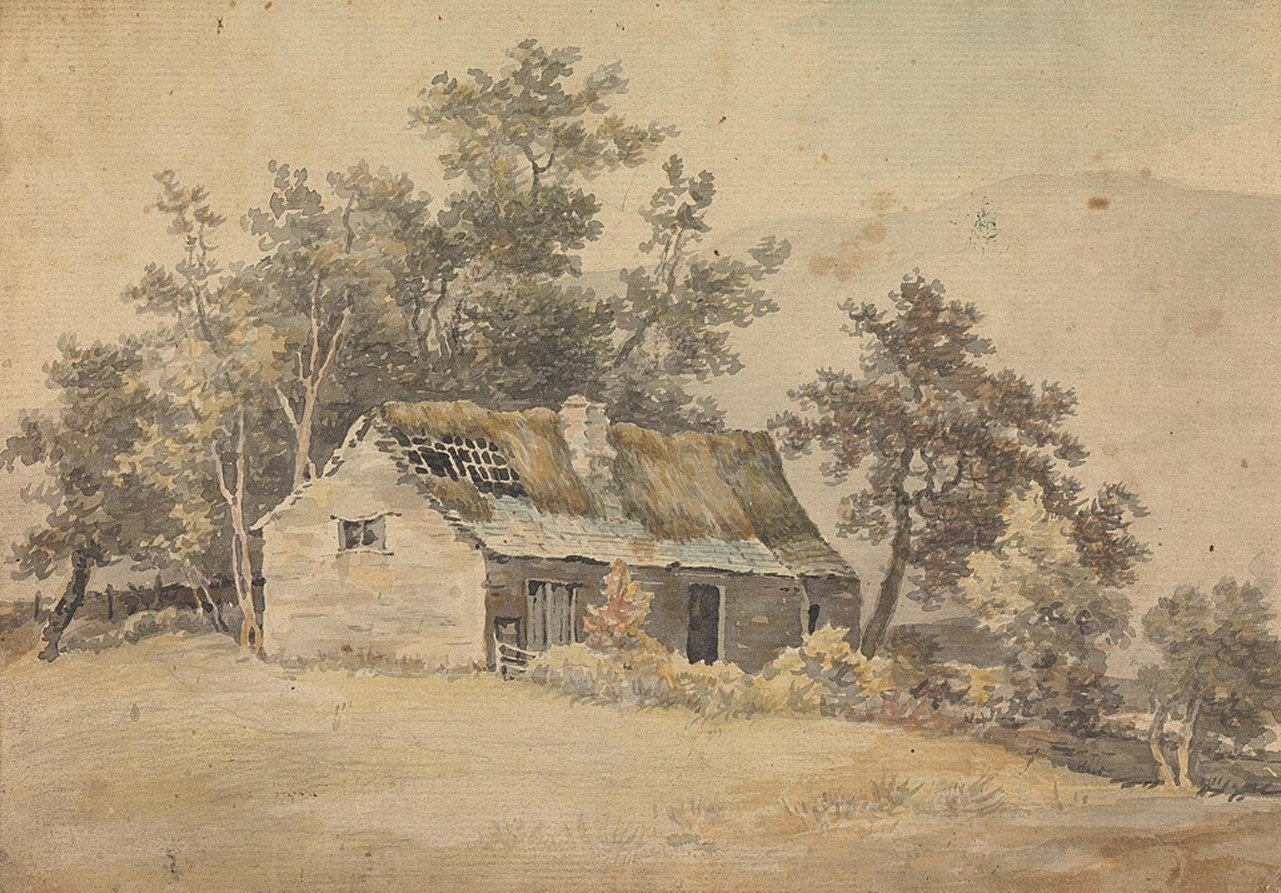
Sawrey Gilpin, Landscape with a Dwelling in Ruin (1760). Yale Center for British Art.
Why shall the slender comforts of the poor,
In futile pomp, augment the rich man’s store?
Why must the low, laborious, starveling band
For ever curse Improvement’s ruthless hand?
The Progress of Agriculture can pose this fateful question, but it cannot answer it. The curses of these starveling labourers break in discordantly upon Bachelor’s eulogium to his patron, the agriculturalist Francis Russell, fifth Duke of Bedford, and to Bedford’s class. The poem wants to see these agricultural magnates as a ‘truly noble’ race, full of humanitarian concern (p. 97). But how are we to distinguish that landowning class from the ‘great,’ those men who are grubbing up cornfields and displacing the ‘reaper train’ from the countryside for the sake of a narrow profit in sheep farming?
There is no solution to that problem in The Progress of Agriculture, just the hope that one day—in some ‘dim futurity’— it will no longer be the case that the ‘swain, / Disgusted views fair Ceres’ spreading reign’ (pp. 98–99). The complications and ambivalences of Bachelor’s poem are of a piece with the ambivalent, counterintuitive picture of English agriculture during the Industrial Revolution that still confronts us today.
Further reading
- John Barrell, The Idea of Landscape and the Sense of Place, 1730–1840: An Approach to the Poetry of John Clare (Cambridge University Press, 1972)
- J. V. Beckett, ‘The Debate over Farm Sizes in Eighteenth and Nineteenth Century England,’ Agricultural History 57, no. 3 (1983): 308–25
- Jeremy Davies, ‘Rural Poetry, Capitalist Agriculture, and the Food Price Crisis of the 1800s,’ forthcoming in Nineteenth-Century Literature in Transition: The 1800s, ed. Andrew Stauffer (Cambridge University Press)