
Reactions to the Industrial Environment: The Severn Gorge as Archetype
The narrow gorge where the River Severn cuts the Shropshire coalfield was one of the world’s earliest concentrations of coal-based industries, long before the classic period of the Industrial Revolution. By the late eighteenth century, it was frequented by artists and writers who saw in the area something new and remarkable that might be a taste of things to come. P. J. de Loutherbourg’s painting Coalbrookdale by Night of 1801 was a sensational conjuring of its transformation. It has become the single most readily identified image of the early industrial revolution, published widely and featured on numerous book covers. The Seven Gorge, now called the Ironbridge Gorge, is renowned for its industrial heritage and in 1986 joined the first handful of industrial sites globally to be inscribed on the World Heritage list.
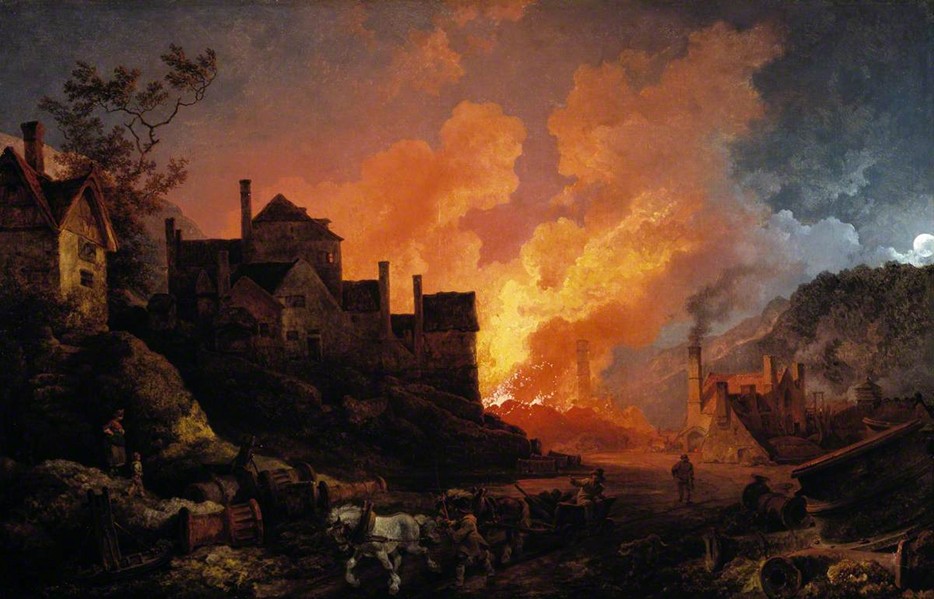
Philippe Jacques de Loutherbourg, Coalbrookdale by Night (1801). Science Museum Group. Creative Commons Licence CC BY-NC-SA 4.0 Licence.
The area can be seen as an archetype among places of early industrialization in Britain that were so conspicuously developed as to attract the attention of artists and commentators. All were either close to coal supplies or had exceptional waterpower resources. They included:
- The Halifax area, where the concentration of weaving, fulling and dyeing was noted by Daniel Defoe in the 1720s.
- Neath and Swansea, which had led in smelting and manufacturing of non-ferrous metals since the seventeenth century.
- The Staffordshire Potteries, where ceramic production had grown since the seventeenth century and where Josiah Wedgwood developed factory methods from the 1760s.
- Birmingham, where the gun-making and brass-manufacturing were well established and urban growth was eating up surrounding fields by the time Matthew Boulton began his engineering works.
- Sheffield, which was a centre of edge-tool and cutlery manufacturing by the seventeenth century and introduced new techniques in steelmaking and plating in the eighteenth.
- Derbyshire, where the development of multi-storey cotton factories around Cromford after 1771 followed Lombe’s water-powered silk mill half a century earlier.
As an area of longstanding industrialisation the Severn Gorge provided rich material for comment. As early as 1660, its exports of coal amounted to 100,000 tons a year – perhaps 400 loaded river vessels a month. By the early eighteenth century, coal-fuelled iron smelting had been established for the first time and several other forms of coal-based production were thriving: iron manufacturing, pottery, tobacco-pipe making, lime burning and lead smelting.
Artists and commentators perceived common themes that such environments represented. Among them are ‘busy-ness’ and population growth, enterprise and ingenuity, immensity and sensation, contrasts of industry with nature, and pollution or air and water.
‘Busy-ness’ and the growth of population
Witnesses were struck by the increase in people, their ‘busy-ness’ and the rate of building. An engineer drawn to work in Coalbrookdale, George Perry, promoted its virtues in 1758: ‘The Face of the Country shews the happy Effects of this flourishing trade, the lower classes of People who are very numerous here, are enabled to live comfortably; their Cottages, which almost cover some of the neighbouring Hills, are throng’d with healthy Children, who soon are able to find Employment.’
The agricultural promoter and economic commentator Arthur Young, touring the area in 1776, perceived prosperity in this activity, recording that just one of the several ironmasters, Abraham Darby, employed 1,000 people. When the landscape painter Joseph Farington sketched the Gorge in 1789 he not only captured the dramatic landforms but was moved to record the intricacy of activities along the river, drawing tiny details of the vessels on the Severn, houses growing up around the ironworks and the clustered buildings at the new Iron Bridge.

Joseph Farington, The Iron Bridge near Coalbrookdale (1789). Ironbridge Gorge Museum Trust CBD59.129.
The scene was no less remarkable to the Shropshire topographer Charles Hulbert two generations later, who noted in a flurry of excitement the activity he saw in this ‘most extraordinary district in the world’: ‘studded with iron Works, Brickworks, Boat Building Establishments, Retail Stores, Inns and Houses, perhaps 150 vessels on the river, actively employed or waiting for cargoes; while hundreds and hundreds of busy mortals are assiduously engaged.’
Enterprise and ingenuity
Observers understood the quickening economy to grow from visible instances of enterprise, invention and ingenuity while being less aware of distant forces such as demand from colonial markets or the inflow of capital from slavery. Young noted the diversity of iron products being made, the introduction of coked coal (‘an invention which must have been of the greatest consequence’) and John Wilkinson’s new machine for boring canon. Numerous artists drew and painted the innovative Iron Bridge with close attention to its construction. Nearby, many sketched the extraordinary waterwheel at Benthall Mill, which at 60 feet diameter was one of the largest ever built. Paul Sandby Munn, touring with his friend John Sell Cotman in 1802, made the delicate wheel not a picturesque adornment to a landscape but rather his main subject.

Paul Sandby Munn, Great Wheel, Broseley, Shropshire (c.1803). Ironbridge Gorge Museum Trust.
Immensity and sensation
Visitors were amazed by the scale and drama of the industrial world they entered as they came down into the Gorge. In the late eighteenth century, few people had seen vertiginous quarries, fiery coke heaps, skies obscured by smoke or the vast scale of activity of which industrial society seemed capable. They reacted as they might to mountains or sea-cliffs, often using the same word to express their awe: ‘sublime.’ De Loutherbourg’s Coalbrookdale by Night captured an unearthly fire so great as to light up the hillside and silhouette the towering buildings. It was both beautiful and horrifying.
Young wrote of ‘that variety of horrors art has spread at the bottom: the noise of the forges, mills &c. with all their vast machinery, the flames bursting from the furnaces with the burning of the coal and the smoak of the lime kilns, are altogether sublime.’ The travel writer Henry Skrine viewed similar scenes in 1798: ‘by night the numerous fires arising from the works on the opposite hills, and along the several channels of the two valleys, aided by the clangour of forges in every direction, affect the mind of one unpractised in such scenes with an indescribable sensation of wonder.’
Visitors who had the chance to go inside industrial operations or approach close up were even more affected. When the Shopshire resident Katherine Plymley entered the underground limestone workings of the Gorge in 1794 she wrote in her diary that she was much pleased by ‘a vast cavern of limestone which they work under Lincoln Hill, as they take out the stone they leave massy pillars of it for support, they are formed into grand rude arches, no caverns or made grottoes that I have seen can bear the least comparison with it.’
Contrasts of industry and nature
Artists and writers saw the works of humanity in cities; in the country they saw nature. Yet in the Severn Gorge and other early industrial areas they were confronted with the conjunction of the two. Most industries were still in rural locations, whether ironworks in the barren uplands of south Wales or water-powered factories spaced out in river valleys. Production had not yet taken up every available resource and urban streets had not yet eaten up surrounding fields. Nature’s backdrop was ever-present in the Severn Gorge and Coalbrookdale’s slopes cloaked with woods. Katherine Plymley wrote: ‘it is wonderful to see the vivid green of the plantations so near the smoke of the works […] there is something in this contrast very pleasing.’
For visual artists, such contrasts were a gift. A view down Coalbrookdale by William Williams in 1777 conjured the dense smoke of the ironworks rising between luxuriant woods. He added gentlefolk apparently discussing the extraordinariness of prospect.

William Williams, An Afternoon View of Coalbrookdale, Shropshire (1777). Shrewsbury Museum and Art Gallery.
Environmental alarm
The pernicious environmental effects of industrialisation were not observed widely until the mid- and late-nineteenth century, when the intensity and spread of industry were apparent to all. Most visitors to places where coal was burned on a prodigious scale—like the Severn Gorge—viewed fires and fumes with amazement more than criticism. They called the scene ‘remarkable’ or ‘impressive’ and distanced it by classical allusions to ‘the regions of Pluto.’ Skrine felt transported ‘to the workshop of Vulcan or an epitome of infernal regions.’ Nevertheless, some artists and writers were alarmed. The map-maker and topographer Samuel Simpson complained in 1746, ‘The Lead Works are vastly poisonous, and destructive to everything near.’ The tourist Charles Dibdin in 1803 commented: ‘It was our intention to stay all the night, but this was impossible, for the day was insufferably hot, and the prodigious piles of coal burning to coke, the furnaces, the forges, and the other tremendous objects emitting fire and smoke to an immense extent, together with the intolerable stench of the sulphur, approached very nearly to an idea of being placed in an air pump.’
The Shropshire artist George Robertson depicted the problems even though he needed buyers for his prints. In his view of Calcutts Ironworks, published in 1788, smoke pours from coke heaps and chimneys to fill the top left quarter of the picture. In the distance a cliff of slag is slumping into the Severn. The works is stifling both air and water.

George Robertson, engraved by Wilson Lowry, An Iron Work, for Casting of Cannon, and a Boreing Mill, Taken from the Madeley side of the River Severn, Shropshire (1788). British Museum. Shared under a Creative Commons Attribution-NonCommercial-ShareAlike 4.0 International (CC BY-NC-SA 4.0) licence.
Visiting in 1802, the 20-year-old John Sell Cotman was fascinated but bleakly critical. When he made a watercolour of a horse whim at a coal shaft a few years later, he remembered a rickety framework in a mess of waste, nearly smothered by smoke. In another painting, looking across the Severn to bottle kilns and chimneys, the valley is held in a miasma of grim-grey and sickly yellow fumes and the riverbank is bare but for wrecked timbers and a dying tree. Thriving production is in step with desolation and despoilation. Both pictures foreshadow the critical views of industrial pollution that would prevail many decades later and understanding today about carbon and the climate emergency.

John Sell Cotman, Coal Shaft on Lincoln Hill at Coalbrookdale (c. 1806). Leeds Art Gallery LEEAG.PA.1923.0500.
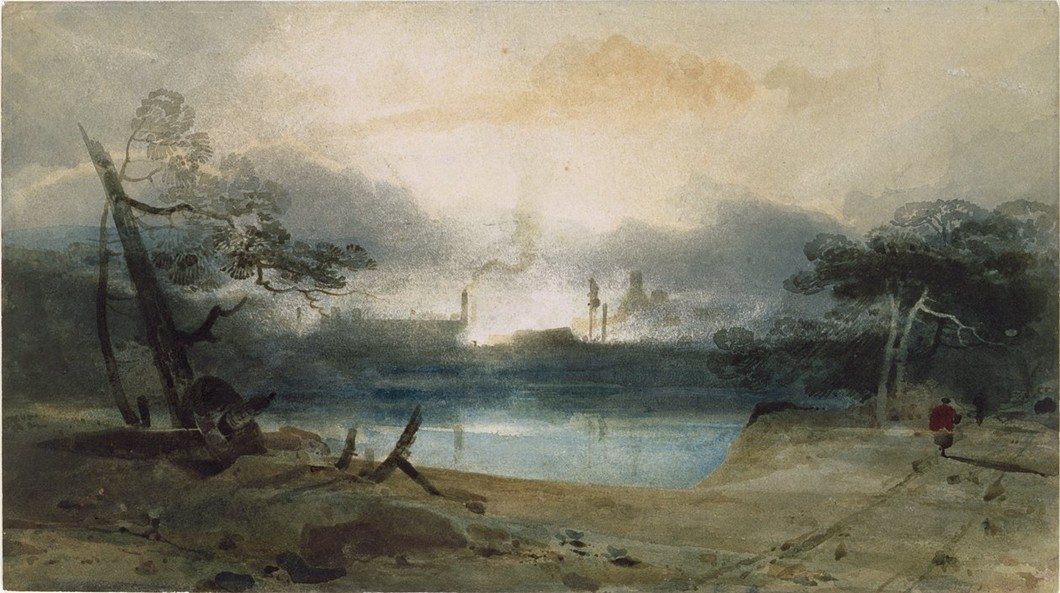
John Sell Cotman, Bedlam Furnace near Irongate in Shropshire [incorrectly titled] (c. 1802). Private collection.
Further reading
- Barrie Trinder, ‘The Most Extraordinary District in the World’: Ironbridge and Coalbrookdale, 2nd edn (Phillimore, 2017)
- A View of the Iron Bridge, online exhibition, Ironbridge Gorge Museum Trust, ironbridge.org.uk