
Industrial Chiaroscuro: Sir George Head’s Northern Tour
Roseanna Kettle, Leeds Beckett University
Sir George Head’s A Home Tour through the Manufacturing Districts of England, in the Summer of 1835 presents a vision of industrial Britain ruled by an abiding aesthetic struggle between light and darkness. At the time of Head’s writing, numerous different strategies were being pioneered to light Britain’s towns, manufactories and amenities more efficiently, and an impressive variety of light technologies illuminate Head’s narrative. Argand lamps beam out from Northumbrian lighthouses; coal miners in Wigan make use of brightly-burning cannel coal when in want of candles, or work by the ‘glow-worm glance’ of Humphry Davy’s safety lamp (p. 396).
Head’s narrative, like many others of its time, primarily associates industrialisation with darkness, at least initially. His picture of Manchester’s canals, ‘black as the Styx, and absolutely pestiferous,’ opens a voyage through industrial Britain that frequently imagines a metaphorical descent into the underworld (p. 8). As much is conveyed by his early journey through the underground cargo railway tunnels from Edge Hill station, opened shortly after the establishment of the Liverpool and Manchester passenger railway (p. 23):
There are, indeed, lights at rare intervals within the tunnel; but, nevertheless, by far the greater part of the distance is performed in total darkness. As we passed along, a train came rumbling downwards … The scene brought the regions of Pluto to the imagination, while the hogs grunted, and the calves lowed in funereal cadence, like a legion of discontented spirits.

Thomas Talbot Bury, Warehouses etc. at the end of the Tunnel towards Wapping, in Coloured Views on the Liverpool and Manchester Railway (1831). Wikimedia Commons.

This is just one of many tableaus Head offers over the course of his narrative that demonstrate a recurrent fascination with the descent into darkness, with subterranean spaces and gloomy polluted districts particularly drawing his attention. Much of Head’s tour is deeply preoccupied with the task of lighting these ‘dark places,’ through a variety of different means. On his visit to Marston Pit, a salt mine in Northwich, Head uses ‘a paper of powder, prepared by a chemist in the town,’ providing a short-lived ‘blue light’ by which to view the cavern (p. 64). Finding this insufficient, he claims the best way to view the space is with the aid of a ‘Bengal Light,’ another inflammable powder capable of throwing a ‘tantalizing glare,’ although again disappointingly fleeting (p. 66).
Head’s narrative returns repeatedly to these careful evaluations of the quality of man-made light, in terms of both its practical and its aesthetic effects. In doing so, he participates in a contemporary discourse that had, since the late eighteenth century, become fixated on the potential of emerging light technologies and their possible applications in a variety of different contexts.
Numerous breakthroughs in lighting solutions had been achieved in the preceding decades, including the first installation of urban gas lighting in Pall-Mall, London, in the early 1800s, as well as the aforementioned safety lamp pioneered by both Humphry Davy and George Stephenson over the course of the 1810s. These lamps were designed to prevent the ignition of inflammable gases in coal mines that had cost the lives of so many miners.
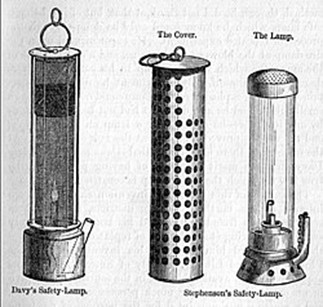
Davy’s and Stephenson’s Safety Lamp mechanisms, from Samuel Smiles, Lives of the Engineers (1862)
Upon reaching Saltham Pit in Whitehaven, an area notorious for its deadly hydrogen gas explosions, Head is fortunate enough to experience using one of these novel lamps himself, though he finds its initial effect rather disappointing. Its ‘glimmering’ is ‘so feeble, as to be … quite useless,’ though he does marvel at its mechanical simplicity, given its life-saving impact (pp. 393–94). Head gains a new interest in the lamp, however, when he perceives its response to the presence of hydrogen gas:
The temperature now being very warm, my conductor remarked that probably the air was impregnated with hydrogen gas: and immediately, as if solely for my edification, he unscrewed his safety lamp … a bluish haze rested upon the flame, which, he said, was indicative of the existence of the fluid. I was much surprised at this experiment … when burning in a tainted atmosphere, the particles of air which enter by the divisions of the wire ignite gradually, so as first to brighten the flame, and then illuminate the whole space within: finally, the heat becomes so great, that, provided the above phenomenon be not regarded, the wire melts, and then, but not before, explosion ensues. (p. 398)
The lamp being a recent development in lighting technology, this demonstration prompts Head not only to describe the chemical process that enables it to function, but also to detail the controversy over the lamp’s patent, as well as mentioning new improvements made to the lamp by ‘an individual of Sunderland,’ permitting the lamp to self-extinguish upon danger of exposure to gas. Despite these technical points, Head also makes some remarks upon the aesthetic effects of the lamp. Even if he finds it is no great practical asset in terms of light produced, the gleam of the flame on the faces of the miners in the dark nevertheless renders them ‘a subject worthy of Canova’ (p. 401).
This dramatic aesthetic contrast between light and darkness is also evident in Head’s descriptions of industrial manufactures, taking on the language of the industrial sublime to convey astonished awe at what modern readers might regard as industrial light pollution. Approaching Low Moor Ironworks, near Bradford, Head identifies a ‘universal combustion,’ not dissimilar to the ‘crater of a volcano’ (p. 127). This ‘cluster of low blackened building’ encircles ‘numerous fires,’ with ‘broad flaring flames crawling upwards from the main furnace’ (p. 128). As is the case in many industrial tour narratives such as this, overwhelming visual impressions are paired with deafening noise, here the ‘steam-blast rushing through the furnaces,’ presenting a sensory overload that inspires ‘the sentiment of veneration’ (p. 129).
Head is prompted to remark on the technological ingenuity on display at the works, viewing this cataclysmic sight as evidence of man’s mastery over a volatile, defiant natural world, though he retains an inward knowledge that this relationship might easily become reversed (p. 128):
It is a noble sight to stand here and see the devastating element in such radiant glory, yet at the same time under perfect subjection; but awful to reflect, that human science will never, probably, wholly avert those catastrophes which, either by combustion or explosion, in the melancholy reverse of fortune, serve to remind man of the finitude of his wisdom, by occasionally obtruding the fortunes of the victim on the victor.

James Baker Pyne, The Mulgrave Alum Works at Sandsend, Yorkshire Coast (1844). Wikimedia Commons.
_-_The_Mulgrave_Alum_Works_at_Sandsend,_Yorkshire_Coast_-_N01545_-_National_Gallery.jpg)
Low Moor is hardly alone in producing this sort of spectacular light effect. Head goes on to describe Lord Mulgrave’s alum works, near Whitby, which present to his sight ‘heaps of alum-rock,’ in ‘a state of smouldering combustion,’ again with an appearance ‘truly volcanic’ (pp. 279–80). The shale from the alum-rich hills is refined by being ignited and burned ‘for several months together.’
The processes contributing to this long-lasting light pollution are, as Head mentions, detrimental to human health. He wonders how it is ‘possible for any living creature to exist and work in such an atmosphere’ where ‘fumes of sulphur predominate in such a degree as almost to stop the breath,’ although it is important to note that, like many industrial commentators, Head’s anxiety relates to toxic chemical pollutants, rather than to light pollution itself (p. 281). Indeed, many writers in Head’s time conceived of light pollution as either a helpful practicality or even a sight of extraordinary beauty and emotional impact, a perspective remote from modern concerns over disruption to human sleep patterns, night sky visibility, or the effect on flora and fauna.

Joseph Mallord William Turner, Leeds from Beeston Hill (1816). Yale Center for British Art.
Head’s most revealing depiction of anthropogenic light emerges, however, not from the industrial site, but from the city. Describing the town of Leeds, he finds that the combination of air pollution and gaslight has effectively reversed the conditions of day and night (p. 169):
THERE is no manufacturing town in England, I should imagine, wherein more coal is consumed, in proportion to its extent, than Leeds: situated in the heart of a coal-field, and fed by an abundant daily supply, a single glance, whether by night or by day, is sufficient to verify the above conclusion. The sun himself is obscured by smoke, as by a natural mist; and no sooner does he descend below the horizon, than streams of brilliant gas burst forth from thousands of illuminated windows.
Curiously, however, this does not prompt a sense of alarm or distaste in Head as a spectator. Instead, his narrative breaks off here, discussing recent improvements at the nearby coal-staithes, saying nothing more of the light conditions.
After surveying the extent of Leeds’s cloth manufacture, in particular its utilisation of steam power, Head comes away with a remarkable confidence in the ‘combination of the powers of mind and body [to which] England owes her present state of commercial greatness,’ evident in the ‘features of each hard-working mechanic blackened by smoke, yet radiant with the light of intelligence’ (pp. 184–85). Even on this figurative level, Head applies the imagery of chiaroscuro in a manner that preserves the negative connotations of darkness, and the positive ones of light. Light is virtually always depicted as useful and aesthetically pleasing, even in its more spectacular, sublime forms. Head’s text documents a period prior to modern anxieties over the presence of anthropogenic light, frequently returning to it as a hopeful signifier of burgeoning industrial modernity.
Further reading
- Susanne Bach and Folkert Degenring, Dark Nights, Bright Lights: Night, Darkness, and Illumination in Literature (De Gruyter, 2015)
- Sir George Head, A Home Tour through the Manufacturing Districts of England, in the Summer of 1835 (John Murray, 1836)
- Bridget M. Marshall, ‘The Haunted Industrialized Nightscape: Factories, Mills, and Ironworks at Night,’ in Enlightened Nightscapes: Critical Essays on the Long Eighteenth-Century Night, ed. Pamela F. Philips (Routledge, 2023), pp. 229–47