
A Fly in the Industrial Ointment? William Turner's Tour Through the North
Jon Mee, University of York
Some economic historians have made the relatively free circulation of ideas key to industrial take-off in Britain. One doesn’t have to see this phenomenon as the key causal factor in ‘the great divergence’ to recognize that it was a distinctive feature of the British economy in the period, if one reliant in all kinds of ways on exchanges with other cultures near and far. Nor do ideas have to be understood in a restrictive technical sense to be seen as having encouraged the pursuit of industrial development. Moreover, plenty of those who participated in the circulation of knowledge expressed reservations about the directions it was taking, some of them remaining hopeful for what now would be called sustainable growth. Over the last few years, I’ve been working on the circulation of knowledge through networks and institutions in the north of England c. 1780-1840. Although I’m not in the main interested in the agency of men or women of ‘genius,’ as inventors of all kind were and often still are described, various individuals have come to interest me for their unheroic roles as link-men and women across disciplines and fields, often as organizers of knowledge institutions.

Engraving after Andrew Morton, Reverend William Turner (1820s)
Among them was the Unitarian minister William Turner, primarily known to literary scholars as the addressee of Anna Laetitia Barbauld’s ‘Verses Written on the Leaves of an Ivory pocket-book, presented to Master T*****’ (1769, but first published in full in the obituary Turner wrote for her in 1825). Barbauld encountered Turner via his father, a key player in the West Yorkshire push towards Unitarianism that included his friends Joseph Priestley and Theophilus Lindsey. Unitarianism’s emphasis on rational belief meant that its proponents, mainly ex-Presbyterians, with some defecting Anglicans like Lindsey, played a conspicuous part in knowledge institutions, out of all proportion to their relatively small numbers.
Educated at the Warrington Academy and then Glasgow University, Turner junior shared Priestley’s interest in experimental and applied science, carrying though his ideas on the importance of local associations when he founded the Literary and Philosophical Society of Newcastle upon Tyne in 1793 and then the associated New Institution in 1801—where he lectured (badly it seems) on chemistry. As part of the same general project of promoting the circulation of knowledge, he also proposed to pool information about mining sent in by the pit owners of the region but found himself frustrated by their reluctance to share their secrets. Only in 1850 did the region gain its Mining Institution. Markets did not always make for the free circulation of knowledge.
Turner did all he could to overcome such barriers of self-interest, not only through encouraging monthly papers on a variety of subjects at the Lit Phil, ranging across topics from the chemistry of common manure to the Persian poetry of Hafiz, but also aiding their publication in places like the Monthly Magazine, where Barbauld’s brother John Aikin junior was editor.

Newcastle Literary & Philosophical Society
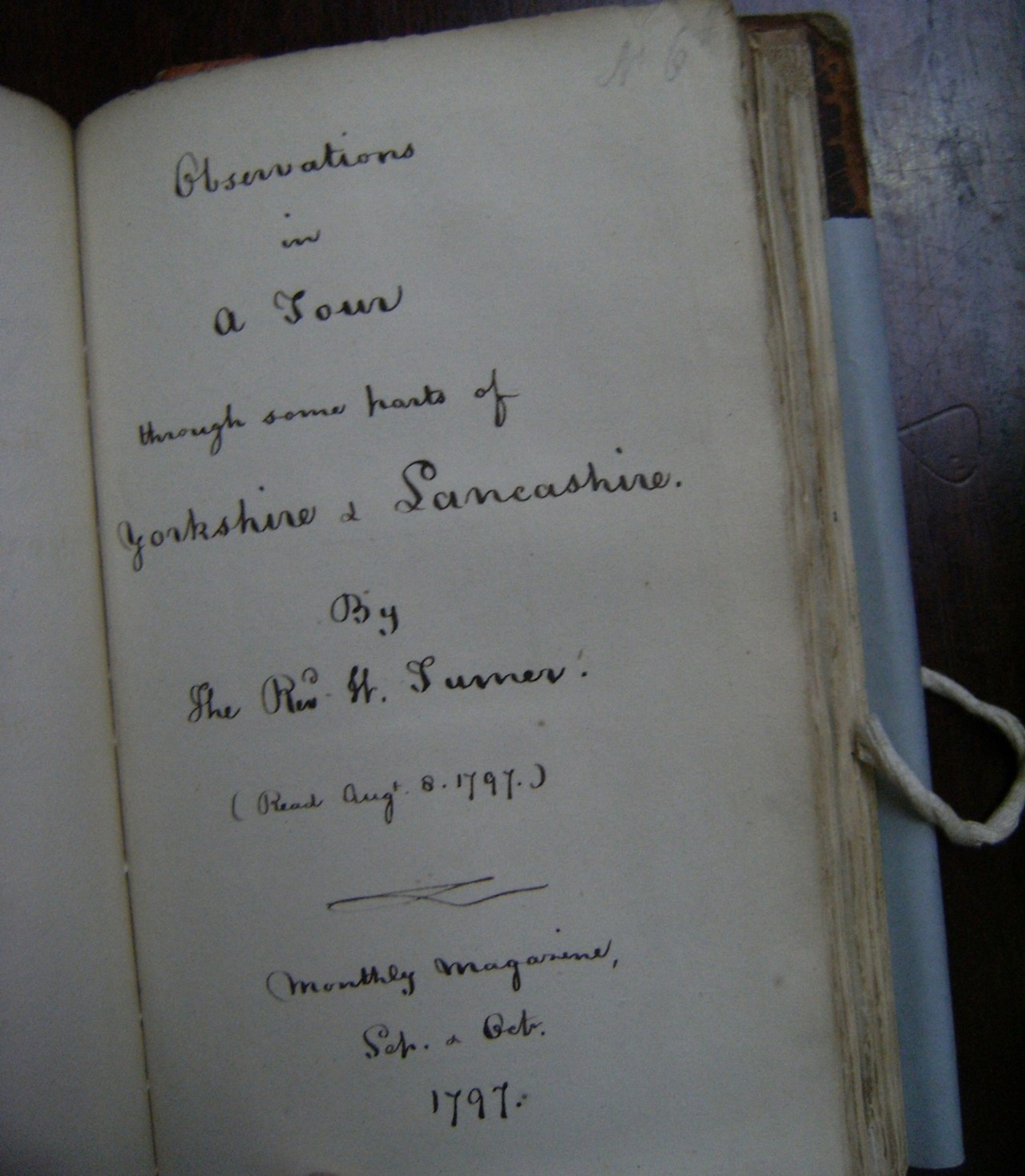
From its inception in 1796, the Monthly’s Prospectus encouraged readers to provide information on improvements in commerce, manufactures, and agriculture, boasting particularly of its provincial orientation. It was open to antiquarian material but complained about the ‘trivial’ nature of ‘dull epitaphs of persons never heard of in their life.’ Among the papers it published across September and October 1797 was ‘Tour through the North of England,’ by V. F., William Turner’s usual pseudonym when writing in the press. Like several papers published in the Monthly around this time, it already been read to the society in Newcastle under the extended title ‘Observations in a Tour through some parts of Yorkshire and Lancashire, with some remarks on the political utility and moral influence of the machines introduced to shorten labour in the cotton Manufactures.’ This fuller title indicates Turner’s desire to investigate the emerging social and moral implications of industrial transformation as well as its commercial and technical accomplishments.
The first few sentences of Turner’s essay are devoted to the description of the ‘delightful prospect up the valley of the Tyne,’ as he sets out from Newcastle to Gateshead. This delight in the picturesque, though, is soon freighted with scientific information, including an account of a steam engine being used to raise water at a nearby colliery. He notes local customs and traditions but finds little pleasure in ancient mysteries perpetuated in the inauguration of the Bishops of Durham, dismissed as ‘ridiculous ceremonies …., described at sufficient length in [Thomas] Pennant’. Civic improvements are always interesting to Turner’s eyes, including a ‘fine sessions-house and prison on the Howardian plan’ at Northallerton, but there is an eagerness to get to the manufacturing districts of the West Riding.
When he gets there his appreciation of the ‘elegance’ and ‘utility’ in the new cloth hall at Leeds seems to hint at a nostalgia for a moral order he fears ‘recently been broken in upon by the introduction of large factories.’ The darker hint is amplified in his account of the cloth-hall at Halifax, which he imagines as a magnificent ruin in a distant future: ‘A melancholy sort of prognostic for the trade and manufactures which gave birth to it!’ Turner gives a twist to the aesthetics of ruin by projecting them forward as Barbauld was to do in her poem Eighteen Hundred and Eleven (1812) when she imagined a future Britain in ruins.
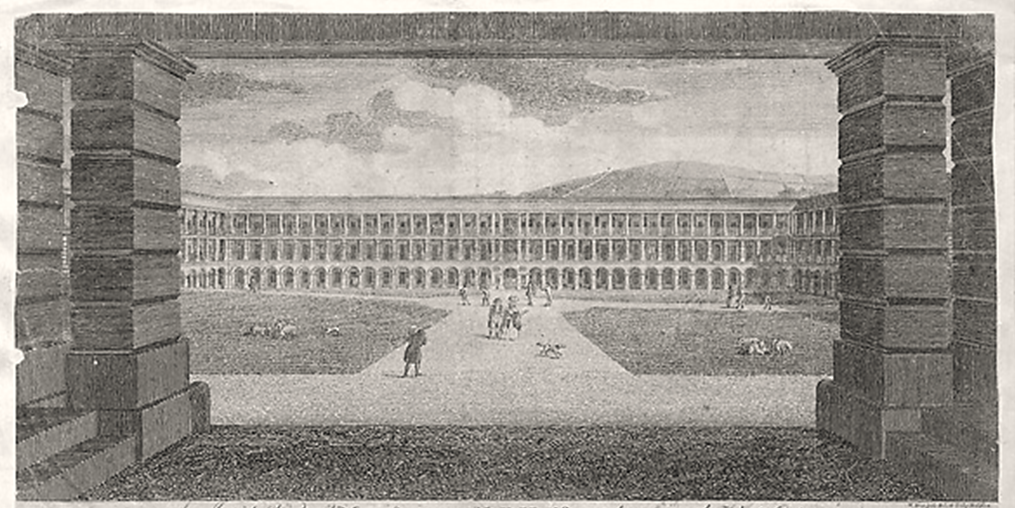
W. Burgess, Manufacturers’ Hall, Halifax (1789). Calderdale Council.
The second part of Turner’s tour is devoted to Cheshire and Lancashire. It centres on a detailed explanation of the different processes in the cotton manufacture, ‘imperfectly known’ and, he claims, somewhat unfairly, ‘scarcely at all noticed in Dr. AIKIN’s Description of the Country round Manchester.’ John Aikin’s Description of the Country for thirty to forty miles around Manchester (1795) had tempered its enthusiasm for the emergent cotton industry with praise for the moral superiority of the domestic economy of the West Riding (a contrast implied in Turner’s tour).
For Turner, the rapid increase in the cotton trade was the result of ‘the more liberal introduction of machinery into every branch of it, than in any other of our staple manufactures.’ He praises the new inventions as ‘most wonderful productions of human genius, the progressive exertions of which neither can nor ought not to be stopped,’ but then pivots to the questions they raise for the ‘moralist and the friend of mankind.’ ‘It will not require any very acute talent for observation,’ he continues, ‘to discover a sensible change in the manners of the people in the neighbourhood of these great factories.’
A veteran abolitionist, Turner hints at the entanglement of the cotton manufactures with the transatlantic slave trade when he describes the wagons bringing pauper apprentices to the cotton mills as ‘slave vessels upon wheels.’ The factories he claims to have heard called ‘a receptacle for white negroes.’ Possibly he is describing a scene from Quarry Bank, ten miles from Knutsford, the small Cheshire town mentioned in the essay, where the Greg family—eminent Unitarians—employed parish children until well into the nineteenth century, longer than many similar firms. Turner’s cousin Peter Holland—who sent his son to Turner’s school in Newcastle—was physician both to the family and to the apprentices, but these connections didn’t mean Turner could not see the need to insist upon the duty to protect the poor ‘from being abused or corrupted either of the landed or commercial aristocracy’.
 The phrasing in the passage treats the idea of a ‘commercial aristocracy’ as a contradiction in terms, an unlooked-for product of the improvement that, in other circumstances, Turner encouraged. The optimistic vision—the more dominant tone of Aikin’s Description of Manchester—of the flat networks of a meritocratic middle class overthrowing the old hierarchies of the nobility would be confounded for Turner if the new cotton masters simply turns out to be slaveowners (which some of them, including the Gregs, were). Struggling against this picture of a ‘commercial aristocracy,’ he introduces the more benevolent example of David Dale at New Lanark, where Robert Owen, founder of the co-operative movement, was about to make his name as a model employer.
Faced with the embarrassment of a progress that might appear regressive, Turner changes tack again towards ‘subjects connected with geology, to adopt a new word,’ a topic of direct interest to his Newcastle audience as I’ve suggested. The new topic emerges from a discussion of salt production in Cheshire, a subject he knew to be ‘pre-occupied’ by Peter Holland, whose son Henry wrote from school in 1801 to ask him to send samples of salt crystals for Turner (possibly in an 1804 talk on Cheshire salt springs that he gave at the Lit. and Phil.).
Mid-Cheshire was the prime producer of salt in Britain in this period. Its traditional use of the evaporation method to process brine from local springs was supplemented by mining after a bed of rock-salt was discovered (when local salt proprietors had been searching for coal deposits to heat their salt pans). Discussing geology leads Turner back to the recent discovery of marine fossils in the Pennines, which opens up a dizzying temporal scale with traps and snares of its own, especially for a Unitarian minister concerned not to directly question creationism.
Unitarians were often accused by orthodox Christians of deliberately courting such controversy. Turner’s essay tries to insulate his geological interests from these dangers, as he often did, by insisting that his concern was only with practical science: ‘Mineralogy is doubtless a very rational and important study, when applied to the purposes of life; to the discovery of things which may be turned to use, and meliorate the conditions of society,’ Turner writes, ‘but when distorted with a vain ostentation of science, to furnish matter for dressing out theories of the earth, it appears to me to be very much out of its place.’
Turner ends his tour with a fable that tries to set limits to what geological discoveries can reveal about the origins and structure of the world. He points out that the deepest mine in the world bears nothing like the proportion to the diameter of the earth that the rind of an orange does to its diameter. Similarly, a fly penetrating the rind with its proboscis knows as little of an orange’s ‘real formation and structure’ as ‘do our theorists know of the formation and structure of the earth.’
The question this rhetorical device raises, though, is what scale would be adequate to judge the innovations he began his tour by praising and ended by reprobating? His account of the cloth-hall in Halifax had opened up a prospect of far-distant ruin. His discussion of the fossil opens up a very large timeframe to judge these issues against. Was Turner implicitly comparing himself to the fly whose senses could not know the larger significance of what he was exploring? Turner’s anxiety about the scale of what was happening around Manchester and spreading westwards, perceived but difficult to translate into a clear framework of historical explanation, haunts many descriptions of this early stage of the ‘Industrial Revolution.’
Further reading
- Stephen Harbottle, The Reverend William Turner: Dissent and Reform in Georgian Newcastle upon Tyne (Northern Universities Press, 1997)