
Living History, or Pandaemonium Revisited
Sarah Baylis, Heritage Interpretation Consultant
Hearing the writer Frank Cottrell-Boyce on the radio recently, I was reminded of the masterly spectacle he co-created with Danny Boyle and Paulette Randall for the opening ceremony of the London Olympics. It prompted me to watch, yet again, an (edited) film of the whole ceremony (almost 4 hours in total) and triggered a rambling, unresolved train of thought about the difficulty of categorising such a multi-faceted public event. ‘The Isles of Wonder’: performance art piece, theatre, circus, or national pageant? What messages are conveyed about the story of Britain and where, if anywhere, does it belong in the annals and narratives of the Industrial Revolution itself?
The spectacle
July 27, 2012. The wettest summer for a century. An aeon ago. A now barely comprehensible era, distanced from us by the strange temporal distortions and divisions wreaked by Brexit and Covid. Perhaps (unlike me) you witnessed the event live in the Olympic stadium. Although I wasn’t even there in person, the opening sequence remains—an obstinate, outstanding memory—as if I had been. Throughout this 17-minute sequence, titled ‘Pandaemonium,’ we are all spectators to (yet somehow also participants in) a blistering, euphoric re-enactment of the birth of the Industrial Revolution. It’s a visual and auditory spectacle that seems to encapsulate the energy, genius, astonishment and contradictions of the revolution itself.

Matt Lancashire, 2012 Summer Olympics opening ceremony. Wikimedia Commons.
I remember the bucolic opening tableau: a village green, real horses ploughing real furrows, cricket and football, cottages with billowing smoke, water wheels. Maypole dancers, a family picnic, and a ripe cornfield. It stirred memories of a jigsaw I had as a child and never quite completed. Alongside its 7,500 human volunteers, the huge cast included many animals (to be precise: 12 horses, 3 cows, 2 goats, 10 chickens, 10 ducks, 9 geese, 70 sheep, and 3 sheepdogs.) In my mind’s eye, I see the Glastonbury thorn rise up, and the seething stage, as 17,000 square metres of rain-sodden turf is rolled up and systematically removed. Making way for the future.
I can even hear the drummers, led by Evelyn Glennie’s rousing, breath-taking drum score. Their brief—as volunteer musicians—is to frighten people. They are playing (for economy’s sake) metal buckets, not drums. The voice of Industry, driven by synthesiser and percussion. Electronic. Metallic. It is a physical sensation, both alarming and exciting. And then I witness the monstrous factory chimneys: an industrial powerhouse rising up amidst sparks and smoke, and the molten Olympic rings being forged before our eyes. And look! There is Kenneth Branagh, now tiny, now screen-huge, strutting the stage in his stove-pipe hat. In his bravado, channelling not just Brunel but Everyman the industrialist, factory owner, capitalist, inventor. Every smug fashioner of the future.
A strange, ambiguous energy, a visceral excitement, ripples through the stadium. The electronic soundtrack is relentless—those wheels and cogs, levers and pistons reach a crescendo. The paradigm-shift from rural to urban is complete. From the garden of Eden to paradise forever lost.
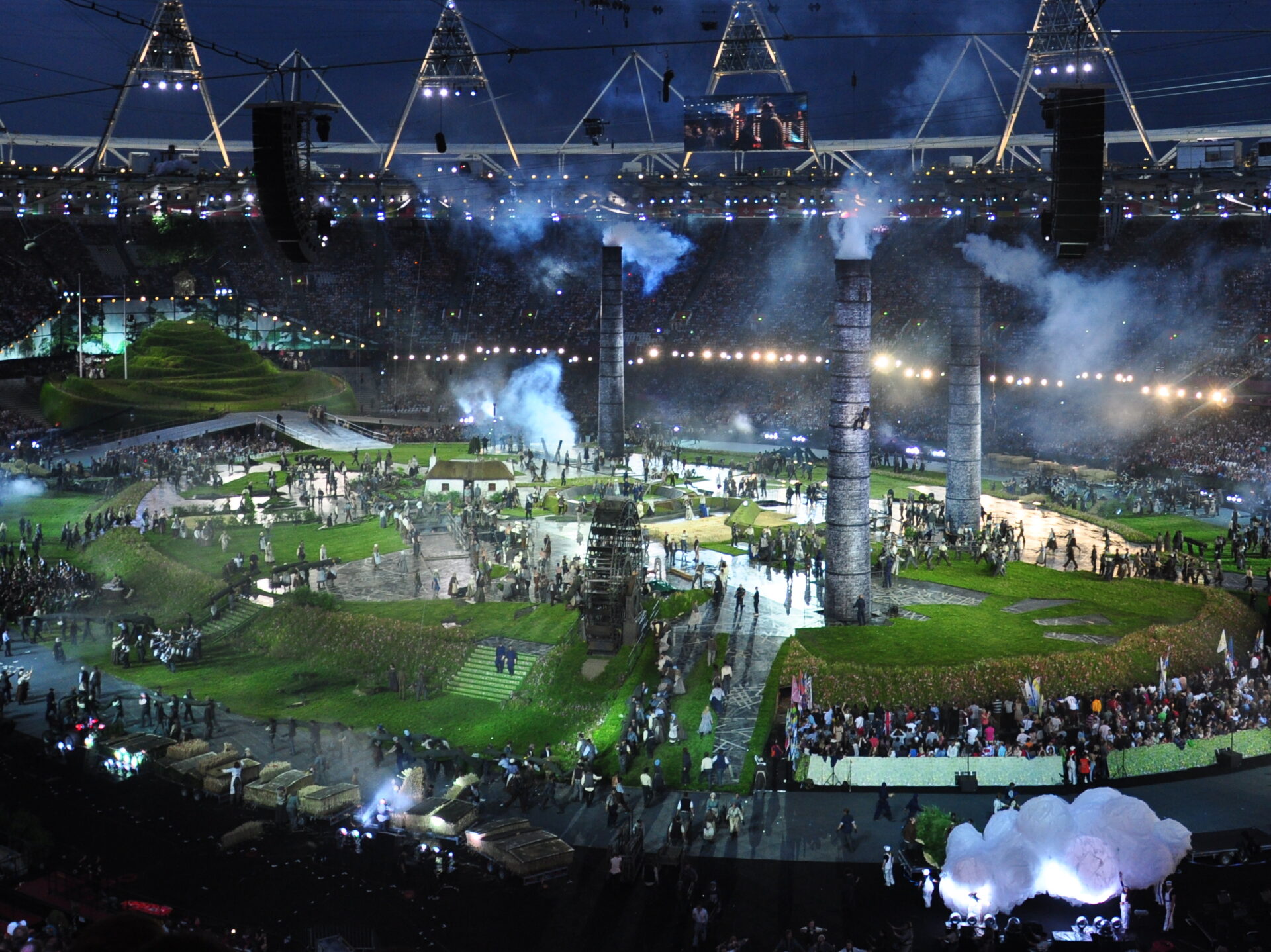
2012 Olympics opening ceremony. Department for Culture, Media and Sport, via Wikimedia Commons.
Antecedents: national spectacle or living history?
Having worked for some decades in the UK heritage sector, I am inevitably drawn towards an evaluation of this extraordinary event as a piece of historical interpretation. Even as I am caught up in the drama, the mediated memory of it, I’m trying to place the Olympic spectacle within a ‘tradition’ of some sort. What are its antecedents, and how does it connect to that over-arching story of the past two centuries—our troubled relationship with our own industrial past? Is it, as some might argue, an energetic glorification of a period in British history which now, a dozen years later, appears obscured, increasingly tangled in darkness? Or are there other cultural forces at work here?
The Olympic ‘Pandaemonium’ did not emerge, spontaneous and fully-formed, from the imaginations of its celebrated creators. The acknowledged genius behind the script was Humphrey Jennings, a brilliant documentary maker, poet and artist. He was born in 1907 and died in 1950, after a career largely devoted to making propagandist films for the Ministry of Information. His idiosyncratic history of the Industrial Revolution, a touchstone for both Cottrell-Boyce and Boyle, was a life-long endeavour, also entitled Pandaemonium. It was not published until 1985.
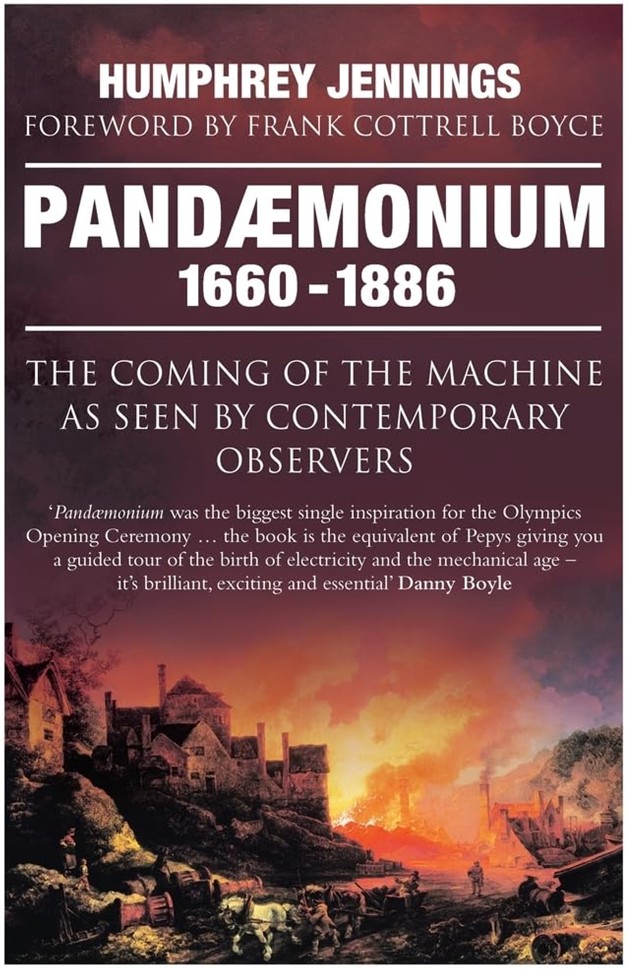
‘When I first held this book in my hand,’ writes Cottrell-Boyce, ‘I swear I could feel it shaking with its own internal energy.’
There are, of course, other, much earlier examples of extravagant London-based shows with an industrial theme. In 1851 —by which time the English had already earned a reputation abroad for what Edward Bulwer-Lytton called ‘that love for shows, / Which stamps us as the “Staring Nation”’—one third of the population flocked to the Crystal Palace in Hyde Park to view 13,000 exhibits in the Great Exhibition of the Works of Industry of all Nations. A century ago, 27 million people flocked to Wembley to see the British Empire Festival. It was a world trade fair, complete with amusement park, a staged history of the Empire, whose spectacular displays included a life-sized figure of the Prince of Wales sculpted in Canadian butter. The Palace of Industry and Engineering included a mock-up of a contemporary coal mine into which visitors could descend, via a lift, to satisfy their weekend curiosity.
In 1951, the Festival of Britain was staged on the South Bank for a postwar-weary fun-starved population. This was another multi-faceted event, and a determined look at the future: industry would help us leave behind the old order and prevent another war. It was, in Roy Strong’s words (p. 6), a ‘secular state festival … presenting the ideals and goals of a new society … framed within a view of history recast in terms of romantic nationalism.’ Opinions, however, were split: to some it was a glorious monument to the future; to others, merely a tawdry and extravagant carnival.
These earlier spectacles and mass gatherings undoubtedly informed the 2012 Olympic event, bringing with them, perhaps, many of the uncomfortable paradoxes inherent in all national celebrations. But there are other, equally relevant and powerful, ways in which the past is brought to life. Perhaps ‘The Isles of Wonder’ belongs more properly to the theatre-adjacent traditions of living history and of ‘history from below’ —a movement which emerged fully in Britain in the 1960s and 1970s. It derived partly from the work of Joan Littlewood at Stratford East theatre, where radical, collaborative, ensemble and improv techniques marked a break with classical theatre; it developed alongside the oral history movement, reminiscence-based theatre, memory gathering and grass-roots museums, salvaging community and the industrial past.
These ideas fed into the emergence of public history as a discipline, with an increasing focus on telling the stories of working lives, in the work of writers such as EP Thompson, who aimed to rescue working-class history from the ‘enormous condescension’ of middle-class intellectuals. The rise of living history was also a response to an accelerated loss of national heritage—railways, canals and steam-driven industries—and dramatic social change. Industrial archaeologists drove the excavations of now deserted factories, foundries, mills and mines. Resurrected as open-air museums (a new thing in the UK) they were run with the support of dedicated community volunteers. Some had personal experience of these moribund industries, now on the very edge of living memory, thus prolonging language and knowledge of customs, tools, and working practices.


Beamish, the Living Museum of the North, opened in 1970, following the pioneering model of Scandinavian open air folk museums. Coal-mining, ship-building, iron and steel manufacturing were disappearing fast, along with the communities and lifestyle that served them. Frank Atkinson, Beamish’s founder, ‘wanted the new museum to “illustrate vividly” the way of life of “ordinary people” and bring the region’s history alive.’
Live interpretation is now common museum practice: the immersive and educational potential of living history is widely recognised as an alternative to heavily text-information-based interpretation. And it is no longer just for children.
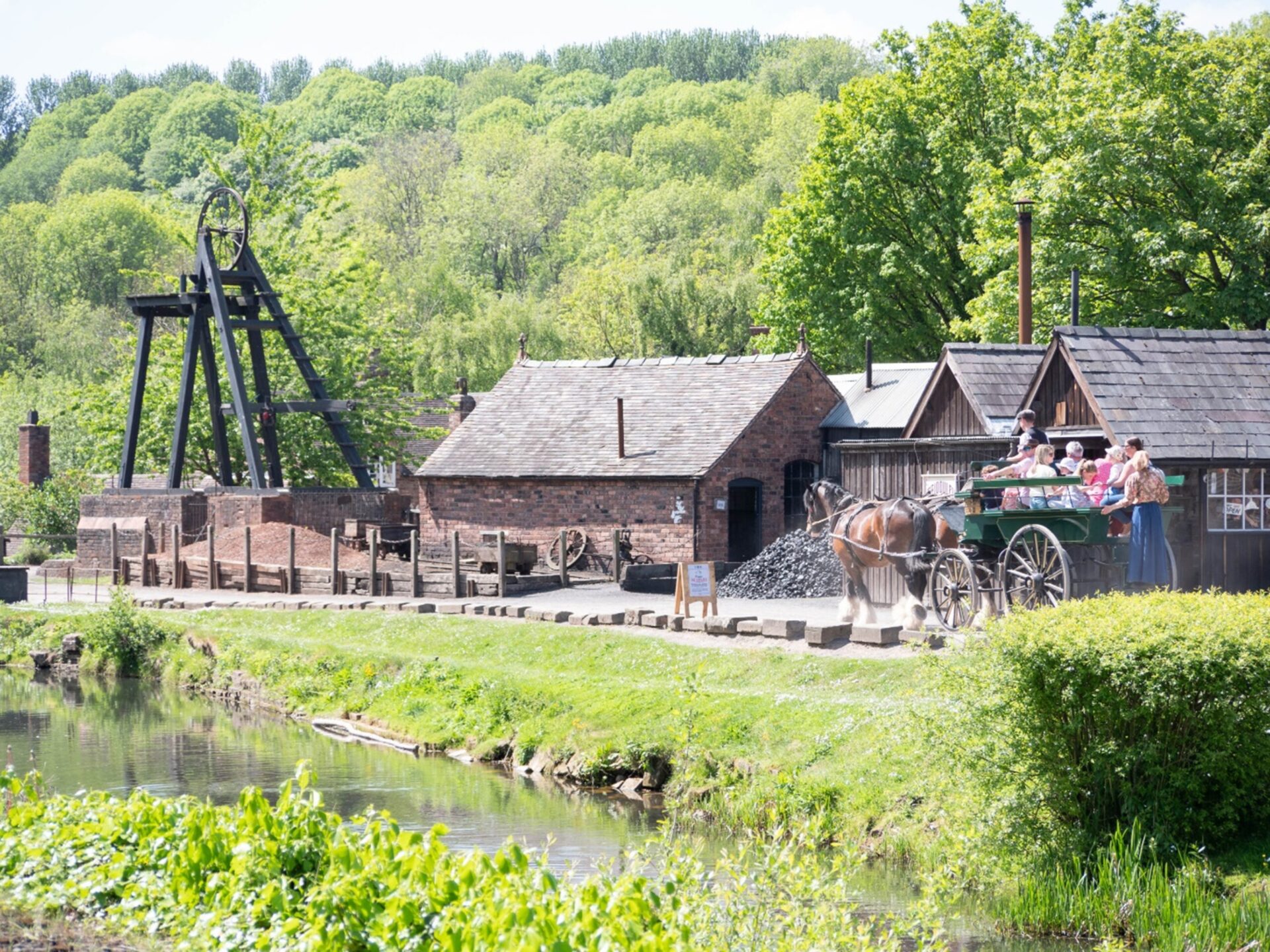
Blists Hill Victorian Town
At Blists Hill Victorian Town at Ironbridge, which opened in 1974, collections curator Kate Cadman tells me that costumed demonstrators were there from the start:
We do call them demonstrators rather than re-enactors, it has always been third person interpretation rather than re-enacting. As we were one of the earliest open-air museums, I assume we were fairly ground breaking at the time, and one of the first support areas was having a designated costume department.
Living history is always more than mere ‘dressing up.’ It can play a therapeutic, healing role by nurturing an unbroken, living link with the past and invested family and community memories. It has, I believe, the capacity to change people’s understanding of history.
Back to Pandaemonium
Which brings us back to the Olympic Stadium in 2012. Cottrell-Boyce insists this event—led and driven by volunteers—was ‘all about the participants.’ During three months of open-air rehearsals, held in the old Ford plant in Dagenham, the volunteers were told repeatedly to ‘save the surprise.’ (Even the Queen, it’s said, did not divulge to her family any details of her helicopter stunt with James Bond). With 300,000 spectators, and 1 billion viewers globally, perhaps this was, indeed, the greatest ever spectacle of living history. It certainly drew on traditions which were, by now, fully embedded in our national consciousness.

Lee Miller, Humphrey Jennings (1942). National Portrait Gallery.
But the spark was undoubtedly the extraordinary work of Humphrey Jennings. Pandaemonium is an idiosyncratic compilation of nearly 400 contemporary texts (‘images,’ as Jennings calls them) dating from 1660 to 1886, which illustrate ‘the coming of the machine as seen by contemporary observers.’
This massive book has a living, raw, organic quality which is hard to pin down. It presents an unfolding narrative which uses techniques and effects more akin to the cutting, editing and montage techniques of film-making than a literary text. As Frank Cottrell Boyce put it:
If you pick this book up, I swear you can feel it clanking.
Further Reading
- Humphrey Jennings, Pandæmonium, 1660–1886: The Coming of the Machine as Seen by Contemporary Observers, new edn, with a foreword by Frank Cottrell-Boyce (Icon, 2012)
- Kevin Jackson, Humphrey Jennings (London: Picador, 2004)