
The Copper and Iron Manufactures, Wales and Slavery
Maxine Berg, University of Warwick
Greenfield Valley, Flintshire, was a major site of copper refining and copper battery works that formed part of the Warrington Company in the eighteenth century. Holywell and the Greenfield Valley had great locational advantages with access to the Parys Mine Company on Anglesey and to Warrington, where copper smelting took place and Liverpool with its access to trade routes. Ken Davies published a fine article on Holywell and the Slave Trade in 2015. Pat Hudson and I did not know of that article when we were researching and writing the first draft of what became chapter six, ‘Iron and Copper Revolutions,’ in our book Slavery, Capitalism and the Industrial Revolution, published in 2023. There are absences in this chapter concerning the place of North Wales and its Liverpool connections in the story of copper in the Industrial Revolution, as well as some errors of emphasis or expression. I wish to address these here, and to set the place of Holywell copper in context of the wider story of copper’s place in the early Industrial Revolution.
Greenfield Valley copper production was started as a refining and battery works and became part of Thomas Patten’s Warrington Company from 1717. Copper mining took place at the Parys Mines works on Anglesey, and employed c. 1500 men and women at its height. Smelting was carried out at Ravenhead, St. Helen’s. A great deal of Greenfield’s production was focussed on the Africa trade—copper rods, manillas, pans and copper sheet. The copper sheet and later copper bolts were made for the copper sheathing of ships as protection against the teredo worm. The copper works is described by Ken Davies as ‘at the forefront of factory design and factory systems of production’.

John Ingleby (engraved by William Watts), Copper Works Near Holywell (1792). Wikimedia Commons.

This was a particular copper production at two different ends of the slave trade, markets for Africa in exchange for slaves on the one hand and transport of enslaved peoples on the other. But copper, as a small industry in eighteenth-century Britain, and one that had been stagnant before the early eighteenth century, is usually neglected in accounts of British industrialization. First, much focus is on textiles, and after this it is on iron. But copper brings a distinctive story—its transformation was early and rapid; it was the site of major, transferable technological innovation; it was highly capital intensive and concentrated, both in its mining and smelting, but also in many refining and battery works. It drew on large-scale capital investment, and in all parts of the country the sources for this can be traced to profits from the slave trade and slave plantations. Reinhold Angerstein’s wonderful travel account and industrial espionage found copper and iron works in many parts of the country with workshops specifically dedicated to items for the Africa trade. Holywell’s was an early and very large manufactory with close regional integration with copper mining, smelting and overseas commerce.
Thomas Pennant in his history and travels in North Wales (pp. 203–4) wrote in detail about the products and markets of the Greenfield manufactory.
The first brass made at Greenfield, was on the 20th August, 1766, then held by Mess. Patten and Co. Since January 1786 they have been in the hands of Thomas Williams, esq and Co. under the firm of The Greenfield Copper and Brass Company, who have very much improved them by various erections, so as to enable them to finish goods for Africa, America, and most other markets, viz. brass Neptunes, or large pans, in which the negroes make salt; pans for getting the gold out of their rivers, and for various other purposes; kettles; brass and copper rods; bright and black manillas—the first are rings for ornaments to the arms and legs, the last for the current money of the country. The last are not unlike the golden bracelets of the antient Britons, the ends turned up and flatted; and add to these various sorts of latten, brass, &c. for mathematical instruments...

Smelting works on the Dee Estuary, from Thomas Pennant, History of the Parishes of Whiteford and Holywell, extra-illustrated copy (1796)
Copper production was not only for the manufactured luxury items of manillas and copper rods, forms of coinage markers or substitutes, and for jewellery that slave traders might exchange with African merchants for enslaved peoples. It was also for production processes. It provided for West Indian plantation needs for copper vessels used in boiling and crystallizing sugar and distilling rum. These were huge copper cauldrons and coolers and great copper stills: the plantations and Africa took c. 90% of British copper and brass exports. Exports of copper and brass to Africa were significant, but they were nowhere near as important as those going to the West Indies, indeed the West Indian market was the mainstay of the industry. Exports to these islands were twice those going to the North American colonies in the 1770s. The West Indies took nearly half the export of wrought and unwrought copper in 1771: in 1776 c. 4,500 cwt of brass and c. 12,300 cwt of copper were exported to the West Indies. The Greenfield manufactory also produced for this market.
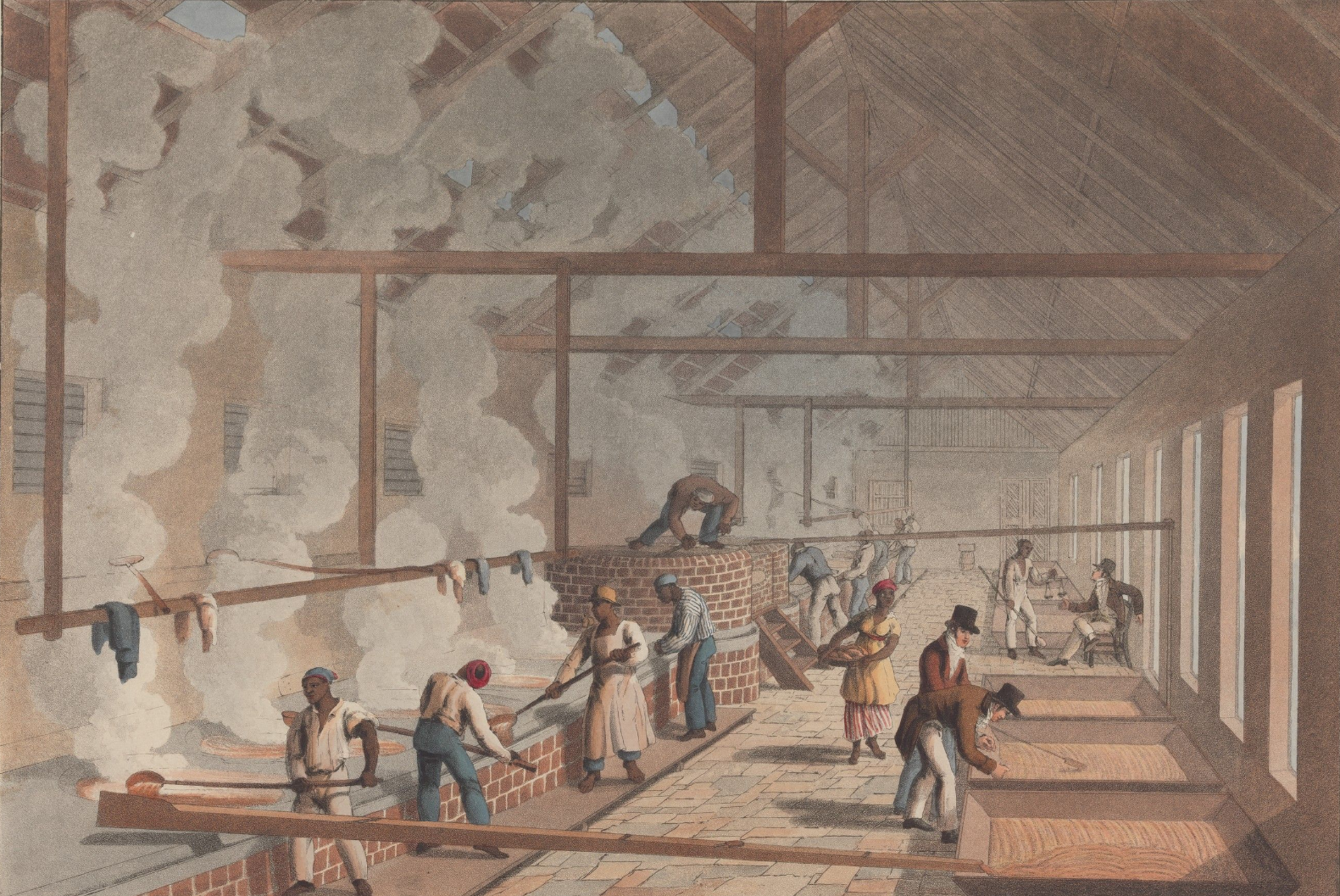
The Boiling-House, from William Clark, Ten Views in the Island of Antigua (1823). Yale Center for British Art.
The copper industry in addition provided for home markets. Sugar refineries were major manufactories all over the country from early in the eighteenth century, and needed their own copper vessels. Richard Warner in his Second Walk through Wales in 1798 found 600 employed in the copper mills; in addition to this there was a large brass works.
Copper also played an early and very significant part in innovation. Coal was substituted for charcoal in copper smelting, and from here the process spread to other non-ferrous metals. The famed Welsh Method of smelting was pioneered in the Swansea Valley near the South Wales coalfield. Copper was also central to the development of steam power, used as this was in the copper mines, and with the heavy involvement of Boulton and Watt. Copper and brass were crucial to the great metal-working product innovation of Birmingham and its outskirts – 1,000 tons was used there by 1780, rising to 2000 tons in the early 1790s, then dropping back. The copper bolts developed for copper ship sheathing were a Birmingham and Lunar Society collaboration with the copper manufacturer William Forbes and with Thomas Williams in his Holywell manufactory. The Greenfield manufactory produced much copper sheathing and most of the copper bolts until the early nineteenth century.
There were other close connections between copper and iron. Abraham Darby, so well-known for developing coke-smelted iron at Coalbrookdale, had earlier connections with the coal smelting of copper through his early career with the Bristol Brassworks and with copper smelting at Crew’s Hole near Bristol. That story continues into iron puddling. Anthony Bacon between 1768 and 1776 had contracts worth £67,000 to supply slaves to the West Indies. He also took out mineral leases in Merthyr Tydfil, then followed with the coke smelting of iron in the South Wales coalfield in the 1750s. His giant works, Cyfartha, transformed the technology of the iron industry in South Wales. Richard Crawshay took over from him in the later 1780s and developed Cort’s puddling process there.

Penry Williams, Cyfarthfa Ironworks Interior at Night (1825). Wikimedia Commons.
.jpg)
The great iron capitalists of the early to mid-eighteenth century were like the copper capitalists. They employed 300–500 workers in highly developed capitalist enterprises in Shropshire and Staffordshire. South Wales manufacture drew great advantage from its access to coal and copper sources nearby, and to its links with the Staffordshire and Birmingham metal manufactures with its transport links up the Severn and a great network of canals. North Wales heavy industry likewise had such advantages with close transport links to copper mines, great smelting works and the major port of Liverpool. Both, at this early stage, were connected with the slave trade and Atlantic markets.
The story of the copper and iron manufacture is one of heavy industry, high capital investment, large-scale works and capitalist organization even in the early stages of the Industrial Revolution. Our histories have dwelt for too many decades only on the smaller capital needs of the textile industries and the circulating capital they relied on. Metals and textiles were two distinctive manifestations of industrialization. Slave trade profits and slave plantations contributed the capital and the markets for both. The travellers, writers and artists of the Romantic movement visiting the Greenfield Valley and Ironbridge Gorge depicted a ‘pandemonium’ of landscapes disembowelled, great water courses, factory works with centralised labour forces and the fire and molten metal of transforming minerals.
As Thomas Pennant marvelled:
IN the year 1766 began the memorable epoch in the annals of our famous stream, when the late Mr. Patten of Warrington, and Co. built the first battering-mill for copper and brass. In about ten years from that time, Mr. John Smalley, now deceased, introduced the first manufacture of cotton. By his successors, and by the great copper-companies, those behemoths of commerce, our little Jordan was soon drunk up. By their skill and industry they succeeded, to the benefit of the state, and to their private emolument.
Further reading
- Maxine Berg and Pat Hudson, Slavery, Capitalism and the Industrial Revolution (Polity, 2023)
- Ken Davies, ‘Holywell and the Transatlantic Slave Trade’, Flintshire Historical Society Journal, 40 (2015), pp. 75–106
- Chris Evans, Slave Wales: The Welsh and Atlantic Slavery 1660–1850 (University of Wales Press, 2010)