
Poets on Pollution: The Romantics Encounter the Factories
Tim Fulford, De Montfort University
To be what we now call a Romantic poet did not mean turning away from the industry that, from the 1790s, increasingly disfigured the British landscape. Nor did it mean ignoring the ‘manufacturing system’ that enriched the engineers, the mill-owners and the aristocrats who owned the land on which the mines were sunk and the furnaces constructed. Their social conscience, political radicalism and love of nature made the Romantics the first analysts of industry’s human and ecological costs.
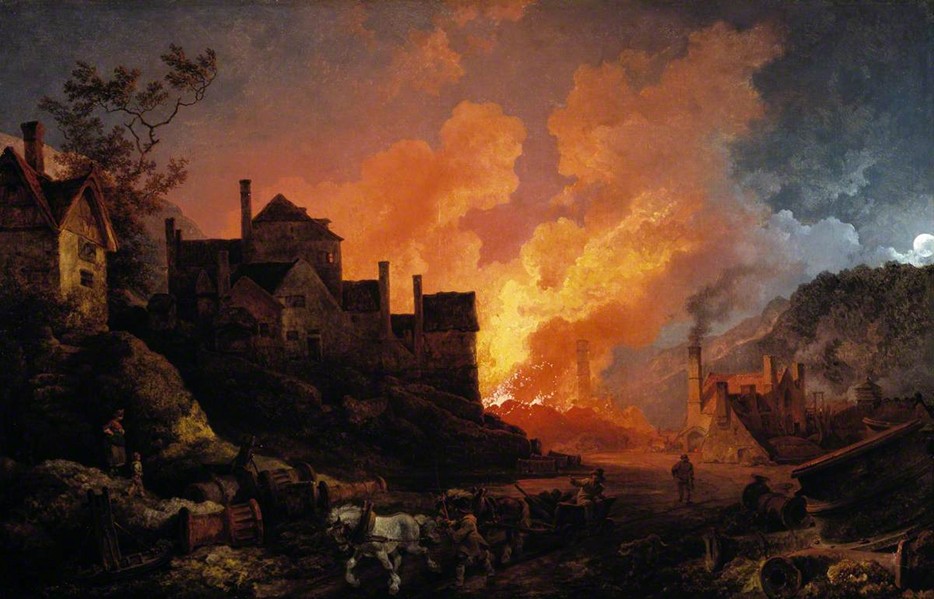
Philippe Jacques de Loutherbourg, Coalbrookdale by Night (1801). Science Museum Group. Creative Commons Licence CC BY-NC-SA 4.0.
While artists like de Loutherbourg saw industrial production as a sublime light show, Robert Southey focused on its exploitation of workers’ bodies and minds—exploitation he understood as systematic, both reliant on and contributing to poverty and suffering. Visiting the ‘Black Country’ to the west of Birmingham, he wrote (letter 36):
When we look at gold, we do not think of the poor slaves who dug it from the caverns of the earth; but I shall never think of the wealth of England, without remembering that I have been in the mines. Not that the labourers repine at their lot; it is not the least evil of the system, that they are perfectly well satisfied to be poisoned soul and body. Foresight is not a human instinct: the more unwholesome the employment, the higher of course are the wages paid to the workmen; and incredible as it may seem, a trifling addition to their weekly pay makes these short-sighted wretches contend for work, which they certainly know will in a very few years produce disease and death, or cripple them for the remainder of their existence.
I cannot pretend to say, what is the consumption here of the two-legged beasts of labour; commerce sends in no returns of its killed and wounded. Neither can I say that the people look sickly, having seen no other complexion in the place than what is composed of oil and dust smoke-dried. Every man whom I meet stinks of train-oil and emery. Some I have seen with red eyes and green hair; the eyes affected by the fires to which they are exposed, and the hair turned green by the brass works.
Southey also saw that pollution was on a scale and of a kind never before seen—poisoning people and places:
The noise of Birmingham is beyond description; the hammers seem never to be at rest. The filth is sickening: filthy as some of our own old towns may be, their dirt is inoffensive; it lies in idle heaps, which annoy none but those who walk within the little reach of their effluvia. But here it is active and moving, a living principle of mischief, which fills the whole atmosphere, and penetrates every where, spotting and staining every thing, and getting into the pores and nostrils. I feel as if my throat wanted sweeping like an English chimney. Think not, however, that I am insensible to the wonders of the place:—in no other age or country was there ever so astonishing a display of human ingenuity: but watch-chains, necklaces, and bracelets, buttons, buckles, and snuff-boxes, are dearly purchased at the expence of health and morality.
Southey perceptively understood that the metalworking boom and the wealth it generated for a few was emphatically not just a problem at home (still less a blessing): it was part of a system dependent on and in turn enabling cheap, mechanised violence and slavery across the world:
if it be considered how large a proportion of that ingenuity is employed in making what is hurtful as well as what is useless, it must be confessed that human reason has more cause at present for humiliation than for triumph at Birmingham. A regular branch of trade here is the manufacture of guns for the African market. They are made for about a dollar and a half; the barrel is filled with water, and if the water does not come through, it is thought proof sufficient; of course they burst when fired, and mangle the wretched negro who has purchased them upon the credit of English faith, and received them most probably as the price of human flesh! No secret is made of this abominable trade; yet the government never interferes, and the persons concerned in it are not marked and shunned as infamous.
Opposition to slavery required opposition to the whole ‘commercial system,’ Southey argued, and in this he resembled Coleridge, who likened the child apprentices labouring in the cotton mills to the enslaved Africans working on the sugar plantations. This was a more holistic and radical position than that of prominent anti-slavery campaigners such as William Wilberforce, who remained quiet about the exploitation of workers at home.
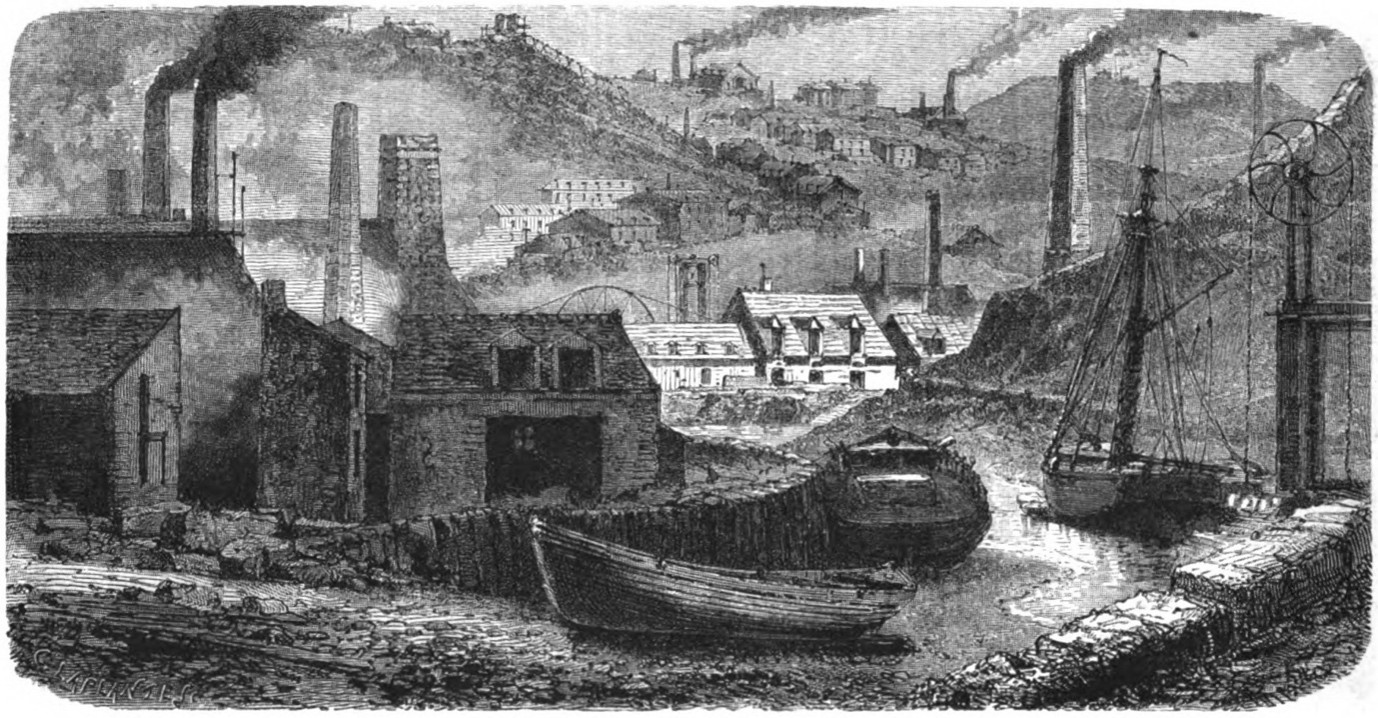
Henri Durand-Brager, ‘View of the Vivian Works from the canal,’ Le Tour du Monde 12 (Paris, 1865). Wikimedia Commons.

The Birmingham area was not the only ecologically devastated zone. By 1813 the copper-smelting works outside Swansea had turned the nearby valley into scorched earth: one traveller noted ‘there is not a blade of grass, a green bush, nor any form of vegetation: volumes of smoke, thick and pestilential, are seen crawling up the sides of the hills, which are as bare as a turnpike-road.’ As in Birmingham, the workers, desperate for employment, did not complain, though they lived within walking distance. But local farmers made complaints. Concerned to obviate these, John Henry Vivian, who ran the Hafod Works, brought in the renowned chemical researcher Humphry Davy (Southey’s friend and a Romantic poet in his own right) and Davy’s assistant, Michael Faraday. Their aim was to filter the toxins out of the smoke before it left the chimneys.
Flues were constructed in which the smoke was exposed to ignited charcoal, flame, steam and showers of water. The water washed out the fluoric and arsenious acid gas, but the sulphurous acid gas remained—and this blighted all living things in the vicinity. Removing the sulphur by any other method would, Davy advised, prove so expensive it would make the business unprofitable. So, as a fallback option, the height of the chimneys was raised—dispersing the pollution more thinly but also more widely.

Henri Durand-Brager, ‘General view of the Vivian Works,’ Le Tour du Monde 12 (Paris, 1865). Wikimedia Commons.

So, while Davy visited Vivian’s country house (located safely away from the fumes), enjoying woodcocks and mutton from his estate, farmers downwind of the works found their fields tainted and their grazing animals deformed. In 1833 eleven of them jointly sued Vivian for damages and for an injunction to prevent the ‘public nuisance.’ Their barrister declared of Hafod—in a phrase that recalls poems by Southey and Byron—that ‘like the poisonous Upas tree, it spread desolation all around.’ But mobilising Romantic poets’ depictions of pollution to prick the court’s conscience was in vain: Vivian hired an expensive London lawyer who discredited the farmers’ evidence and argued that the smoke problem had been suppressed. Big tech, commanding big money, won the day, and Swansea, dependent on the industry as it was, celebrated. The pollution continued, despite further lawsuits, although the installation of improved furnaces in 1860 abated it somewhat. In the 1980s, although the industry had been finished for twenty years and the furnaces lay derelict, the soil was still contaminated by chemicals and the watercourses still ran orange.
Further reading
- ‘Carmarthen Spring Assizes. Most Important Trial. Indictment of Messrs. Vivian’s Copper Works, near Swansea, as a Public Nuisance,’ The Cambrian (16 March 1833), pp. 3–4
- Ronald Rees, ‘The Great Copper Trials in Nineteenth-Century Wales,’ History Today 43, no. 12 (December 1993)