
Peacock’s ‘Infernal Flotilla’ of ‘Iron Chickens’: Steamboats, Opium and Poetry
John Gardner, Anglia Ruskin University
Thomas Love Peacock and his best friend Percy Shelley both engaged in making steamships at a time when the technology was in its infancy. Shelley’s steamship was never completed, a failure he called an ‘Asymptote’ as his lines of interest failed to converge. Conversely, Peacock was hugely successful, producing iron steamships. For Peacock, fast steam navigation technology offered ‘government … a new arm of great and irresistible power,’ and he supervised the design, construction and fitting of the first steamships to India. Peacock also produced some of the world’s first iron gunboats, his ‘infernal flotilla,’ several of which saw action in the first Anglo-Chinese Opium War of 1839–42.
Peacock, the author of some of the most popular novels of the first half of the nineteenth century, was employed by the East India Company from 1819 until his retirement in 1856. The joy of Peacock’s literary abilities is highlighted in his enduringly funny novels: Headlong Hall (1816), Melincourt (1817), Nightmare Abbey (1818), Maid Marian (1822), The Misfortunes of Elphin (1829), Crotchet Castle (1831) and, after an almost thirty-year gap, Gryll Grange (1860). However, he had another life within the East India Company where he furthered Britain’s imperialist endeavours.

Thomas Love Peacock, photographed in 1857. Wikimedia Commons.

Steamboats were a new technology that came out of practical experimentation rather than established theory. There were various efforts in the eighteenth century to build steamships, but the most prominent is that of Patrick Miller who made a small boat with a steam engine that sailed on Dalswinton Loch in 1788. There is a legend that Robert Burns was on this steamship, but no hard evidence has yet been found. A steamer service began in America in 1807, carrying passengers the 150 miles between New York City and Albany, and relying on machinery supplied by Matthew Boulton and James Watt from their works in Birmingham.
Henry Bell is credited with being the first to offer a commercial service in Britain. This began on the Clyde in 1812 with the Comet, a forty-five-foot boat with a four hp Watt-type engine. It carried up to forty passengers, charging three to four shillings for the short distance between Glasgow and Greenock. Walter Scott and James Watt both sailed on it.

The ‘Comet’ Passing Dumbarton Castle. Glasgow City Libraries and Archives.
This is the kind of ship that Shelley tried to copy in his failed attempt to run a service between Livorno and Marseilles. From 1818 there was a regular Greenock to Belfast steam service, soon followed by a service between Dover and Calais. This was the technological moment when Peacock joined the East India Company.
Peacock began a two-year apprenticeship with the East India Company in 1819, after which he became Assistant to the Examiner of Public Works. Thomas Babington Macaulay writes of the bizarre power the Company held:
It is strange, very strange, that a joint-stock society of traders … should be intrusted with the sovereignty of a larger population, the disposal of a larger clear revenue, the command of a larger army, than are under the direct management of the Executive Government of the United Kingdom.
This joint-stock company, which existed between 1600 and 1874, had immense power. From Charles II it obtained ‘the right to acquire territory, coin money, command fortresses and troops, form alliances, make war and peace, and exercise both civil and criminal jurisdiction.’
In 1829 John Loch, chairman of the Company, asked Peacock to investigate the problem of communications with India, from which mail came twice a year. The question was whether steam could be quicker than sail. Peacock consequently authored a Memorandum Respecting the Application of Steam Navigation to the Internal and External Communications of India, and became the main authority on steam navigation within the company. Peacock oversaw the building of at least six steamships in the 1830s.
In a letter to his cousin Harriet Love, Peacock wrote:
I am in high spirits about my iron chickens; having excellent accounts of them from Madeira. I have accounts of “Nemesis” from the Cape, where she arrived in fine order, and literally astonished the natives. I shall scarcely be absent from town till the “Pluto” is ready for sea.
These ‘iron chickens’ were four river steamers of 275 tons and sixty horsepower which were commissioned by the Bengal Government. They were built between 1832 and 1833 on the Thames, taken in parts to Calcutta and launched there between April 1834 and January 1836 for service on the Ganges. Records show that they were all still active almost twenty years later. Of the six Peacock had built only the Ariadne did not see service in the war with China between 1839 and 1842. In a letter to John Cam Hobhouse on 6 October 1843 Peacock called the Nemesis, Phlegethon, Pluto and Proserpine ‘the infernal flotilla dispatched against the Celestial Empire.’ Peacock championed imperial might through greater commerce; but he also advocated military aggression against Russia.

Edward Duncan, The Iron Steam Ship Nemesis Destroying the Chinese War Junks (1843). Wikimedia Commons.

In his Memorandum, Peacock argued that ships should go via the Euphrates river, as:
The first thing the Russians do when they get possession of, or connexion with, any country, is to exclude all other nations from navigating its waters. It is therefore of great importance that we should get prior possession of, or at least an established footing on, the Euphrates. The establishment of Steam-Navigation along that river would have the effect of counteracting Russia, by giving us a vested interest and a right to interfere.
Peacock advocated war when he wrote:
If we do not mean to fight in Central Asia, we may as well leave the field to Russia, who certainly does mean to fight there some time or other. If we do mean to fight under any conceivable circumstances, let us conceive those circumstances and see how we mean to fight. Surely we shall begin by sending troops up the Indus. Indian troops from India, but European troops, how? I say down the Euphrates. Then let us retain our present pre-occupation of that river.
Ownership of the new ships Peacock built was kept a secret by registering the ships in the name of the makers. There was good reason for this, but it was an open secret as an article in The Times from 30 March 1840 confirms:
Sailed to-day the Nemesis, private armed steamer, Hall master, destination unknown. It is said this vessel is provided with an Admiralty letter of license or letter of marque; if so, it can only be against the Chinese; and for the purpose of smuggling opium she is admirably adapted … she is also well suited to defend a port, or for offensive operations in shallow water.
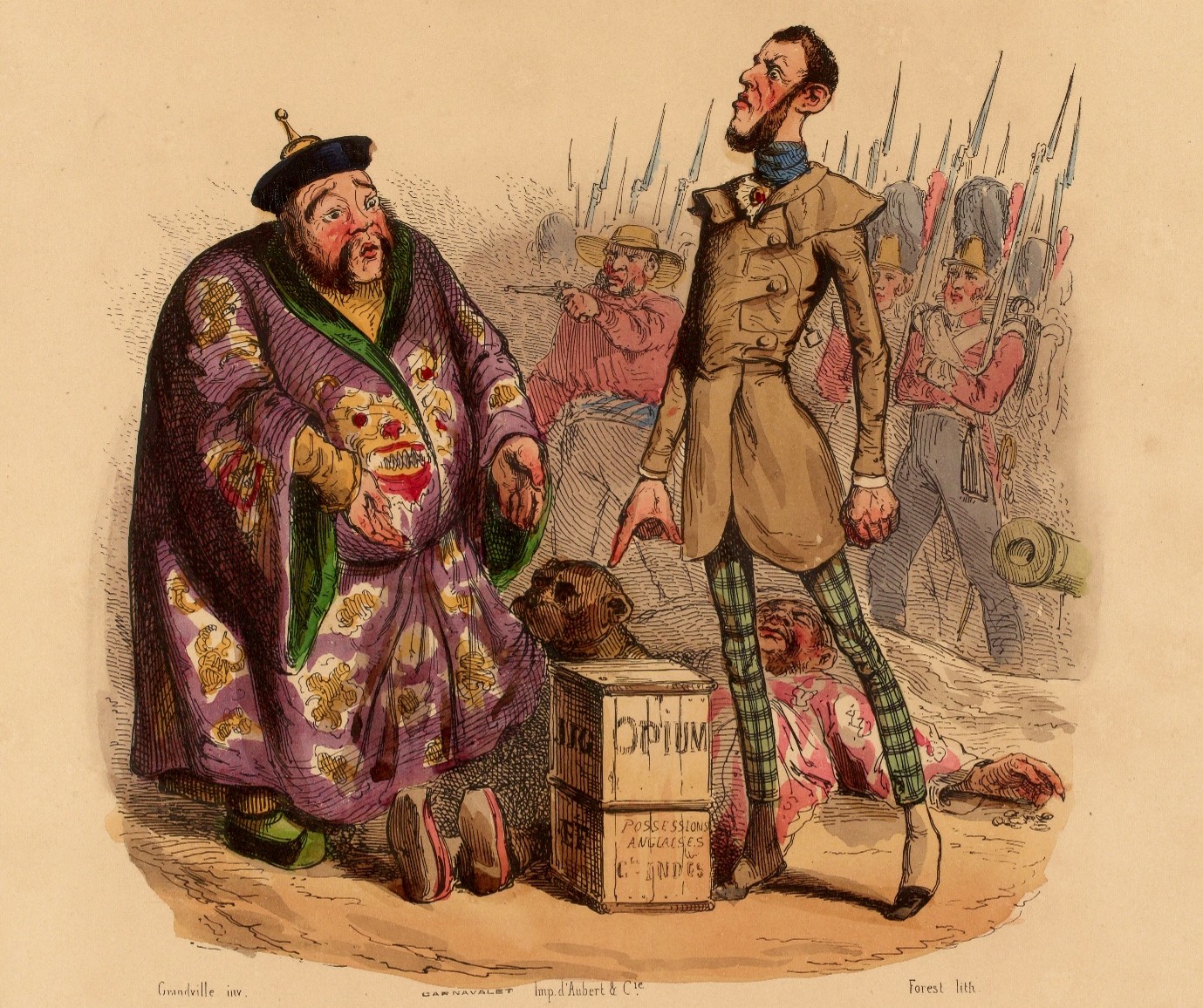
J. J. Grandville, Commerce Anglais (1840). Wikimedia Commons.
.jpg)
Opium yielded up to a fifth of the total revenue of British India in the nineteenth century. Josephine McDonagh and Briony Wickes write that Peacock’s ‘job at the East India Company involved examining the revenue dispatches from Bengal, Madras, and Bombay, including the revenue raised through the production and export of opium,’ and that it was this that ‘spurred his interest in steam navigation, the field of his “most notable achievements” … at the East India Company.’
Peacock’s interest in creating steamships was complex. A champion of the new technology like his friend Shelley, Peacock was charged with speeding up communications between Britain and India. This meant increasing the reach and power of the East India Company. Shelley recognised his friend’s character long before he created steamships, writing: ‘Mr Peacock conceives that Commerce is prosperity; that the glory of the British Flag, is the happiness of the British People.’ While against colonisation, Peacock was, as Peter Kitson notes, a liberal imperialist. This was the period of the ‘Great Game,’ where Britain and Russia vied for domination in central Asia. Steamships played a vital role in the Crimean War of 1853–56, showing that Peacock’s thinking was far-reaching.
For Peacock this was the moment for Britain to put Russia in its place and to increase British trade and influence in the East, and his means for this was the steamship, a technology that enabled the kind of rapacious robbery that Peacock identifies in the first age of iron. In an essay addressing the relationship between Peacock’s literary works and his steamships, I have argued that Peacock was instrumental in contributing to a ‘new age of iron’ that could be succeeded by another ‘golden age’ of poetry.
Further reading
- John Gardner, ‘The Politics of Ollier’s Literary Miscellany,’ in Close Reading the Nineteenth Century, ed. Jane Stabler and Simon Kövesi (Palgrave, 2026)
- John Gardner, ‘Shelley’s Steamship,’ Keats-Shelley Journal 71 (2022): 87–113
- Peter Kitson, ‘Steam and Iron in the 1830s: Liberal Imperialism, Thomas Love Peacock, and the Nemesis,’ in Nineteenth-Century Literature in Transition: The 1830s, ed. John Gardner and David Stewart (Cambridge University Press, 2024), pp. 170–90
- Sylva Norman, ‘Peacock in Leadenhall Street,’ in Shelley and His Circle, vol. 6, ed. Donald H. Reiman (Harvard University Press, 1973), p. 712