
Steamships and the Literary Rendering of Technology
Ute Berns, University of Hamburg
The transition to fossil-powered transport marked a significant threshold in the Industrial Revolution. In Britain, this transition began with steamships and regular steamship traffic from the 1810s onwards, revolutionizing the transport of goods and people. Accelerating speed and reliable schedules increased the efficiency of transport and travel on British waters and bolstered the commercial and military network of the British Empire in the following decades. The steamship, even in its experimental version of 1788, was a hybrid object. It carried a steam engine driving paddles, as well as masts and rigging for sails, and most ships continued to do so well into the second half of the nineteenth century.
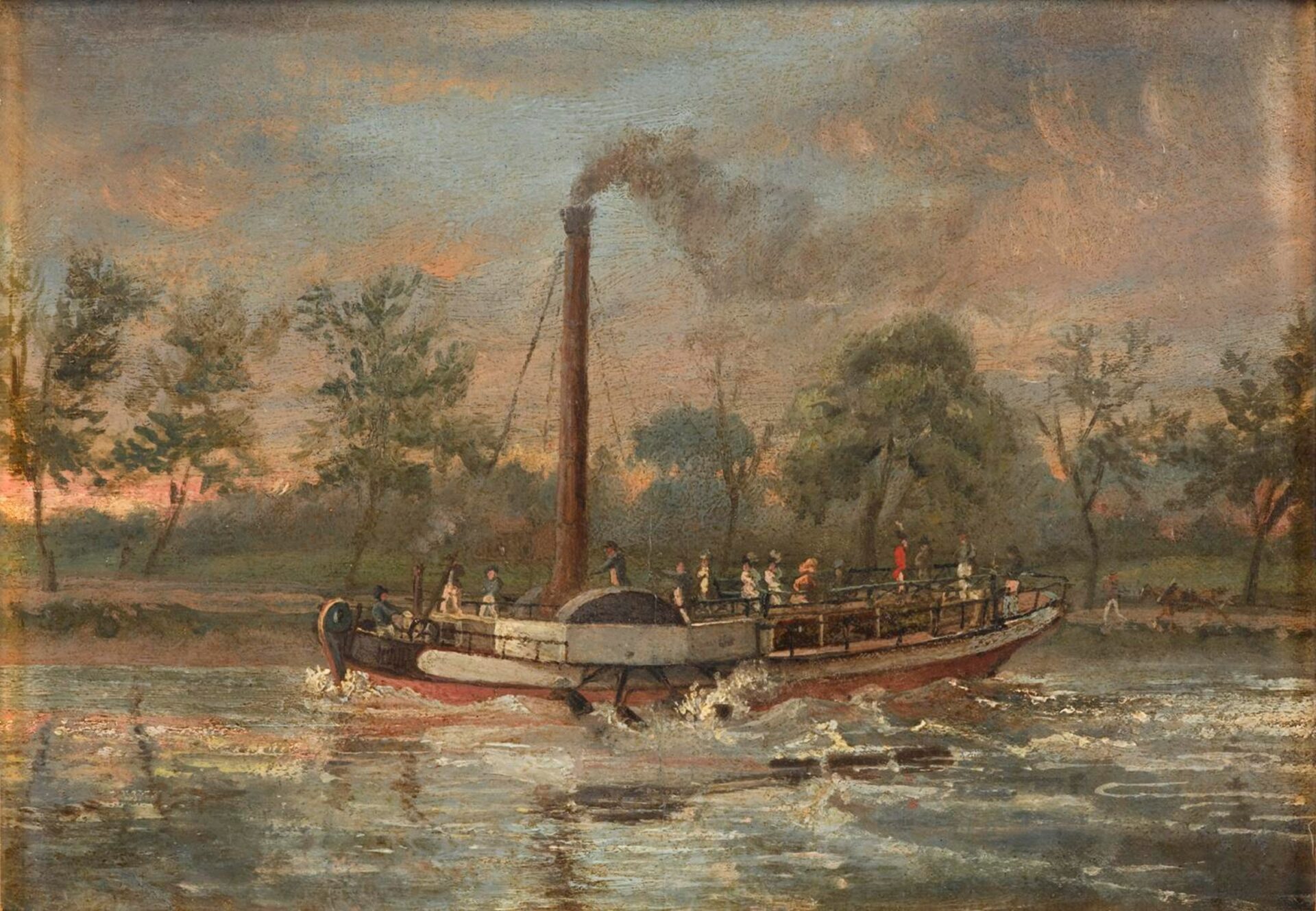
Alexander Nasmyth, The Comet (1816). Science Museum Group.
The steamship also marked a cultural threshold. In contrast to steam engines deployed in mining and manufacturing, the advent of the steamship in coastal and inland ports was a highly visible and public event. All classes, in everyday life, encountered modernity in the shape of a large and novel technical object.
Literary writers from Wordsworth and Coleridge to Byron and Shelley registered this encounter in different genres. Their texts helped to render culturally legible what was perceived to be modern, thus shaping people’s attitude towards fossil transport. Their narratives and poetic language, often in close exchange with scientific advances, interwove the steamship as a new technical object with socio-political and economic perspectives while probing proto-ecological sensibilities. S.T. Coleridge’s ballad ‘Rime of the Ancient Mariner’ (1798) may be read as a multi-voiced and apocalyptic poem in this context; Joanna Baillie’s ode ‘Address to a Steam-Vessel’ (1823) articulates a deeply ambivalent position in the face of an accelerating modernity; while John Galt’s novel The Steamboat (1822) experiments with the narrative possibilities of this new form of mobility.

JMW Turner, Snow Storm—Steam-Boat off a Harbour's Mouth (1842). Wikimedia Commons.
The following examples focus on S.T. Coleridge’s and Thomas Lovell Beddoes’s literary renderings of the technical side of the new fossil mobility. The modern concept of energy (first listed in the OED for the year 1802), considers it as a neutral and convertible potential to perform some kind of physical or mechanical work, long before this description was formalized in the laws of thermodynamics. Early cultural representations of energy, however, tend to resist this neutrality and abstraction. They re-embed and re-encode the technical conversion of coal as fossil fuel in culturally valorized terms, tapping into diverse scientific and cultural realms to make sense of the new source of energy.
In 1825, two poets refer to the steamship in their letters. Both display a strong interest in the novel power driving the vessel. First, Coleridge, in a letter to James Gillman of 9 October 1825, recalls ‘hav[ing] travelled & voyaged by Land, River, and Sea a hundred and twenty miles, with fire and water blending their souls for my propulsion, as if I had been riding on a Centaur.’ The phrase, while marking the technology’s cosmological dimension, highlights the chemical aspect of the energy conversion (i.e. fire burning the coal that heats the water), rather than the kinetic conversion of steam pressure mechanically driving the paddles.
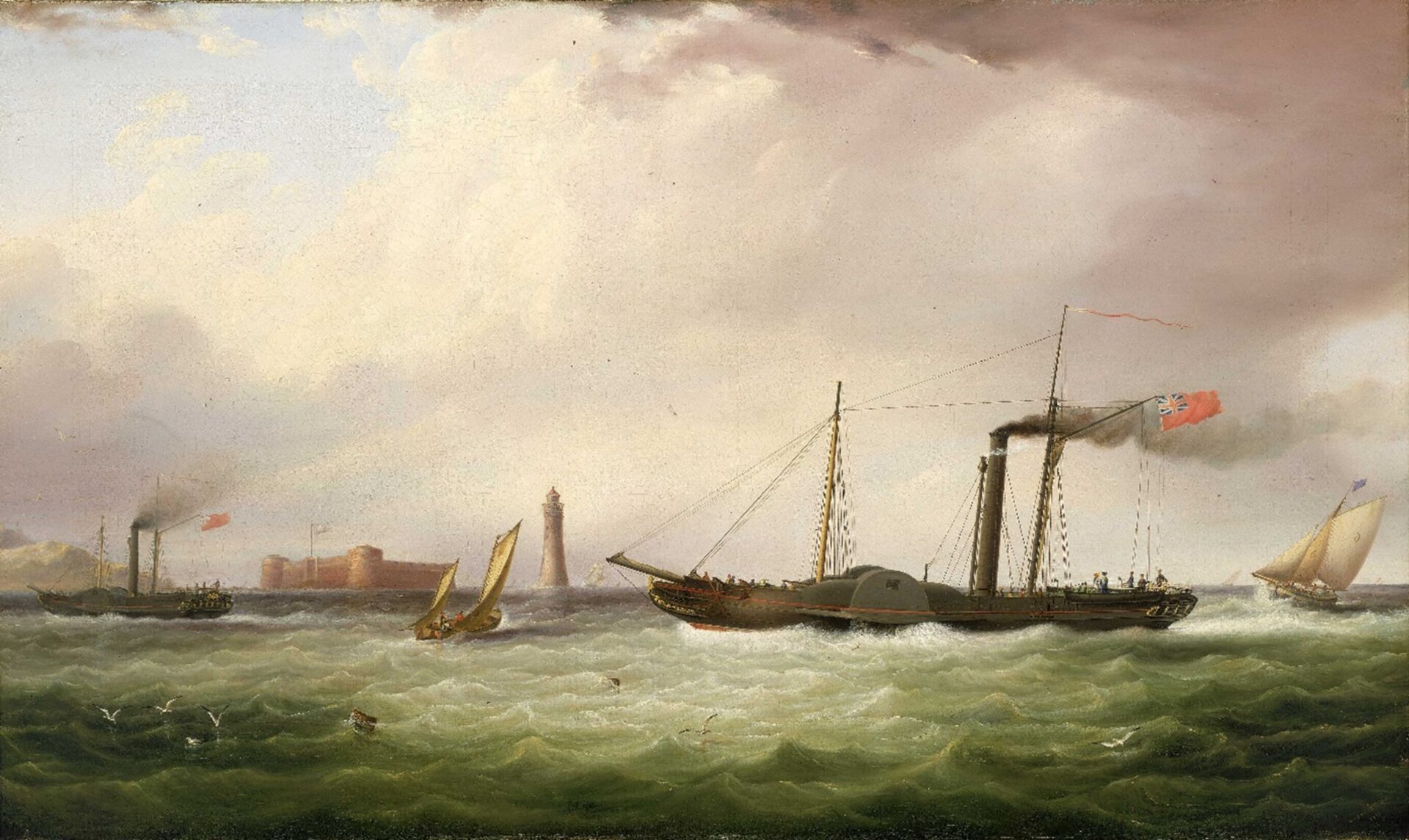
Samuel Walters, The Paddle Steamer ‘Ariel’ (1831). Wikimedia Commons.
The following letter, on 16 October 1825, adds precision to this poetic phrasing. There, Coleridge speaks of someone else planning ‘to mount the long-backed Centaur, STEAM, Off-spring and First-born of the Marriage, which that famous Match-maker and Go-between, the Muse of Science, Epistemè … brought about, of Fire and Water.’ The notion of ‘the marriage of fire and water’ was familiar in alchemy, where it signified the highest union of irreconcilable opposites. The phrase reminds us that Coleridge imbibed his knowledge of steam technology among naturalists and engineers who conceived of steam as generated through principles of chemistry. In Coleridge’s language the (coal) fire remains visible when he thinks about steam power. Yet when he refers to ‘STEAM, as Off-spring and first-born’ of the chemical process, primogeniture makes other offspring like smoke, soot or noise appear negligible, let alone the conditions of labour they create. His foundational image for the generation of fossil-powered energy is one of natural procreation.
This naturalization proves deceptive, however, when we consider Coleridge’s use of myth. His man-horse chimera is not just a classical mythical being. Nor is it the fancy creature characters in modern fantasy novels might ride, even though the attribute ‘long-backed’ suggests precisely that—the longish deck of a steamship carrying many people.
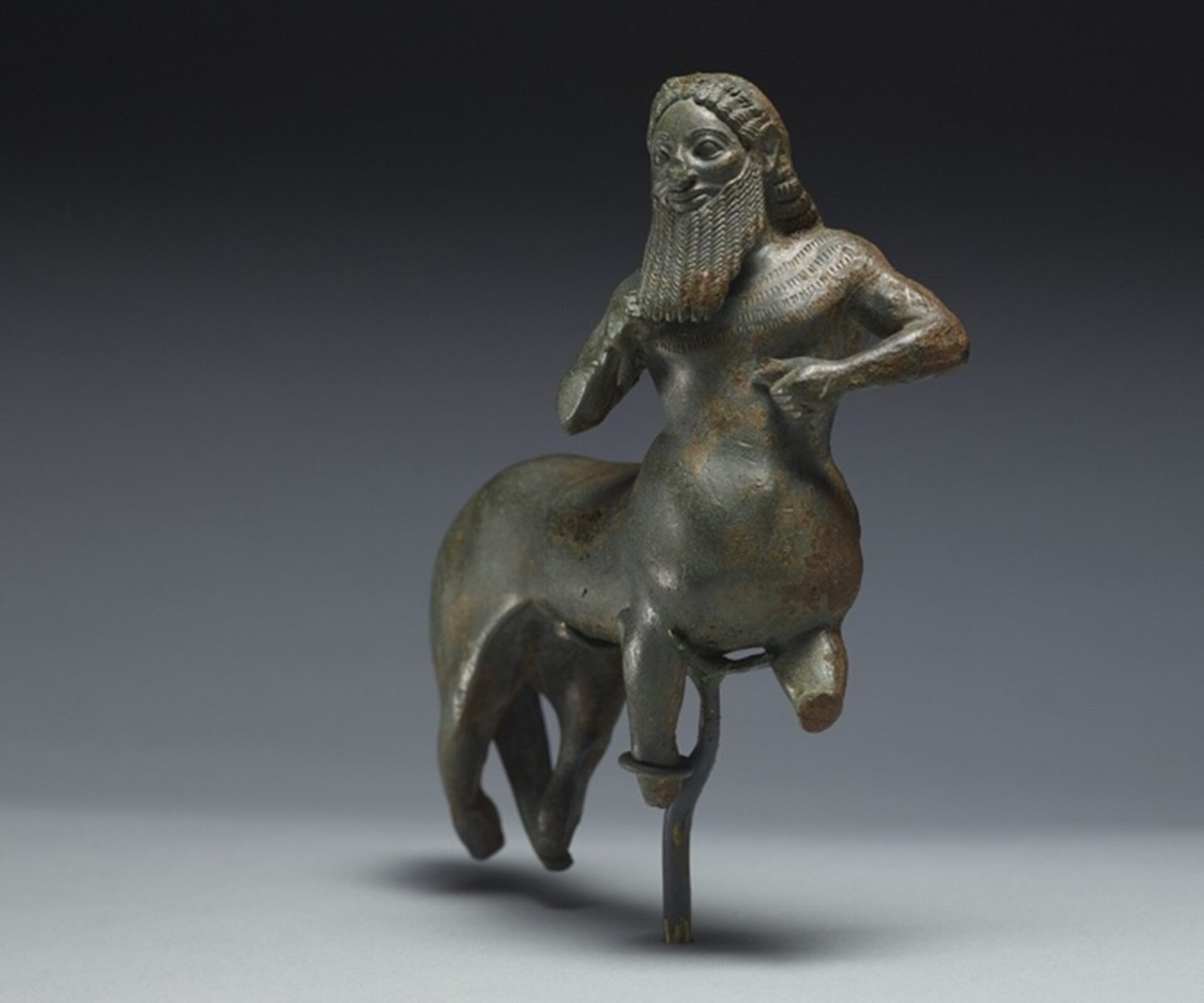
Greek, possibly Athenian Statuette of a centaur (ca. 530 BCE). Princeton University Art Museum, gift of Damon Mezzacappa.
Coleridge’s centaur, however, also indicates something more abstract. Knowledgeable readers would have decoded his beast as a figuration of ‘horsepower,’ a measurement James Watt had introduced to compare the performance of steam engines to that of horses. This mythical chimera of animal power and anthropomorphic countenance gestures to the ingenuity of engineering inspired by the muse of knowledge.
In that same year, 1825, Coleridge’s much younger contemporary, the dramatist, poet and anatomist Thomas Beddoes, characterized his whole generation by gesturing towards the steamship. He referred (p. 622) to those ‘who have plucked the ‘tempest-winged chariots of the deep’ of its winds and imped its pinions with steam.’ Beddoes’ wording merits attention both for its literary and technical resonance. He is reworking a trope which he gleaned from Percy Shelley’s verse drama Prometheus Unbound. It features a long catalogue of the blessings Prometheus gave to man, among them the art of sailing: ‘He [Prometheus] taught to rule, as life directs the limbs, / The tempest-winged chariots of the Ocean.’
In these verses, Shelley compares the art of sailing to ‘life’ directing the limbs of the body. The capacity to direct or rule the limbs, prominent in the Aristotelean notion of the soul, clearly informs Shelley’s notion of ‘life.’ By analogy, manoeuvering sailing ships or ‘tempest-winged chariots of the Ocean,’ redirects the kinetic power of random planetary winds to enable the motion of the ship. Shelley’s comparison between a living body and a sailing ship thus subtly extends the notion of ‘life’ to a complex assemblage—of a human crew, the techne or art of navigation, the artefact of a rigged ship and the elemental forces of wind.
How then does Beddoes update Shelley’s image of sailing? Though ‘plucking’ the chariot of its winds may appear as an act of sabotage, we are told that its ‘pinions’ are, in fact, ‘imped with steam.’ The vocabulary is key: it conveys a sense of technological enhancement and hybridity. First, there is the double meaning of ‘pinion.’ Zoologically, a pinion is a flight or primal feather, i.e. a part of a bird’s wing, yet technically, a pinion is also an impeller or drive wheel.
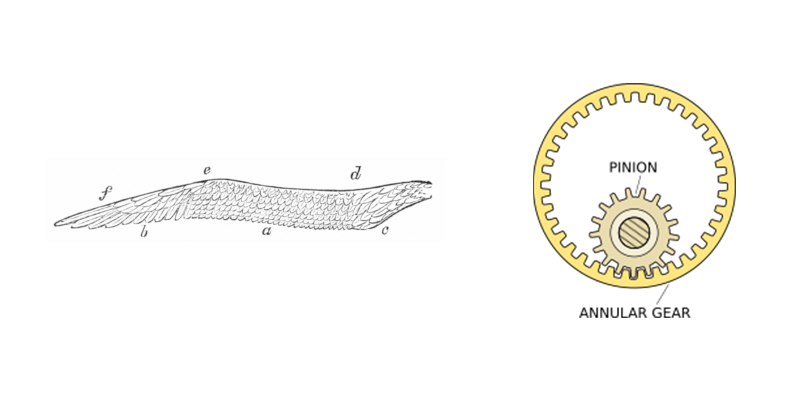


.svg)
Closely observing the novel ‘chariot,’ Beddoes finds a language for its shifting engagement with the earth system. This ship, rather than depending on volatile planetary winds for its sails, also features pinions that relay power to paddles from a wholly different source: steam. The term ‘pinion’ functionally aligns the flight feathers as an object of nature and the drive wheel as a technically built device.
Though Beddoes clearly distinguishes two different technologies and sources of power, the polysemy of ‘pinion’ suggests an almost surreptitious shift from wind to steam. This is further enhanced by the word ‘imping.’ An obsolete meaning refers to the art of joining or gluing new feathers to broken feathers of birds; in falconry feathers could even be lengthened and enhanced. Transferred to agriculture, imping denotes the grafting and thus improving of (fruit) trees. Beddoes’ observation of a transition, with steam engines enhancing the existing technology of sailing rather than substituting it, is a perceptive comment on the steamship’s hybrid technology. Because his words also resonate with meanings concerned with the improvement of living things (i.e. birds or trees) they preserve the expanded notion of ‘life’ which he finds in Shelley’s trope of the sailing ship. Finally, the word ‘imp’ also evokes demons and devils and their fiery dwelling place. The phrase ‘imping with steam’ thus also registers a darker aspect of the new, fossil-powered mobility.
The early energy transition in British transport was not, therefore, only discussed by a small circle of engineers. Literary writers participated in articulating this transition from renewable energy to fossil power in everyday life and bringing it to people’s attention. In the dense figurations discussed here, we see Coleridge and Beddoes seriously grappling with the steamship and its technology as a material feature of the world. As they imagine that technology with reference to scientific practices and objects, as well as literature and myth, they gauge its significance, not least, by tracing its entanglement with the forces of the earth system.
Further reading
- Andrew Barbour, ‘The Rise of Thermodynamics: Mechanical Engineering and Byron’s Poetic Machinery,’ ELH 88, no. 1 (2021), pp. 107–31
- Ute Berns, ‘Anthropocene Speculations: Steam Technology in Coleridge’s “Rime of the Ancient Mariner” (1798),’ European Romantic Review 34, no. 1 (2023), pp. 19–46
- John Gardner, ‘Shelley’s Steam Ship,’ Keats-Shelley Journal 71 (2022), pp. 87–113