
Experiments in Information Management: Reading Landscape through Sir John Sinclair’s Specimens of Statistical Reports
Eric Gidal, University of Iowa

Daniel Lizars, Sir John Sinclair. National Galleries of Scotland.
Scotland’s emergence as an industrial economy was enabled in part through innovations in information management. Maps and surveys, statistical accounts and gazetteers, postal directories and railway timetables organized information in new forms and across evolving networks to facilitate the management of resources in an expanding economy. The masterpiece in this tradition, the Statistical Account of Scotland, was assembled in the 1790s by Sir John Sinclair, a Member of Parliament from Caithness and an advocate for agricultural improvement.
Committed to gathering localized descriptions to inform national policy, Sinclair sought to document ‘the Natural History and Political State of Scotland.’ To achieve this, he sent a detailed questionnaire of 166 items to every parish minister in Scotland and compiled their responses into 21 volumes over the decade. Half a century later, the New Statistical Account of Scotland was initiated by the Society for the Benefit of the Sons and Daughters of the Clergy in the 1830s and republished as a set in fifteen volumes in 1845. These publications offer a rich portrait of Scotland as both a cultural region and an economic zone and stand side-by-side with contemporary journalistic, literary, and philosophical writings as products of a changing society. Aligning these publications with geographical patterns of technological diffusion, social transformation, energy consumption, and ecological degradation establishes their significance not only as social and infrastructural artefacts, but as environmental records of accelerating change.
In recent years, I have been collaborating with Michael Gavin, a professor of English literature and computational humanities at the University of South Carolina. We have published a sequence of experimental articles that showcase methodological combinations of geographical information science (GIS) with corpus linguistics and network modelling in environmental literary and media studies. At the core of these articles is an interest in what we have been calling ‘historical geospatial semantics’ or simply ‘geosemantics.’ This methodology combines computational semantics and GIS to describe how the language of any given print corpus corresponds with spatial features of a defined geographical region so that meaningful correlations can be drawn between historical geography and semantic patterns in the textual records of place. We have attended to the language by which statistical accounts, topographical dictionaries, and gazetteers have recorded the distribution of coal pits, fisheries, livestock, factories, and other features of Scottish industrial economy alongside social, cultural, and antiquarian information and how such distributions align with both geographical location and infrastructural connectivity.
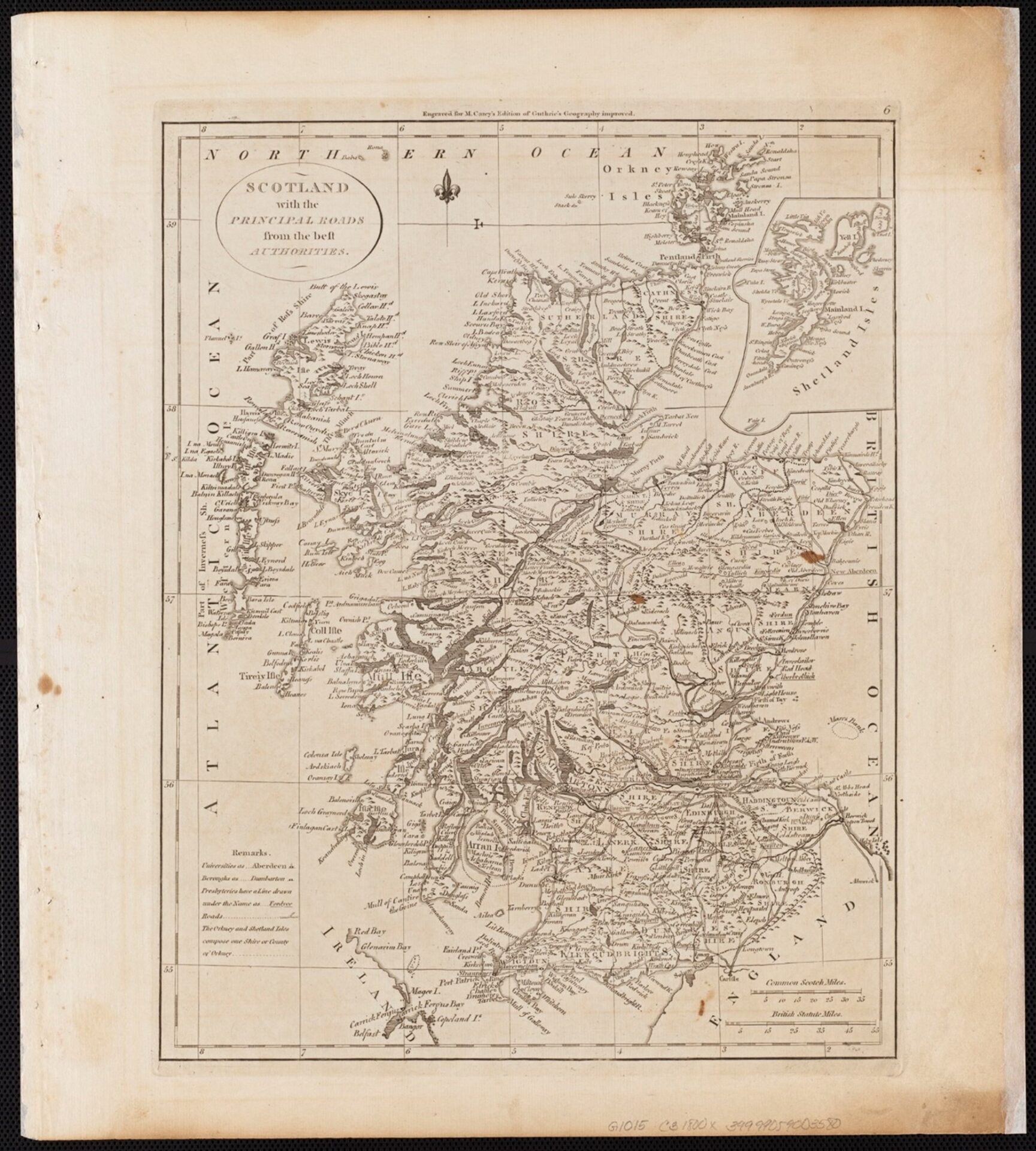
Mathew Carey, Scotland with the principal roads from the best authorities (1800). Wikimedia Commons.
Accounting for this last factor (infrastructure) has involved a third computational method, network modelling, which has also relied on publications whose primary function was the efficient operation of an economic zone: in this case, postal directories. For an article of 2019 on what we call ‘infrastructural semantics,’ we constructed a network model from contemporary postal directories that describes not simply the routes by which various cities and towns in Scotland were connected from the 1790s through the 1840s, but the frequency with which these routes were used and hence the carrying capacity of any particular route in the overall network.
The aim of this exercise was to describe correlations between semantic distribution in both the Old and New Statistical Accounts of Scotland and transformations in network connectivity during the half century that divides them; in other words, how the semantic similarity or dissimilarity of localized descriptions can be correlated with the locations’ changing positions within an industrializing infrastructure of transport and communication. The results were preliminary but suggestive. One feature of this type of work is that the datasets can always be expanded, the correlations always refined, and the causal explanations always reconsidered.
At the same time that we have been experimenting with such approaches, we have become increasingly interested in the eighteenth and nineteenth-century writers, printers, and publishers who curated all of this data for us and whose own experiments in information management can be understood as essential components of the same economic restructurings and consequent environmental transformations that we are trying to describe.
What our digital experiments have thus far demonstrated is not that we can ‘discover’ aspects of environmental history by playing with semantic data—very little if any of the historical geography we have charted in these articles is going to seem earth-shaking to the economic historians upon whose work we have relied to make sense of the semantic patterns—but rather that these materials were themselves innovative uses of print technology to align language with place and may be understood as precursors to the computational approaches to economic and environmental history that we and others are now pursuing. Statistical accounts and postal directories, to take our early examples, are medial elements of the information infrastructure of an industrializing economy and organize data in a fashion that supports multi-scalar reading within and across texts. Understood in this fashion, they are both functional contributors and creative responses to environmental transformations.
Consider a sampling of his work-in-progress that Sinclair published in 1793 in an ultimately unsuccessful bid to promote a parallel Statistical Account of England. Entitled Specimens of Statistical Reports, it announces itself on the title page as an exhibition of the ‘progress of political society, from the pastoral state, to that of luxury and refinement,’ and a methodological primer on ‘the proper mode of drawing up accounts, either of parochial, or of other districts, and of collecting facts, in order to ascertain, the principles of statistical philosophy, and the sources of national improvement.’

Sinclair’s data model is both empirically and conceptually geared towards economic development and organizes the parish reports he had collected within a typical eighteenth-century model of conjectural history. He suggests that statistical philosophy, which he identifies as ‘the science … which tends most to promote, both the good of the individual, and the prosperity of a state,’ may provide a productive asset to political economy. He thus organizes the seven sample reports not geographically by region, but categorically, as specimens of an economic system.
He arranges them, as he puts it, as a pastoral district (United Parishes of Kingussie and Inch, County of Inverness), a small inland agricultural district (Parish of Morham, County of East Lothian), a greater coastal agricultural district (Parish of Graitney, or Gretna, County of Dumfries), a district with developing manufactures (Parish of Moulin, County of Perth), a district with established manufactures (Parish of Nielston, County of Renfrew), a district with manufactures and foreign commerce (Town and Parish of Montrose, County of Angus), and a large city (Edinburgh in the parishes of Canongate, St. Cathberts, South and North Leith).
This arrangement provides a functional reorganization of Scotland that is only secondarily related to geography and primarily related to an evolving system of economic production. Conjectural history offers Sinclair a means of organizing a wide range of information in relation to what he calls ‘the internal structure of society,’ and allows him to identify what in the 1790s was still a basic concentric network structure as a model of stadial progress even as this schema implies the dynamic and evolving function of any given node and, by extension, the overall structure of the network.
Why is this interesting? First, it underscores a shared ambition of conjectural history and statistical philosophy, namely to organize geographical data in a fashion that enables systematic understandings of discrete phenomena. Just as conjectural history, in Devin Griffith’s words (p. 67), aims ‘to assign societies to different places within an overarching taxonomy, locating them within a universal pattern driven by models of economic, philosophical, and political evolution,’ Sinclair’s statistical analyses aim to discern spatialized patterns across localized descriptions.
Second, as a reflexive part of an expanding information infrastructure, Sinclair’s project offers a detailed record of intersecting economic and information systems at a moment of accelerating environmental transformation. Synoptic studies by Richard Grove, Deborah Coen, and Paul Edwards of such seemingly disparate information relay systems as eighteenth-century colonial outposts, the nineteenth-century administrative state of the Habsburg Monarchy, and twentieth (and twenty-first) century weather stations have revealed profound connections between evolving organizational protocols of information collection, transmission, and reception and a consciousness of intersecting earth and world systems, contributing to Grove’s call for ‘an historical anthropology of global environmental awareness.’
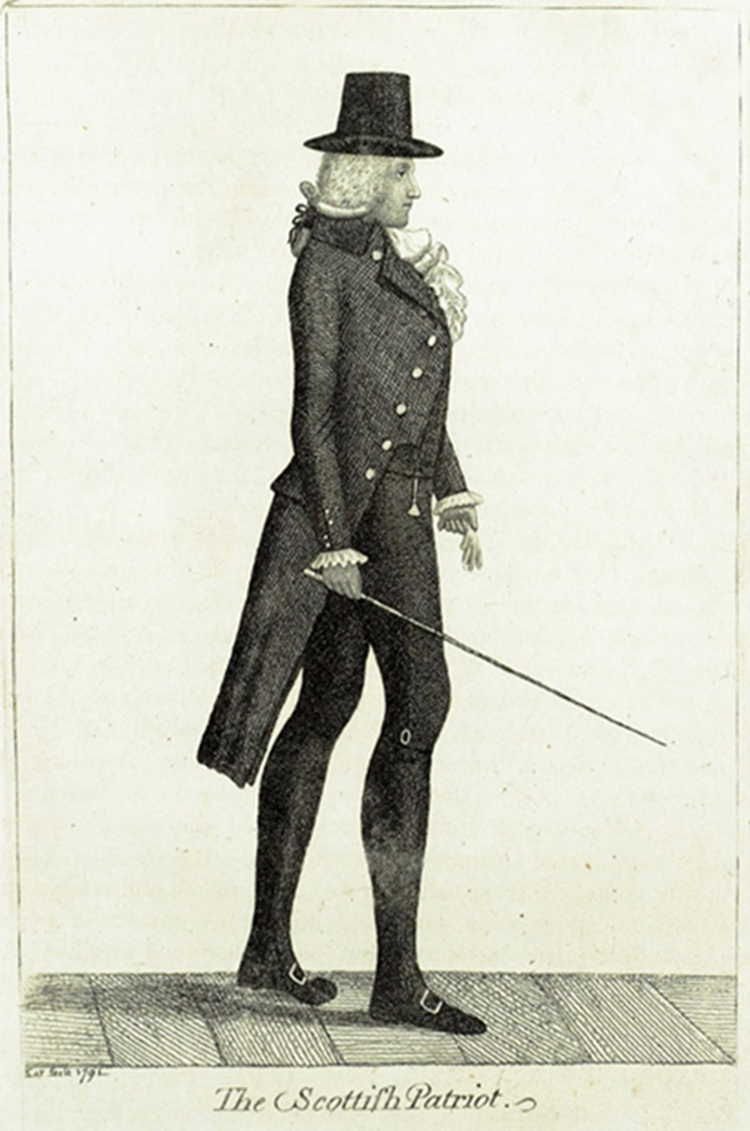
‘The Scottish Patriot’: Sir John Sinclair in the 1790s. National Library of Scotland.
A hint of such awareness is already perceptible in a sequence of letters from his publisher William Creech that Sinclair inserts at the end of the parish report on Edinburgh. ‘It is frequently difficult,’ Creech writes, ‘to assign a reason for the revolutions which take place in the circumstances and manners of a country, or to trace the causes that have occasioned a change; but, it is evident that the first step towards investigating the cause, is to state the facts.’ And so he provides extensive comparative data for the years 1763, 1783, and, when available, 1793 for Edinburgh’s economic, geographic, and infrastructural expansions alongside the proliferation of literary productions, educational institutions, professional organizations, periodical and newspaper publications, philanthropic societies, polite entertainments, hospitals, hotels, haberdasheries and perfumeries, foundries and manufactories, mills and distilleries, along with the development of the quays at Leith and the city’s increased connections to British and global ports. He also charts the corresponding decline in manners, offering a portrait of a population given over to afternoon dining, wine consumption, card parties, cock fights, robbery, prostitution, and public intoxication.
Having documented, in his words, ‘the gradual progress of commerce and luxury, and the corresponding effect upon manners,’ Creech turns in his third letter to geology and the deep history of Scotland, observing the basaltic remains of volcanic activity local to Edinburgh which expand his view to the ‘great and astonishing changes … that this globe which we inhabit has undergone’ and to (relatively) local effects of the 1782 earthquake in Calabria and the 1783 eruption of Laki in Iceland as well as a long list of other earthquakes, interrupted tidal currents, and unusual weather patterns throughout Scotland and the north of England recorded over the intervening decade. ‘I do not mean at present to draw any hypothesis or theory from what I have stated above,’ he concludes, ‘but merely to bring facts into one general view, and to induce others to make observations of the same kind.’
Creech’s letters provide an exemplary instance of the intersection of literary publishing, data collection, infrastructural expansion, societal change, and environmental phenomena captured in a publication promoting the collection of statistical information. His ambition, ‘to bring facts into one general view,’ helps us to position Sinclair’s project as an early foray into geoinformatics, where his amalgamation of economic, social, and material data demanded new strategies for curating such information for a reading public. And his documentation of change over time suggests an important correlation between information and environmental consciousness that would emerge in the early decades of the Industrial Revolution.
Further reading
- Devin Griffiths, The Age of Analogy: Science and Literature Between the Darwins (Johns Hopkins University Press, 2016).
- Richard Grove, Green Imperialism: Colonial Expansion, Tropical Island Edens, and the Origins of Environmentalism, 1600-1860 (Cambridge University Press, 1995).
- Deborah R. Coen, Climate in Motion: Science, Empire, and the Problem of Scale (University of Chicago Press, 2018)
- Paul N. Edwards, A Vast Machine: Computer Models, Climate Data, and the Politics of Global Warming (MIT Press, 2010).