
Milton’s Satan and Industrialization
E.J. Clery, Uppsala University
‘Pandæmonium’ was chosen by Humphry Jennings as the title of his anthology chronicling the ‘imaginative history of the Industrial Revolution.’ Jennings, an artist and documentary filmmaker, collected historical eyewitness accounts of industrialization from the period 1660 to 1886. The collection was published posthumously in 1985, with a passage from Book 1 of John Milton’s epic poem Paradise Lost (lines 670–737) at its head. Milton’s plan was to recount and explain how evil came into the perfect world created by God. At this point in the opening Book, the Rebel Angels, led by Satan, have been cast down from heaven to hell, and have managed to free themselves from their abject position, chained on a burning lake. Satan and his hordes reach land and vow vengeance. Precious metal is detected in a nearby volcano, and a ‘numerous brigade’ of devils under the direction of Mammon excavate gold deposits, smelt the ore, and build from the resulting purified metal a palace of gold to serve as the new capital of hell: Pandaemonium.
It may be that a particular interest of the passage for Jennings lay in Milton’s explanatory asides, designed to make the visionary scene vivid and realistic for his readers. The devils go to work like ‘pioneers,’ a crew of workmen under the management of military engineers, who precede the royal camp on a war expedition, ‘with spade and pickaxe armed…to trench a field, / Or cast a rampart’ (1.676–78). Mining was inseparable from warfare, and Milton returns to this point in Book 6 of Paradise Lost when, in a flashback to the war in heaven preceding his fall, Satan delivers an oration in praise of firearms and their materials excavated from underground (6.470–95).
In Book 1 (lines 685–93) the poet explains that Mammon will provide a model for metal extraction as a mass industry in the human world yet to come:
By him first
Men also, and by his suggestion taught,
Ransacked the centre, and with impious hands
Rifled the bowels of their mother earth
For treasures better hid. Soon had his crew
Opened into the hill a spacious wound
And digged out ribs of gold. Let none admire
That riches grow in hell; that soil may best
Deserve the precious bane.
With these lines, Milton represents mining as sinful. The name ‘Pandaemonium,’ the vast and splendid palace of gold created from Mammon’s excavations, translates literally as ‘every evil spirit.’ Jennings may or may not have known that Milton took an active part in debate on whether the industry could be theologically justified, when it drastically alters and degrades a landscape created by God and despoils its inner riches. Apologists for commerce and industry argued that when in Genesis man is given a licence for dominion over all creation above ground, this extends to the treasure and resources below the surface. Milton, by associating mineral extraction with Satan, opposed the argument and his position has been described as ‘conservationist.’ He does not stop at rhetorically ‘demonizing’ underground extraction. He loads on figurative imagery to provoke horror and disgust, describing excavation and extraction as a violation of ‘mother earth’ with connotations of matricide, necrophilia, and incest. Mining in Paradise Lost is connected with taboo-breaking. It involves a moral pollution with the potential to form part of a critique of environmental pollution.
Fast forward a hundred or so years to the latter half of the eighteenth century, and the Industrial Revolution in Britain is underway. The extraction of metal for machinery and fuel for energy was a vital component of this transformation. The controversy over the incompatibility of mining with Christian ethics was apparently obsolete and, with it, Milton’s linking of Satan to the idea of environmentally destructive greed.
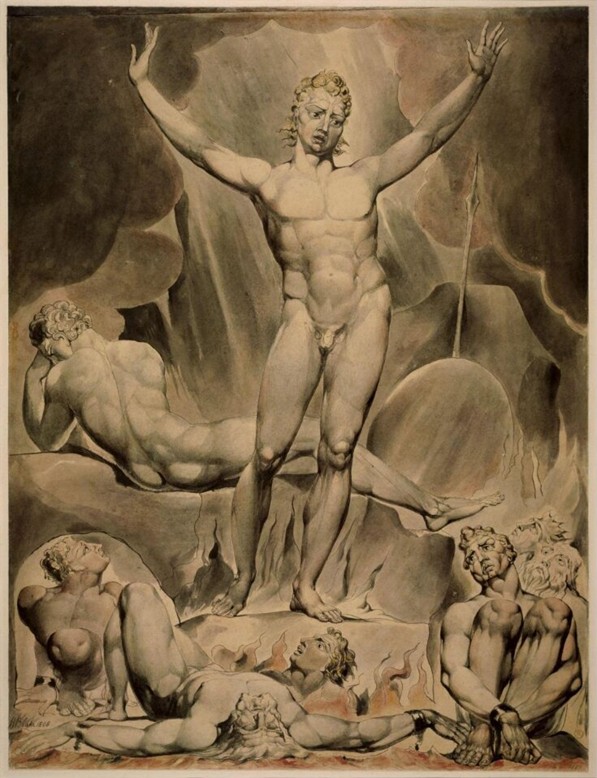
William Blake, Satan arousing the Rebel Angels (1808). © Victoria and Albert Museum, London.
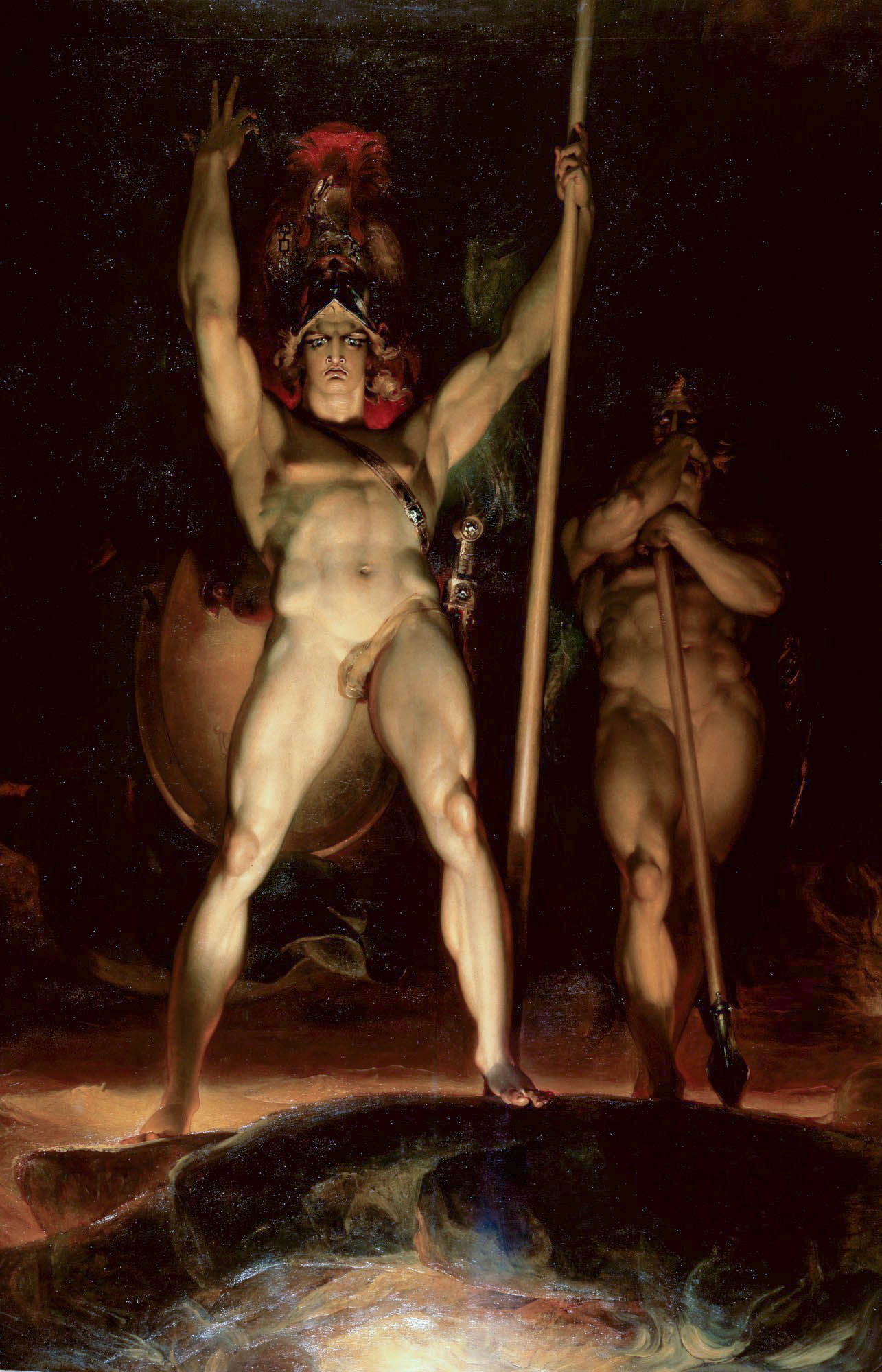
Thomas Lawrence, Satan Summoning His Legions (1796-97). Royal Academy.
The contemporary Romantic movement in combination with the French Revolution brought a resurgence of enthusiasm for Paradise Lost, the narrative of an attempted coup and its consequences, and a revised valuation of Satan as a vector of change, even as a heroic challenger to the cosmic ancien regime. In visual culture, he came to epitomize the aesthetic category of the sublime, and in this guise became a favourite subject for artists. Transgression, chaos, darkness, cacophony, the production of artificial terror as cultural entertainment were all à la mode.
The Satan of Book 1, resurgent and defiant, the Satan of Pandaemonium, was a subject attempted by all the leading artists of the day. But the industrial activities of the demons of hell led by Mammon went unrecorded. The only echo that might be traced is the repeated emphasis on the vertical stance of the King of Hell, reminiscent of a drill (the first drilling technology was applied to mining in Germany in 1683).
The one exception in the visual arts is John Martin’s giant canvas representing a triumphant Satan before the newly completed palace of Pandemonium (engraved 1821, painted 1841), flames from the broken crust of hell’s floor licking his feet.

John Martin, Pandemonium (1841). Louvre.
From here it is not far to travel to Blake’s compressed, elliptical reference to Satan’s historic links with industrialization and pollution in the preface to Milton (1804), the section adapted as lyrics to the hymn ‘Jerusalem.’
And did the Countenance Divine,
Shine forth upon our clouded hills?
And was Jerusalem builded here,
Among these dark Satanic Mills?
We do not know why Humphry Jennings chose to start his collection with the passage in which the fallen angels feature as miners from Book 1 of Paradise Lost. He did not live to provide headnotes for the chosen extracts, or compose a full Introduction. The ideas introduced by Milton seem almost to vanish in the Romantic era.
There is a street called ‘Paradise’ that connected the furnaces and foundries of Coalbrookdale with the wharfs at Ironbridge. The origins of the name are obscure, but it must at times have struck every inhabitant and visitor during the industrial heyday of the district as either an outrageous misrepresentation, or an ironic joke. As Peter Wakelin shows in his account of responses by visitors to the gorge, the ironworks at Coalbrookdale were in fact most often compared with hell. A flurry of analogies to the infernal regions seems to have coincided with the phenomenal expansion in the production of iron from the 1750s, at the time when innovative use of coke for smelting replaced charcoal and coal as an energy source. Philip James de Loutherberg’s painting Coalbrookdale by Night (1801) is frequently described as the most notable visual expression of a growing fascination with the ‘industrial sublime.’
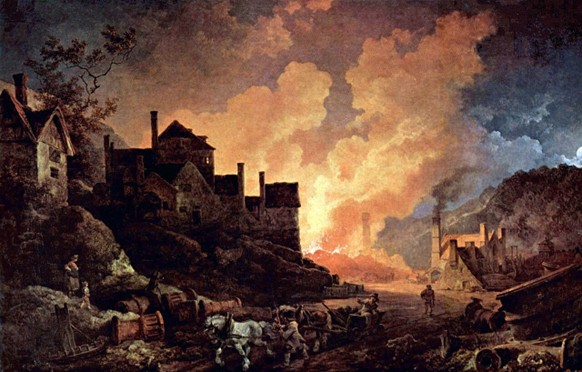
Philip James de Loutherbourg, Coalbrookdale by Night (1801). Science Museum.
It has been argued that the application of a sublime aesthetic to industrial landscapes indicates unease with the environmental consequences, and certainly there are threatening signs for the diminished human figures in Loutherbourg’s image. However, the viewer is passively positioned by the sublime as a connoisseur of the pleasures of terror, not as an active agent who could question, or even protest.
A historical inquiry carried out by accountancy researchers led to the conclusion that another aesthetic lens by which tourists viewed landscape in the eighteenth-century, the ‘picturesque,’ performed the function of ‘impression management in environmental accounting.’ Research in this area ‘explores ways in which companies and other organisations emphasise “good news” and understate “bad news.”’ That is to say that, for instance, the travel writings of William Gilpin occlude ‘the negative industrial externalities in the early years of the Industrial Revolution.’ It could be said that the aesthetic of the sublime was an even more effective tool for ‘impressions management.’ Rather than filtering out the bad news—chemical fumes, toxic debris, dangers to health and ecosystems—the rhetoric of the sublime, textual or visual, allowed pollution to be hidden in plain sight, converted into imagery of triumph and exhilaration, Promethean or Satanic. The ‘bad news’ is folded into the ‘good news’ by means of an aesthetic alibi.
Although the coke innovatively used at Ironbridge Gorge burned cleaner than raw coal, industry visibly polluted the air, land and water, generating volatile gases, particulate matter and byproducts that contaminated the surroundings and the lungs of the inhabitants, and generated its own disruptive sensorium of cacophonous sound and artificial light and heat. Evidence that the category of the sublime was a means for effacing or subsuming pollution can best be seen in the writings of observers in cases where the aesthetic alibi fails to function.
Charles Dibdin arrived at Coalbrookdale intending to stay the night to witness the famous spectacle of fiery furnaces, but retreated early, repelled by the insufferable heat and ‘the intolerable stench of the Sulphur.’ It is striking that among the dissenting voices, female observers are prominent. Writings on industrialization by women are given little space in Jenning’s Pandæmonium. In the case of Coalbrookdale, women record the way violation of natural beauty blocks pleasure. In 1811 the poet and political campaigner Hannah More reported after a visit to Shrophire,
Every lovely piece of scenery is so defiled with stinking, dingy, disfiguring manufactures that the charms of nature are more than half defaced. There is especially at Coalbrookdale a wonderful mixture of Elysium and Factories, but the infernal predominates.
More’s complaint at the defilement of Coalbrookdale may have been inspired by another poet, Anna Seward, who attempted to subvert the association of industry with Satanic grandeur. Her argument is profoundly engaged with the Satan in Book 1 of Paradise Lost.
Seward articulated the flash of insight she gained at Coalbrookdale in 1787 insistently in various forms: in a letter written to one of the most influential cultural entrepreneurs of the day, William Hayley; in ‘Sonnet LXIII: To Colebrook Dale,’ and in a longer poem, ‘Colebrook Dale,’ that exists in two versions. Contrary to accounts deploying the sublime as alibi for environmental destruction, Seward describes the toxic effect of industry on nature as a black, funereal veil or pall smothering the landscape. The sonnet version describes how the ‘columns large / Of black sulphurous smoke’
spread their silk
Like funeral crape upon the sylvan robe
Of thy romantic rocks, pollute thy gales,
And stain thy glassy floods;—while o’er the globe
To spread thy stores metallic, this loud yell
Drowns the wild woodland song, and breaks the poet’s spell.
Seward herself seems to have reconnected with Milton’s scenes of hell only gradually. Initially, in the letter, her Miltonic point of reference is the pastoral poem Comus, a sylvan idyll situated on a stretch of the same River Severn that flows through ‘Colebrooke Dale.’ She first adds the phrase ‘pollute’ in the sonnet version, extending the charge of disgust from the moral pollution of Satan (in relation to ‘mother earth’ in Book 1, and to Sin and Death in Book 2) to environmental pollution by industry. The concept of physical contamination, including ‘excessive levels of light, noise, organic waste’ is a derivation from that of moral or spiritual contamination. It may be that Seward’s is the earliest use of ‘pollute’ in relation to nature. The OED’s first example is from one of S.T. Coleridge’s letters dated 1797.
In the first lines of the later, longer poem ‘Colebrooke Dale’ she preserves the idea that industrial emissions ‘pollute thy gales,’ and adds to the second line the idea of sexual assault: ‘Scene of superfluous grace and wasted bloom, / O, violated Colebrook!’ Seward’s aims are not entirely clear: her concern seems driven by the loss of a landscape that ought by rights to be the preserve of poetry, not science or industry. However, whether intentionally or not, through the hinge-point of Milton’s Satan, she subverts the contemporary tendency to glamourize industry in the language of the sublime, and pioneers a way of seeing environmental damage.
Further Reading
- Penny Fielding, ‘“Usurpt by Cyclops”: Rivers, Industry and Environment in Eighteenth-Century Poetry,’ in Representing Place in British Literature and Culture, 1660–1830: From Local to Global, eds Gottlieb and Shields (Ashgate, 2013), 139–154
- Hélène Ibata, ‘From “Delightful Horror” to Ecological Warning: The Uses of the Sublime in Romantic and Post-Industrial Landscapes,’ in Romantic Ecologies: Selected Papers from the Augsburg Conference of the German Society for English Romanticism, eds Kerler and Middeke (Wissenschaftlicher Verlag Trier, 2023), 229–250
- Sharon Setzer, ‘“Pond’rous Engines” in “Outraged Groves”: The Environmental Argument of Anna Seward’s “Colebrook Dale,”’ European Romantic Review 18, no. 1 (2007), 69–82
- Warren Tormey, ‘Milton’s Satan and Early English Industry and Commerce: The Rhetoric of Self-Justification,’ Interdisciplinary Literary Studies 13, no. 1–2 (2011), 127–159