
Was the Industrial Revolution Really Bad?
Pete Maw, University of Leeds
Both popular and academic depictions of the British Industrial Revolution tend to emphasise the bad at the expense of the good: it is often treated as self-evident that a period of rapid capitalist industrialisation must have been a bad thing for workers.
It’s not hard to see why.
The Industrial Revolution was a time when lots of bad things happened: children lost limbs and lives to unsafe technologies, or worked alone below ground in the pitch dark amidst toxic and flammable gases; men and women lost jobs to machines; one third of children did reach their first birthday in dirty towns and cities.
But, for many economic historians, it is far from self-evident that the Industrial Revolution was bad for ‘the people.’ Indeed, some economic historians portray the Industrial Revolution as the solution to, rather than the cause of, workers’ poverty and misery. If, in the early nineteenth century, people were poor or lived short, unfulfilling lives it was because of an absence of industrialisation in the previous thousands of years of human history rather than because of its sudden appearance from the late eighteenth century.
Far from being bad, indeed, the Industrial Revolution is hereby cast as the best thing that has ever happened to human beings. This is highlighted by the fact that almost every person living on the planet right now is better off than almost every person who ever lived on the planet prior to two centuries ago.
Of course, History, including economic history, is all about approach and perspective. The approach taken in this short blog is to look at two ways of assessing the impact of the Industrial Revolution on workers: how it affected their wealth and how it affected their health. I emphasise that historians’ choice of chronology or their use of a global, national, or regional perspective can radically alter their interpretation of the Industrial Revolution itself.
The Industrial Revolution and workers’ wealth
Did the Industrial Revolution make workers richer?
Economic historians’ assessments of this question tend to draw on two metrics:
- workers’ real wages (the ‘real’ part involves adjusting money wages to take account of the prices of food, rent, clothes and other items of expenditure)
- the average income of each person (calculated by dividing the total size of the economy, the Gross Domestic Product (GDP), by the number of people living in the nation)
These measures provide a first look at how the Industrial Revolution affected workers.
The first graph (based on Charles Feinstein’s ‘Pessimism Perpetuated’) shows historians’ estimates of British workers’ real wages during the Industrial Revolution period.
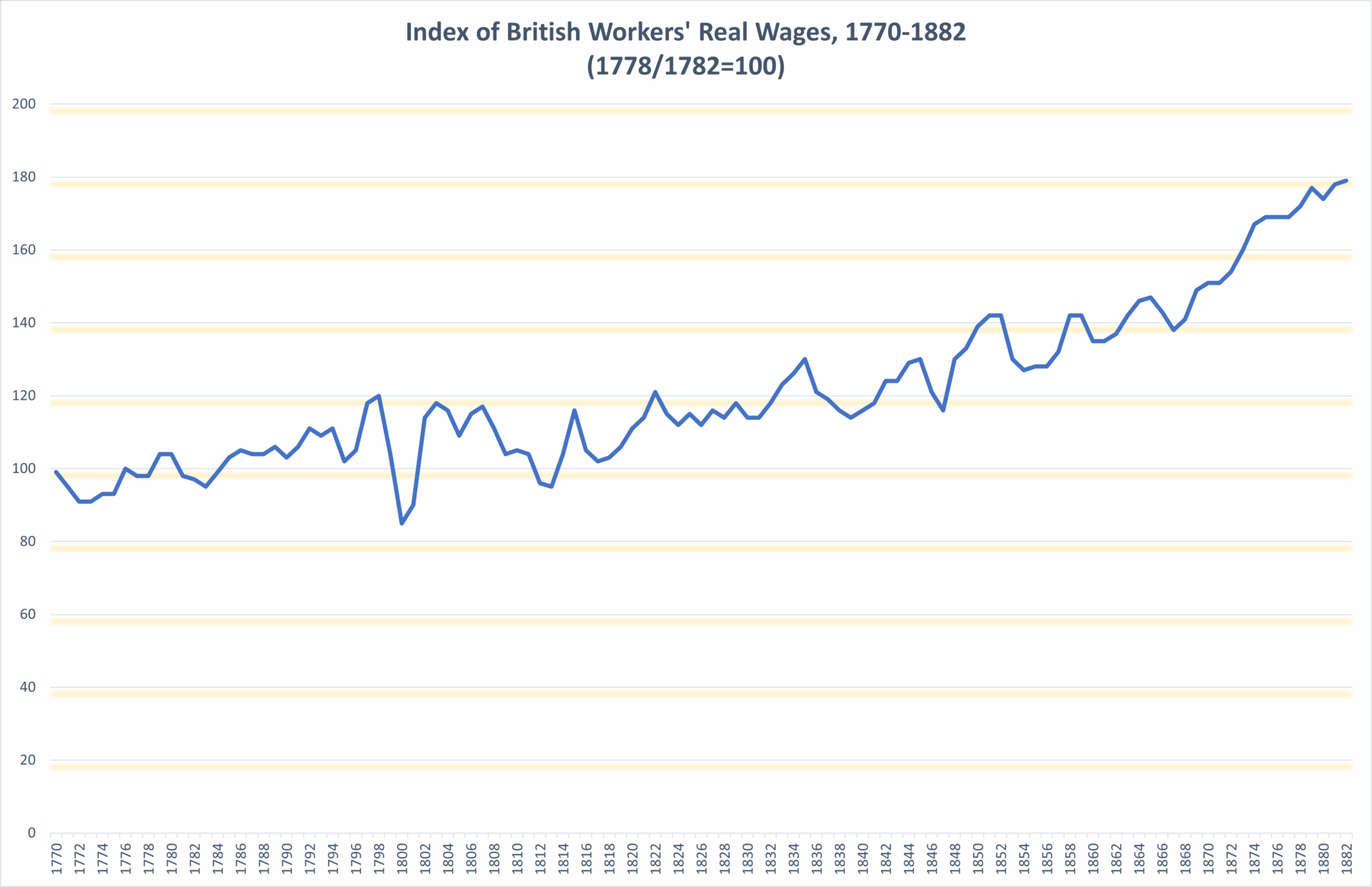 The main ‘takeaway’ from this graph is that workers’ wages were rising but only very slowly, until the 1860s at least.
This is usually interpreted pessimistically, with the suggestion that such small wage increases were unlikely to offset even the direct dis-amenities of industrial work like longer working hours, let alone the more serious health consequences of industrialisation discussed below.
It is important to note, however, that historical real wage estimates are prone to error. It is, for example, more difficult to find wage evidence for women than men, and for adults than children. Moreover, producing one national series of workers’ wages might mask the experience of particular of occupations or regions.
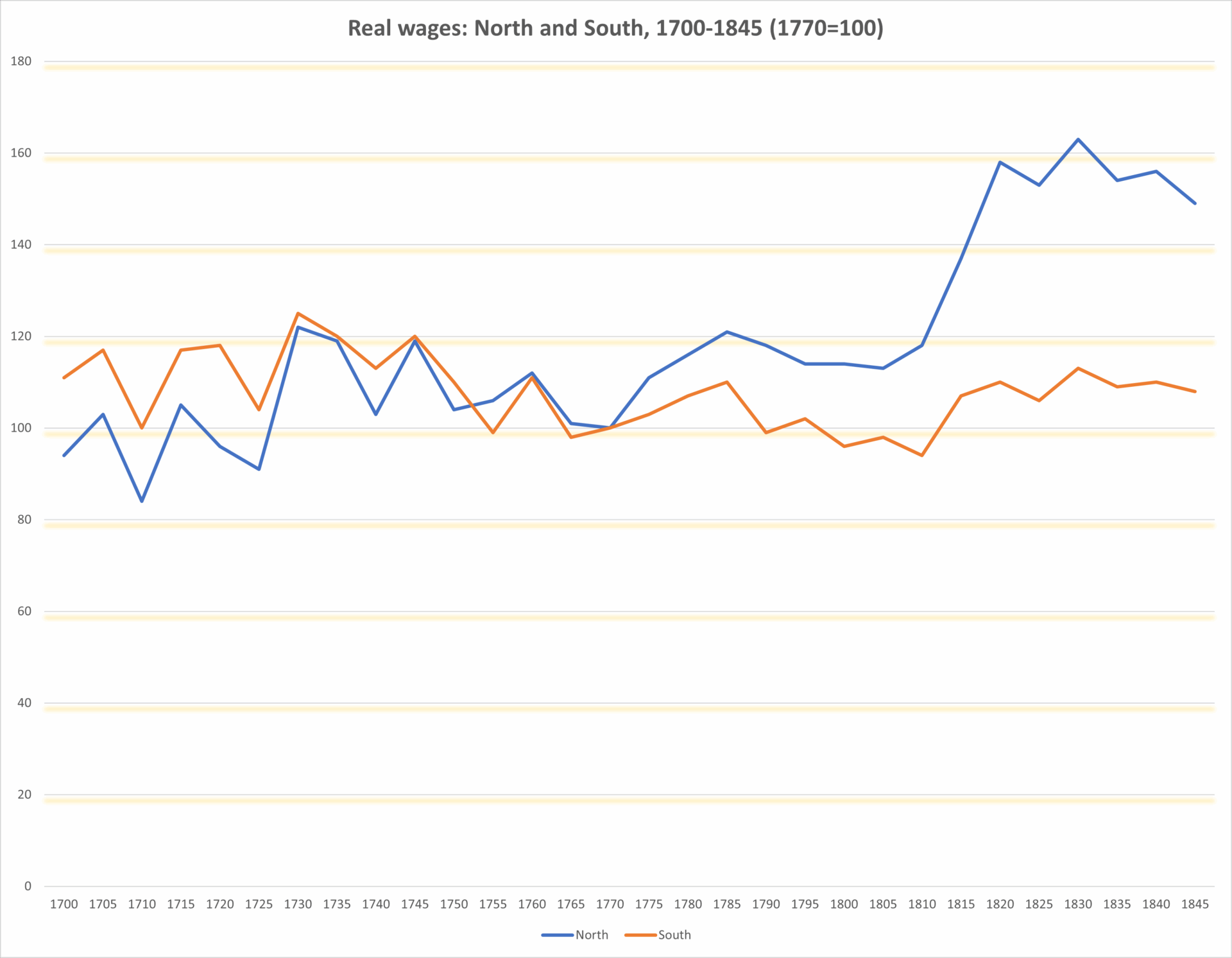
Indeed, if we switch from a national to a regional perspective, things start to look a little different. This is because we can try to disentangle the different experiences of the industrialising north and midlands and the largely agricultural and even de-industrialising south.
The next graph is based on workers’ real wages in the English ‘North’ and the ‘South,’ based on Greg Clark’s work on farms. It shows that after around 1770, real wages in the North significantly outpace those in the South, as working opportunities increase. So, the slow national growth of wages was nothing more than the average of two different phenomena: stagnant wages in the rural south and rapidly growing wages in the industrialising north.
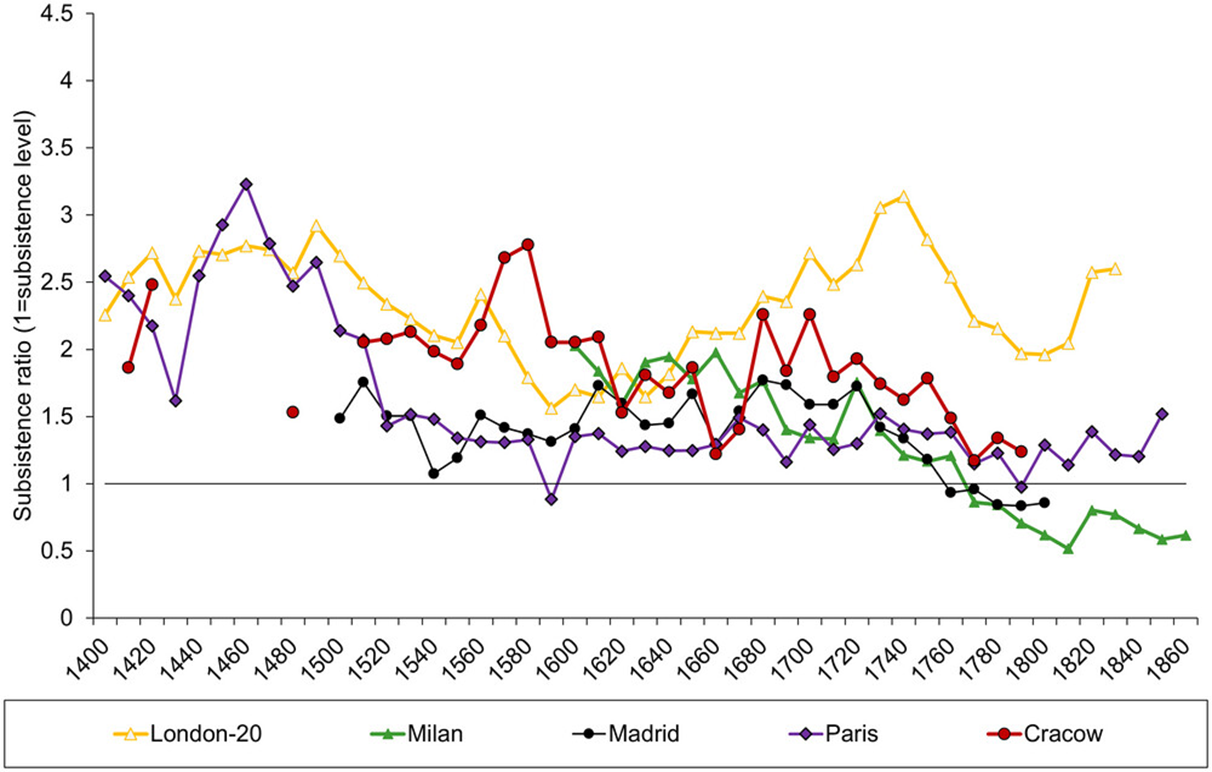
 If we switch again, from a regional to a global perspective, we again see a different picture. The following two graphs are taken from the work of Pim de Zwart.
The first tracks trends in workers’ wages in different parts of Europe. It shows London wages were similar to those in other major European towns until around the 1720s, when British wages moved strongly ahead.
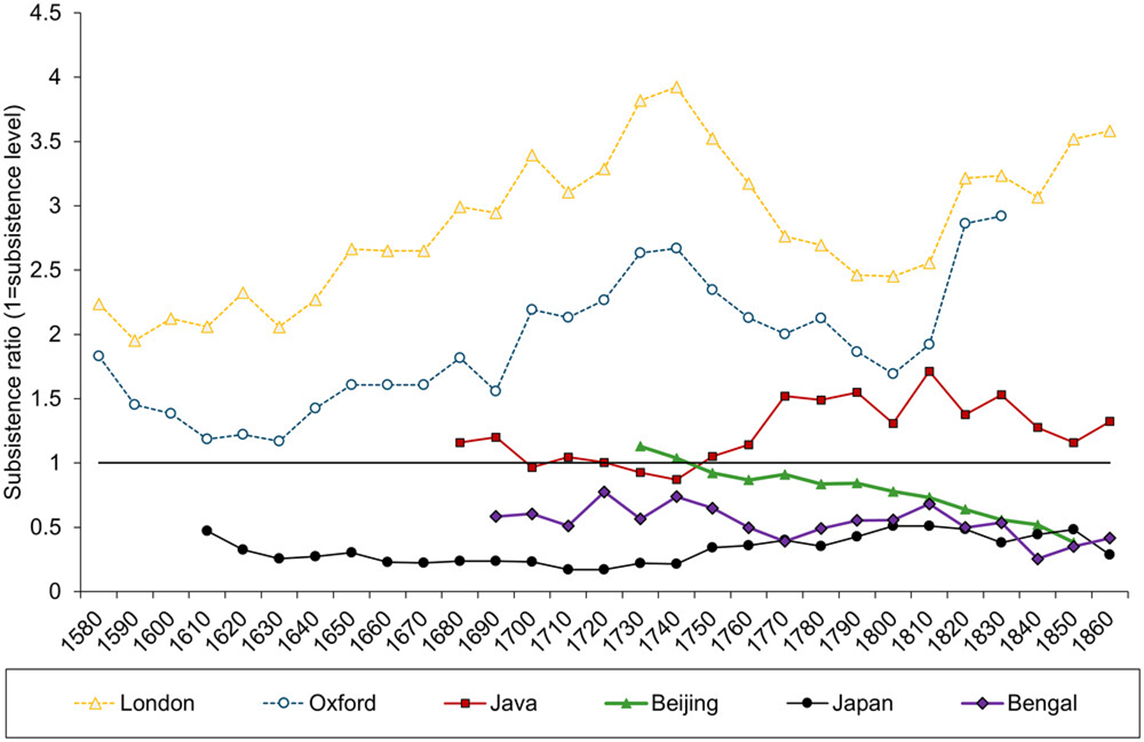
In the comparison with Asia in the second graph, we can see British wages were far higher, with most of Asian workers receiving wages at below subsistence level as indicated by the horizontal line at 1.
The global perspective suggests the Industrial Revolution had brought significant benefits to British workers.
Finally, we can compare long-run changes in workers’ real wages with changes in average wealth (GDP) per person. This is worth doing because it gives a measure of inequality. This is shown on the graph below taken from Mark Koyama and Jared Rubin.
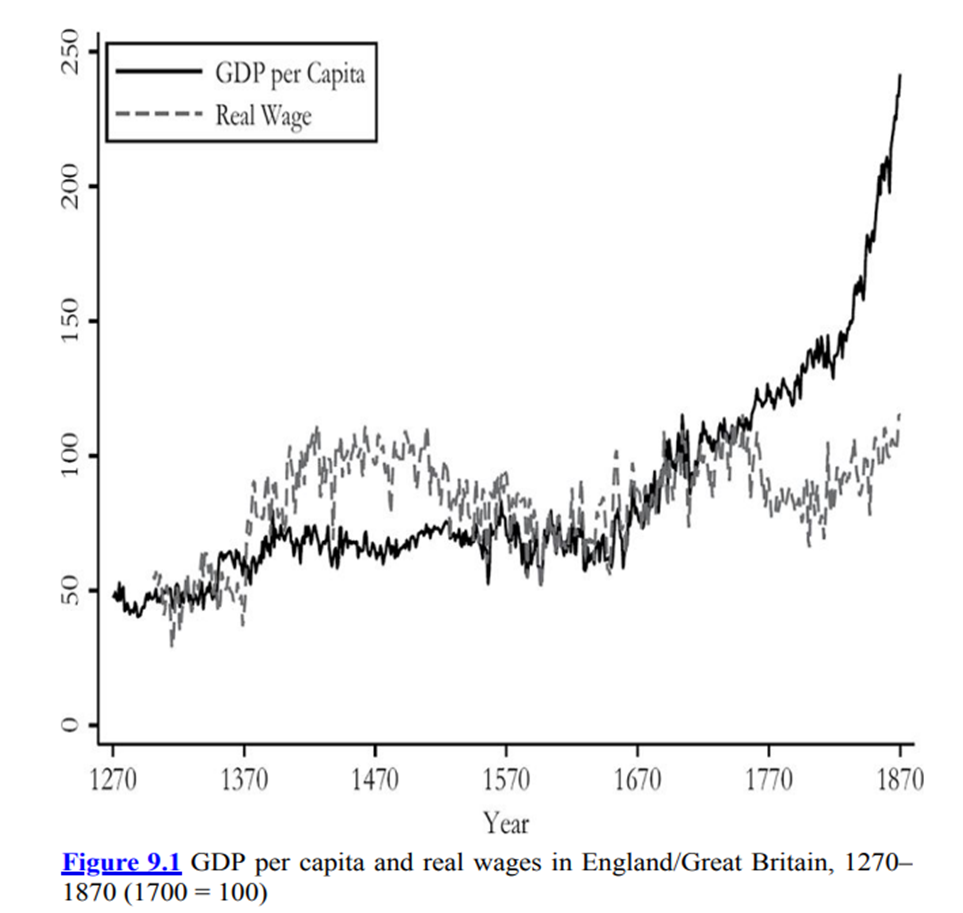 If the gains of the Industrial Revolution were equally distributed then the two series should move in tandem.
But they don’t. Average wealth per British person grew much faster than workers’ wages. The explanation is that workers benefitted a lot less from industrialisation than did landowners or manufacturers.
To conclude this section, we can say that:
- Workers’ real wages grew during the Industrial Revolution but only slowly and workers’ share in national wealth fell compared to owners of land and capital.
- Workers’ real wage growth was strongest in industrial areas,where wages increased for all types of work (e.g. farming, services)
- Based on real wages, British workers had a better standard of living than their counterparts in Europe and Asia. The gap between British workers’ real wages and those of workers in other parts of the world increased as a consequence of the Industrial Revolution.
The Industrial Revolution and workers’ health
Workers’ health could be assessed in various ways. Here, I focus on two metrics for which we have chronologically and geographically rich data: life expectancy and human height.
What we find is that quite different conclusions might be reached depending on whether we adopt a regional, national or global perspective.
| Date | Life expectancy in years (England & Wales) |
| 1721 | 25 |
| 1826 | 41 |
| 1850 | 40 |
Nationally, the picture seems quite positive as implied by the data above from EA Wrigley and Roger Schofield. The data suggest that average life expectancy at birth increased from around 25 years in the early eighteenth century to around 40 at the end of the Industrial Revolution.
However, the regional perspective gives a much less rosy view of health outcomes in industrialising Britain. We can explore this by comparing the same metric—life expectancy at birth in years—but focusing on specific towns and regions.
| Place | Life expectancy in years around 1840 |
| Rural Surrey | 45 |
| London | 37 |
| Birmingham | 36 |
| Leeds | 35 |
| Bristol | 29 |
| Glasgow | 27 |
| Liverpool | 26 |
| Manchester | 25 |
Based on Szreter and Mooney (1998); Davenport (2021)
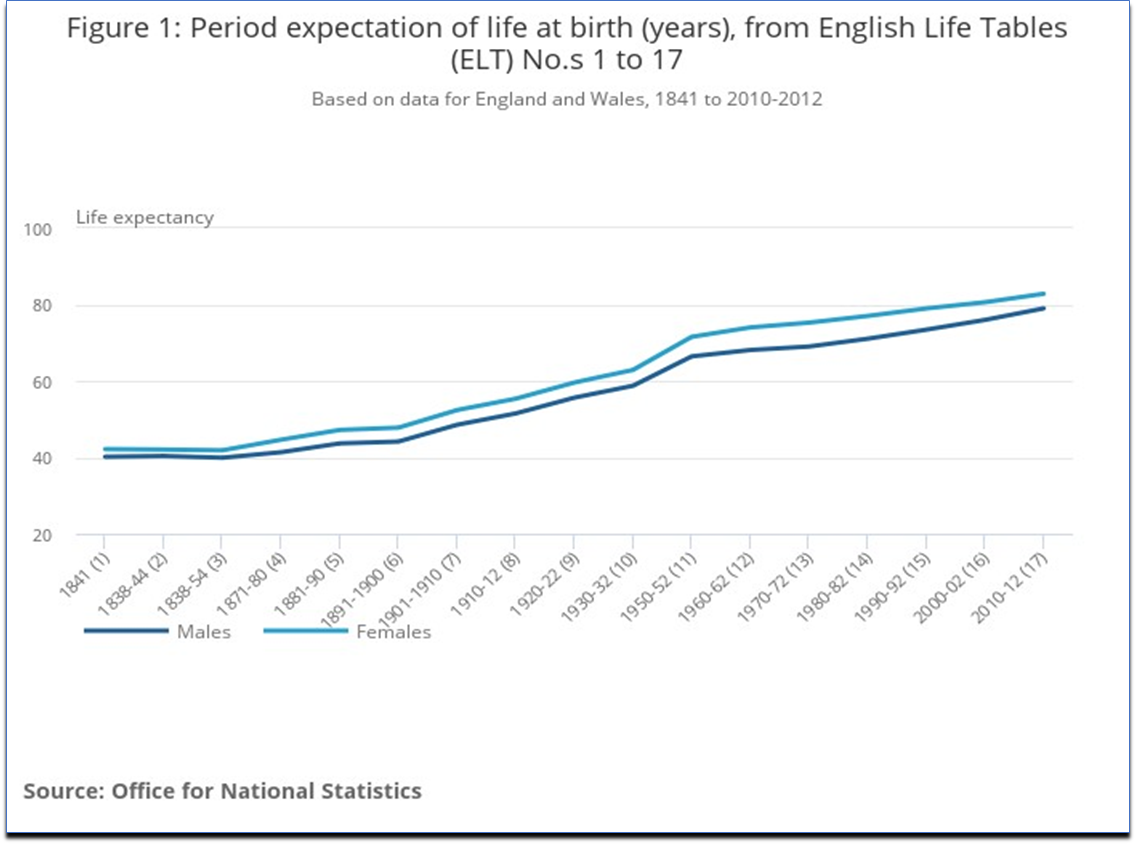
If we take the extreme examples of rural Surrey and Manchester, we can see a huge discrepancy of around 20 years in life expectancy in 1840. Manchester, the leading factory town and ‘shock city’ of the Industrial Revolution, had the lowest life expectancy of these places; Surrey, largely unaffected by industrialisation, had the highest. Indeed, data from the Office for National Statistics suggests that the major improvements in average life expectancy at birth took place only later, reaching 60 years in the 1920s and 80 years in the 1990s.
 The other measure of health considered here is human height. While genetics are the primary determinant of heights in the long run, heights can also vary in response to environmental factors, especially related to diet and disease in utero or during the adolescent growth spurt. Hence, human heights can be used as a proxy for population health and used to assess how environmental factors affected a population’s health, although finding large and non-biased samples of heights can be problematic: the evidence we have is often based on military recruits (who were measured on entry into service) or people in receipt of welfare or charity.
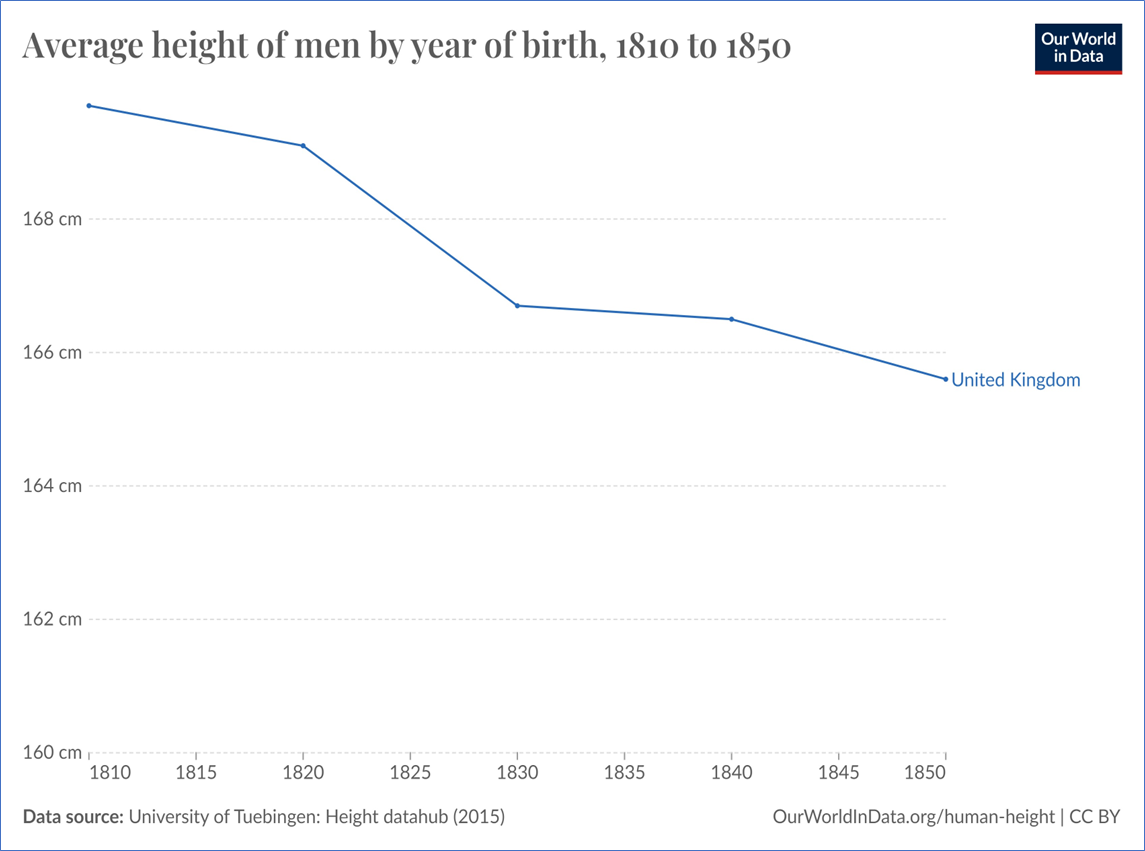
Looking at the national perspective, the Industrial Revolution appears to have been detrimental to the health of the population. This is evident in the graphs below generated from the Our World in Data website. During the Industrial Revolution, British men actually became shorter on average! This pattern of height decline can be readily linked to environmental degradation.
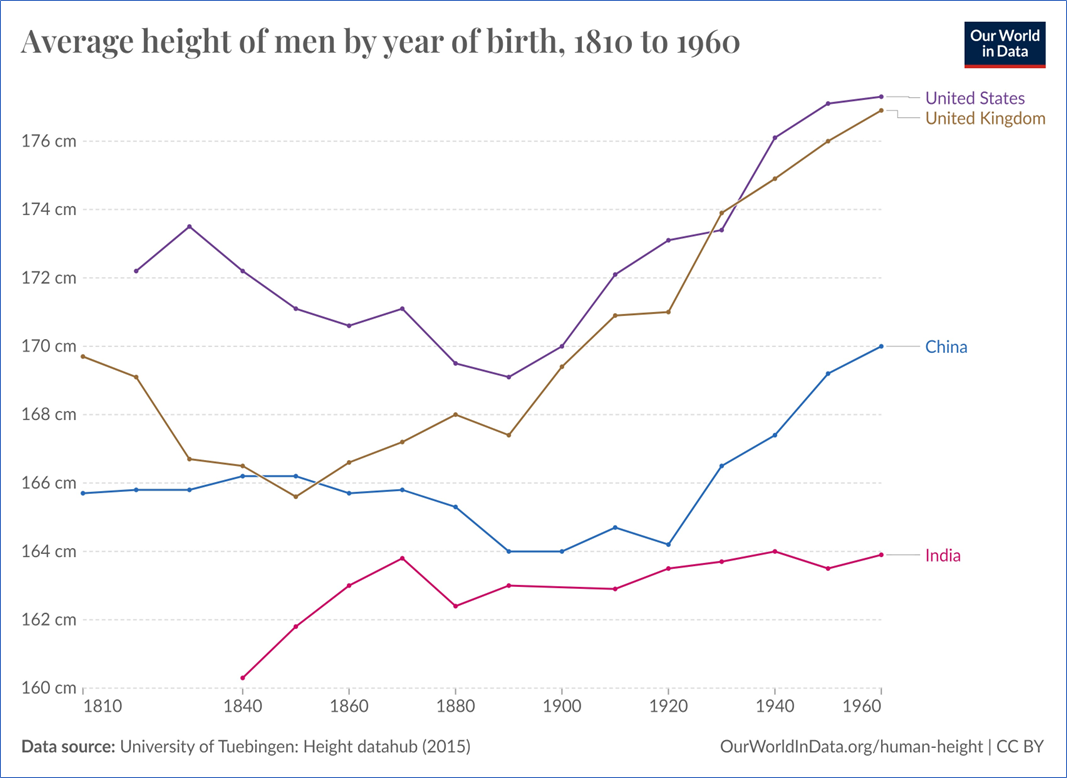
The second graph above contextualises the British experience through comparison with the United States, China, and India. This presents a mixed picture. Height in the United States was consistently higher than in the United Kingdom the years between 1810 and 1960, while heights in China and India were consistently lower. Other research by Jaadla, Shaw-Taylor, and Davenport has shown that average heights in the UK were also above those in continental Europe in the Industrial Revolution period.
Overall, in terms of health, life expectancy at a national level increased only slowly in Britain during the Industrial Revolution. The major drag on this was the industrial areas where environmental factors seem to have shortened lives and stunted growth. Any major improvements in UK health seem to have occurred long after the Industrial Revolution, especially in the twentieth century, and occurred primarily through advances in public health, medicine, diets, and education. Across the health metrics, however, Britain tended to outperform non-industrialised regions.
Conclusions
There is no simple way to summarise the impact of the Industrial Revolution on British workers. A great deal depends on the perspective from which the question is approached.
For example, the national perspective tends to dampen the good (wealth) and bad (health) impacts of the Industrial Revolution, while a regional perspective does the opposite.
The benefits of the Industrial Revolution are clearest in the ‘big picture’ sense: in the long run, when industrialising Britain is compared with pre-industrial Britain, and in the global perspective, when industrialising Britain is compared with the experience of other, non-industrialising countries at the same time.
Even so, the classic period of the Industrial Revolution between the mid-eighteenth and mid-nineteenth centuries was just the beginning of a phase of capitalist industrialisation whose impacts have not yet been fully observed.
Certainly, English people’s lifespans have more than doubled since the mid-eighteenth century and their average inflation-adjusted wealth has increased by at least fourteen times, but this progress has come at the expense of the environment, as the Industrial Revolution not only spurred economic growth but also marked the start of significant human-driven climate change through increased fossil fuel use.
Further reading
- Romola J. Davenport, ‘Mortality, Migration and Epidemiological Change in English Cities, 1600–1870,’ International Journal of Paleopathology, 34 (2021), 37–49
- Mark Koyama and Jared Rubin, How the World Became Rich: The Historical Origins of Economic Growth (Polity, 2022)
- Pim de Zwart, ‘The Long-Run Evolution of Global Real Wages,’ Journal of Economic Surveys (2023)