
Reading Industrial Landscapes through Working-Class Poetry: James Woodhouse and Coalbrookdale
Adam Bridgen, Durham University
Today, the public’s understanding of the Industrial Revolution has two different faces. On the one hand a celebratory view remains: witness Danny Boyle’s phantasmagoric 2012 Olympics opening ceremony, which showcased the Industrial Revolution as Britain’s grandest and most significant historical moment, the means by which enterprising Britons transformed their country and gave rise to the modern world.
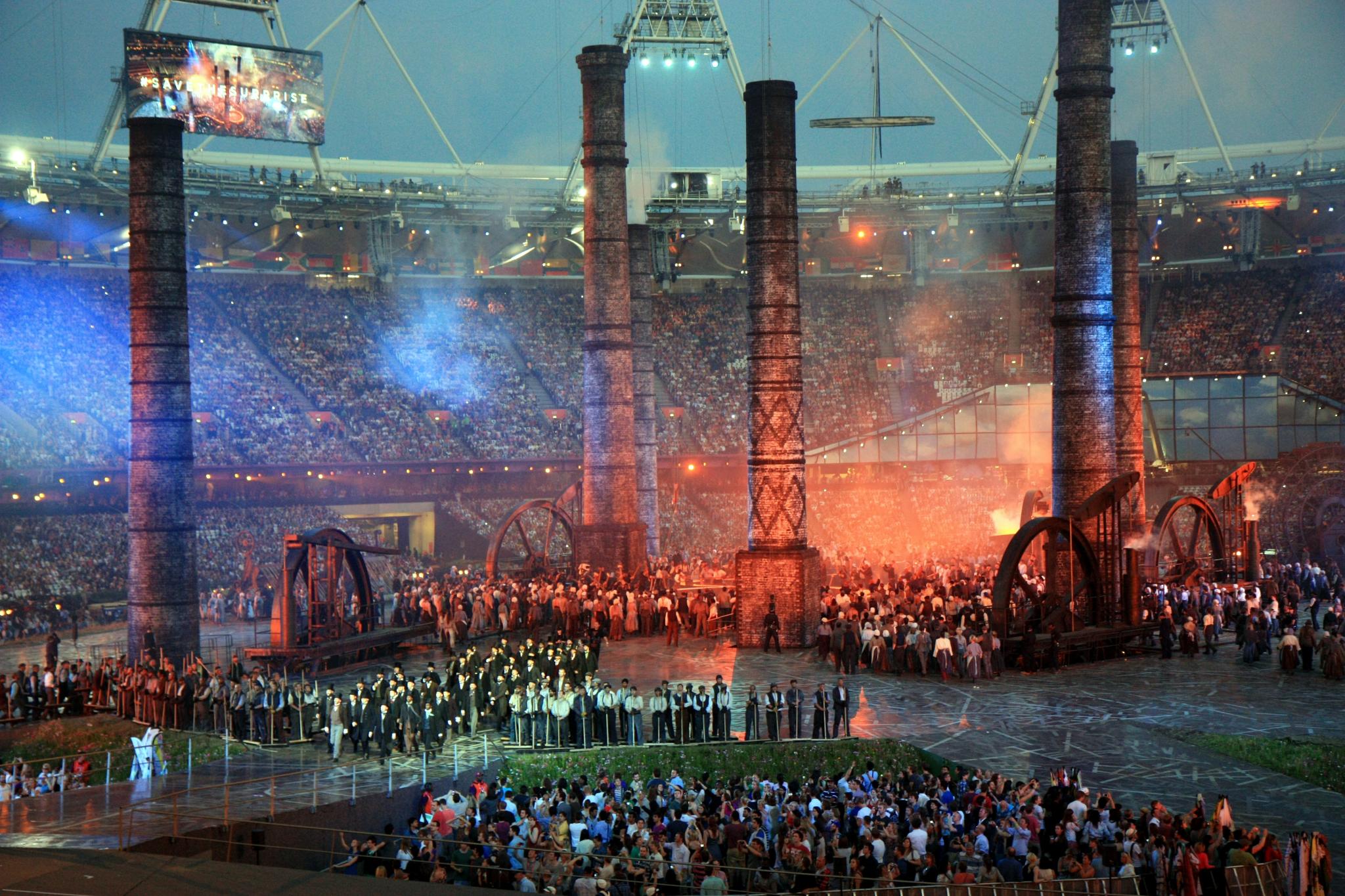
2012 Olympics opening ceremony. Wikimedia Commons.

While this story persists, over the last decade the Industrial Revolution’s association with ‘progress’ has come under strain. Many heritage organisations are now grappling with the extent to which the Industrial Revolution was interwoven with transatlantic slavery. Climate change’s accelerating impacts cast an ever darkening cloud over Britain’s industrial story, particularly as some of the earliest industrial sites become vulnerable to the forces they unleashed. Consequently, traditional accounts of entrepreneurial and technical achievement now seem increasingly off-key, as historians and heritage bodies seek to represent different perspectives on the events of the past.
Taking a lesser-trodden route into the early Industrial Revolution, my Leverhulme research project attends to the voices of workers. These were the people most immediately involved in the labour of Britain’s transformation, as well as impacted by it, though they were not the inventors, investors, or decision makers about whom we know the most today. I draw on a freely available index of British labouring-class poetry, which now includes over two thousand named individuals from the period 1700–1900. Might not workers’ literary creations, rarely included in traditional accounts of Britain’s industrial reinvention, offer an enriching point of view?
One labouring-class poet of particular relevance to this question is James Woodhouse (1735–1820). Born in Rowley Regis, a small village between Wolverhampton and Birmingham, Woodhouse lived on the cusp of the early transformation of this region. He came to publish his poems thanks to supportive patrons in his area—genteel landowners and aristocrats who appreciated Woodhouse’s shrewd discernment of the beauty of their estates (which he put into verse for them, initially in order to gain access to gardens that were otherwise off limits to folk like him).
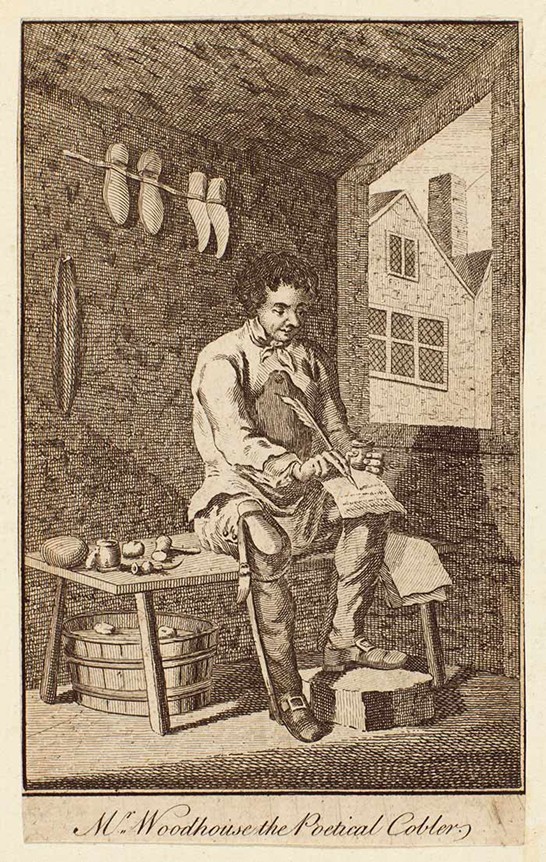
Anon., James Woodhouse (1765). Wikimedia Commons.

Although he was to leave the region in 1767 to take up the position of land steward at another patron’s estate, he did not forget about Shropshire and wrote extensively about it in his 1790s verse autobiography, reimagining the landscape of his youth and his rambles between Birmingham and the Wrekin (a hill just north of Ironbridge and Coalbrookdale, visible in many paintings of the valley). At 28,013 lines, this vast poem is a unique record of one man’s attempt to recount his life and work in a transforming Britain. It has however been largely overlooked by historians, despite recent work on working-class autobiographies that addresses the ‘quality of living’ debate.
Several features of Woodhouse’s autobiography, which he wrote as a self-appointed ‘Poet-Laureat, of the Poor,’ offer useful approaches for developing different and more inclusive forms of storytelling about the Industrial Revolution. One challenge which this poem relates to is that of bringing industrial environments to life for modern audiences. While today such sites offer very little of the sensory experience of the work of early, large-scale industrial production, this is not the case in contemporary poems designed in part to communicate and comment on these novelties.
Take one extended passage in Woodhouse’s poem (p. 25) which narrates the rapid expansion of iron-smelting industries in his region. Set atop one of Shropshire’s many hills, Woodhouse depicts a landscape thoroughly transformed by the preparation of coke in superheated coal heaps:
thro’ prospects scattered far, and near,
Pale-glowing gleams, and flickering flames, appear,
Like new volcanoes, ’mid deep darkness nurs’d,
From cooking coals, in ruddy brilliance, burst,
While smokey curls, in thickening columns, rise,
Obscure the landscapes, and involve the skies

Anon., A Kiln for Burning Coke near Maidstone, Kent (1799). Science Museum Group.
Adapting creatively to the smoke’s cloaking of the visual landscape, Woodhouse then proceeds to attune the ear to the ‘Deep, sullen sounds,’ and the great ‘groans, and sighs’ of the teeming valley. Then, precipitously, he transports the reader down into the heart of cast iron production:
Here clanking engines vomit scalding streams,
And belch vast volumes of attendant steams—
There thundering forges, with pulsations loud,
Alternate striking, pierce the pendant cloud;
While, to these distant hills, respiring slow,
Furnaces’ iron lungs loud-breathing, blow;
Breaking, abrupt, on Superstition’s ear,
And shrink the shuddering frame with shivering fear;
Obtruding on the heart, each heaving breath,
Some vengeful Fiend, grim delegate of Death!
Though less well known than Philippe Jacques de Loutherbourg’s sublime painting of Ironbridge’s Bedlam furnace, these lines are just as evocative. The multi-sensory dimensions of Woodhouse’s description, giving a feel for the terrifying speed, sound, and super-heated atmosphere of the workplace, also offer other advantages. A recording of this extract would especially enhance the experience for visitors with visual disabilities.
Woodhouse's poem is an important form of evidence of workers’ thoughts and feelings about Britain’s industrialisation. Such insights are otherwise very rare. As the ‘Labourers of Coalbrookdale’ panel in the Museum of Iron laments, ‘Most eighteenth century workers are anonymous. The only records that we have are those who are shown in artwork at the time.’
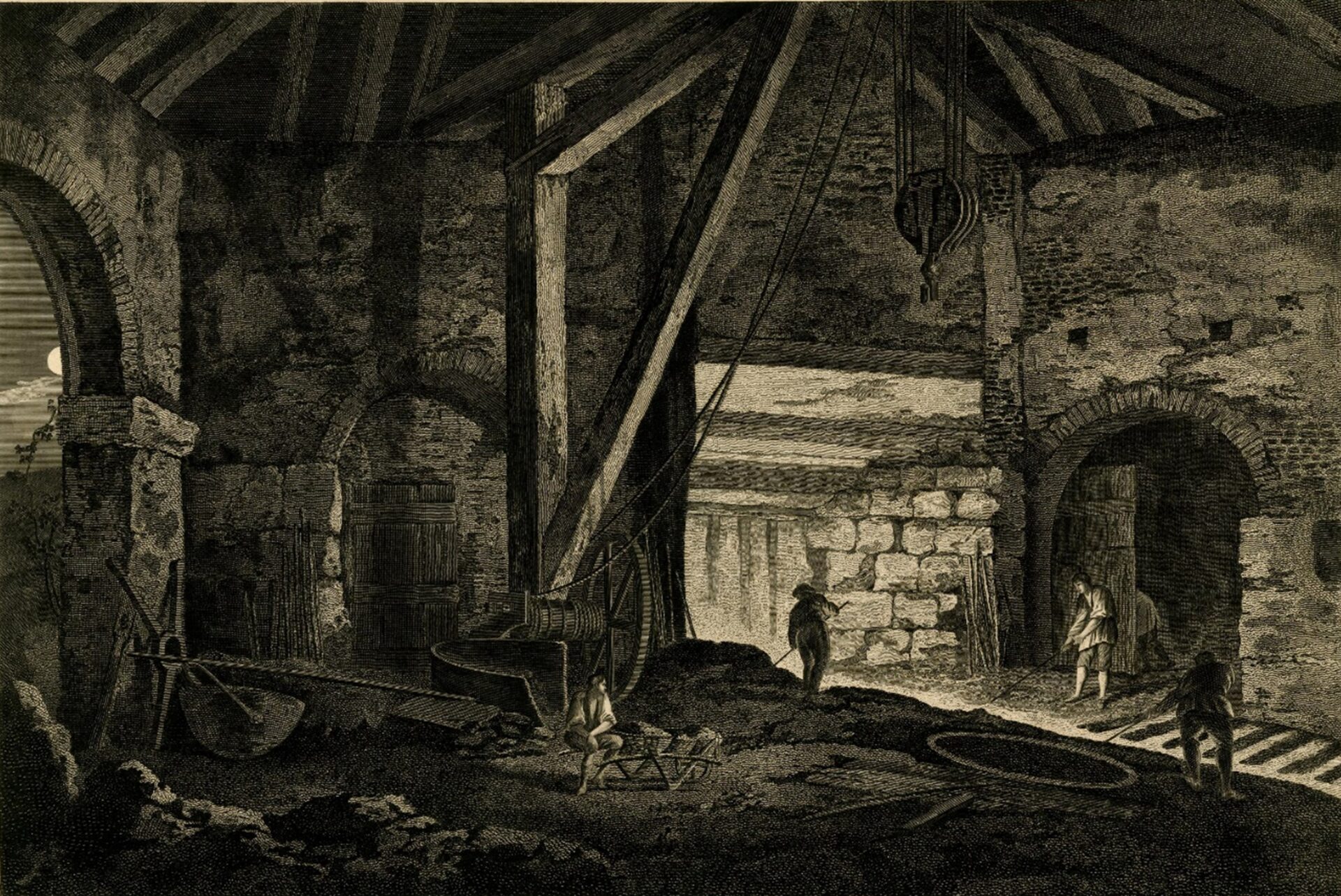
George Robertson, engraved by Wilson Lowry, The Inside of a Smelting House, at Broseley, Shropshire (1788). British Museum.
It is not difficult to detect the ambivalence, perhaps even antipathy, which Woodhouse weaves into the verses above. Adjacent lines register the aesthetic impacts of industry on the landscape (‘such a rude Scene no beauteous forms unfolds’) and the social disorders it threatened to aggravate: quarried limestone might equally create ‘proud shrines for Pomp, or shelters for the Poor,’ while iron serves both ‘the wants, and whims, of Man’s fastidious Race’ (p. 25).
Woodhouse accepts that the ‘Unnumbered’d bounties’ of the earth’s crust could and ought to benefit mankind, but he also includes a darker vision of how their ‘Proteus-like’ powers might deepen existing social inequalities. Later in the poem (p. 209), he takes an unequivocal stance against the ruling class’s growing immersion in an extractive capitalist ethos, abetting what he described as a nationwide ‘distillation’ of wealth, as:
forcing-pumps, and engines, fram’d by Law—
Or what State-chemistry extracts, in drops,
From furnaces and forges; sheds and shops—
From sweat of toiling Man, or labouring Beast,
The mighty mass grows, constantly increas’d;
From every melting eye, and moisten’d hand,
Till every source seems dry, thro’ all the Land.
At the other extreme, he imagines the amassed profits as cataclysmic:
All only pouring from its plenteous stores,
A showery deluge on dependent shores;
Or arrogantly swells Ambition’s tides,
Flooding rank pastures, on proud river-sides—
Although metaphorical, Woodhouse’s language of drought and flooding is not accidental: if it seems prophetic now, it reflected the unequal distribution of rewards and the risk which those at the lower end of the social spectrum are always more exposed to. As I have argued in a recent essay, Woodhouse’s critique of over-extraction was likely prompted by his troubled career as a land steward in Berkshire, tasked with the estate’s agricultural ‘improvement’ and its later emparkment, which was itself funded by the profits of his employer’s collieries in Northumbria.
Long before the titular theory was coined in Rob Nixon’s Slow Violence, workers were finding ways to apprehend and articulate the destructive impacts of the emerging industrial-capitalist ethos. Beyond representing the nature of work during the Industrial Revolution, therefore, labouring-class poets were clearly also attentive to questions about its transformative potential—for good and ill. Studying their writing, and thinking of new ways to include it in heritage storytelling, is an opportunity to confront today’s challenges through and with the people of the past.
Support received from the Leverhulme Trust, with thanks.
Further reading
- Emma Griffin, Liberty’s Dawn: A People’s History of the Industrial Revolution (Yale UP, 2013)
- Laurajane Smith, Paul Shackel and Gary Campbell, eds, Heritage, Labour and the Working Classes (Routledge, 2011)
- James Woodhouse, The Life and Poetical Works of James Woodhouse, ed. R. I. Woodhouse, 2 vols (Leadenhall Press, 1896)