
Canal Mania, Mediation and Imperial Commerce
Miranda Burgess, The University of British Columbia
When we think of projecting, we likely think of a screen on which some kind of digital or analogue light source, an LCD projector or a nineteenth-century magic lantern, throws a transparent image across distance. In the last years of the eighteenth century and the first of the nineteenth, though, projecting meant something else: the speculative imagining and advertising, and sometimes the completion, of complex transportation projects, particularly navigational ones.
In 1758, when Francis Egerton, the third Duke of Bridgewater, proposed building an artificial waterway from his coal mines near Salford to Manchester, nobody called him a projector, despite the scope of the proposed works. The Bridgewater Canal began as an underground waterway, proceeding mostly along level ground. Rising to the surface, it crossed the River Irwell at Barton by means of a stone aqueduct. By the 1790s it extended around forty miles (sixty-five kilometres) from Leigh to Runcorn and by the 1890s it connected with the newly built Manchester Ship Canal.

‘Map of the Canal from Manchester to Runcorn,’ in John Aikin, A Description of the Country from Thirty to Forty Miles Round Manchester (1795)
The canal was no simple monument to Egerton’s ego, though it seems likely that Egerton, one of the richest men in England and an ambitious gambler at cards, had a reasonably big one. Yet the idea for the canal had come from his estate agent John Gilbert, who wanted to eliminate the slowness, inefficiency and expense of carrying loads of coal by road and river. While an Act of Parliament was necessary to authorise each stage of the construction, Egerton self-funded the project. There were no fanciful prospectuses, no newspaper advertisements for investors, and no extravagant claims about future effects.
Rivals often opposed projectors’ plans, fearing that products carried by water would move more quickly and efficiently than those carried by road, or that a canal to a particular harbour would disadvantage other nearby harbours, or worrying that a decline in the coasting trade—in which goods were moved by sea in small boats hugging the land—would compromise the training of Britain’s sailors. More simply, they objected that canal-building was expensive, refusing to risk their own capital and deploring any increase in taxation. But in many cases beside Egerton’s, Parliament was more enthusiastic. In his General History of Inland Navigation, Foreign and Domestic (1792), John Phillips calculated that almost 1000 miles (more than 1500 km) of canals were completed in Britain between 1760 and the early 1790s.

‘The Market or Passage Boat’ and ‘The Dispatch [i.e. Postal] Boat,’ in Robert Fulton, A Treatise on the Improvement of Canal Navigation (1796)
The Dissenting intellectual John Aikin reported (p. 116) in the 1790s that the lowered price of carriage—cut in half on the Bridgewater Canal—had benefited manufacturers by decreasing commodity prices and proportionately increasing demand. Lowered prices enabled manufacturers and miners to increase industrial output of products such as cotton and woollen cloth as well as coals, lime, and brick and stone for building. The demand that Aikin and others identified was global as well as local and regional. Phillips argued that the connection between mines, factories, canals and harbours had provided an ‘extension of our distant navigation’ that had ‘in effect, converted the internal parts of our island into coasts’ (pp. vii–viii).

Johannes Swertner, ‘View of Barton Bridge,’ in Aikin, Description of the Country Round Manchester (1795)
It is here that a third definition of projecting becomes relevant. To project, in psychological thought, is to imagine that other people are responsible for a person’s uncomfortable experiences. To put it another way, projecting makes external objects and other people into a kind of metaphor for discomfiting experience. It is not that ‘I am afraid.’ It is that this other person ‘is making me afraid,’ or even ‘is threatening me.’ The literature of the time is often especially adept at investigating this process of metaphoric imagining. In Mary Shelley’s Frankenstein, published at the height of the public and political debates about canals and mobility, Victor Frankenstein responds to his Creature, created to be his child and second self, in just this way. In his imagining, it is not that Victor has been unjust in making the Creature, producing guilt and discomfort. It is that the Creature—a hypermobile figure who requires neither roads nor canals to move rapidly around Europe, from Switzerland to Ireland to Russia to the Arctic Circle—is a ‘monster,’ not a copy of but utterly and threateningly different from his Genevese creator and from humanity itself.
This sense of projecting is also evident throughout the extensive pamphlet literature on canals that flourished between the 1750s and early 1830s. It manifests itself in several ways. Beginning with Phillips, writers about canals portrayed Britain as playing catch-up with other empires, notably Russia and China. Eugenia Zuroski shows how British writers developed an inflated sense of the importance of the British empire by portraying China as Britain’s rival. Other writers expressed disorientation and fear at the imagined intrusion of foreign travellers and vessels into the landlocked centre of Britain—at the possibility of encountering:
in the interior of the country, the same vessel ploughing through a field of waving corn, or gliding past the rural hamlet, which only a short time before, was seen braving the billows of the vast Atlantic, above a hundred leagues from land.
A less grandiose sense of projecting is equally evident in the discourse of the time about canals. Landowners—especially those with property adjacent to the Regent’s Canal, built through London from Paddington to the Thames from 1812 onwards—wrote letters protesting against the ‘insecurity to the public, from persons passing through a line of country for nine miles at all times of the night.’
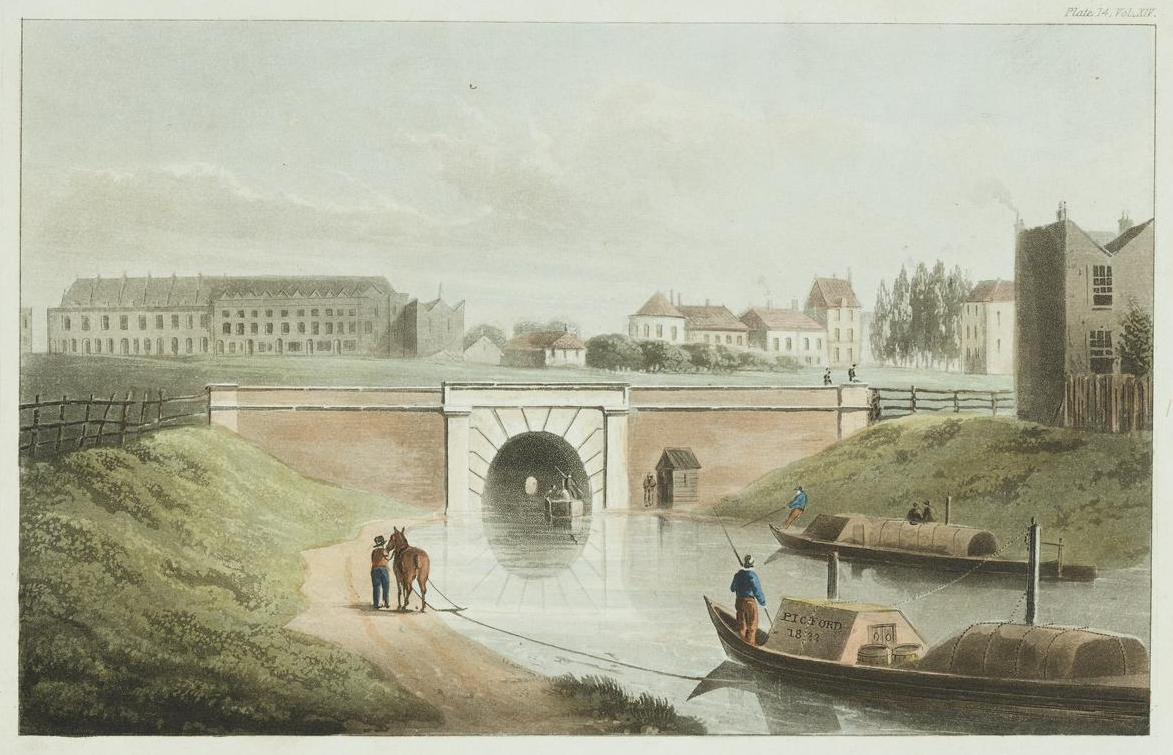
‘West Entrance to the Tunnell [sic], Regent’s Canal, Islington,’ Ackermann’s Repository of Arts (1822). Science Museum Group.
Jon Mee has shown how the literary and corresponding societies in the industrialising cities of the period, such as the Manchester Literary and Philosophical Society, debated questions of commerce and transport in relation to a wider field of literary and political discussion. Charlotte Sussman has suggested that British discussions of mobility in the same period very often correlated the question of immigration, or incoming—highlighted in Phillips’s praise of a Britain wearing its heartland on its sleeve—with outmigration and settlement. This two-step process required British settlers, soldiers and sailors to understand themselves as carrying feelings for Britain with them, typically in the form of memorised poetry and recollected novels. This memory of reading and response enabled Britain’s migrants to establish themselves overseas without undue homesickness. In turn, the consolatory imaginings of Britons abroad characterised the people they found in the places they journeyed to as alien and threatening, a characterisation that let them project the future of British prosperity on to the extractions and enslavements that even the poorest settlers might help to carry out.
The power of Mee’s and Sussman’s analyses lies in their accounts of mediation. Canals—perhaps like any other industrial technology, past or present—did not necessarily accomplish anything on their own. Imagination, metaphor, reading and writing contributed to the development of canals and their imperial and colonial relations. The significance of canals for the Industrial Revolution was as much cultural, in Britain’s understandings and representations of itself, as technological or economic.
Further reading
- Jon Mee, Networks of Improvement: Literature, Bodies, and Machines in the Industrial Revolution (University of Chicago Press, 2023)
- Charlotte Sussman, Peopling the World: Representing Human Mobility from Milton to Malthus (University of Pennsylvania Press, 2020)
- Eugenia Zuroski, A Taste for China: English Subjectivity and the Prehistory of Orientalism (Oxford University Press, 2013)