
Greenfield Valley: An Industrial Landscape
The Greenfield Valley in north-east Wales, with its woodlands, ponds and small farm museum, provides a perception of rural calm. However, current appearances hide a history of human settlement and exploitation going back at least to Roman times. The lead ore-bearing limestone to the south of the valley, the coal measures to the north, and above all, the water power potential of the Holywell stream—springing, as Thomas Pennant put it, ‘with vast impetuosity’ at St Winifred’s Well—enabled the Greenfield Valley to be in the forefront of eighteenth-century industrial development. The proximity of the Dee Estuary and accessibility to the port of Liverpool with its trading connections ensured that the Valley resounded to copper and brass mills’ battery hammers and rolling mills and cotton-spinning machinery operating day and night. This essay shows how, through alliances, take-overs, and some cunning strategising, the key players at Greenfield transformed the mile-long valley with astonishing rapidity.
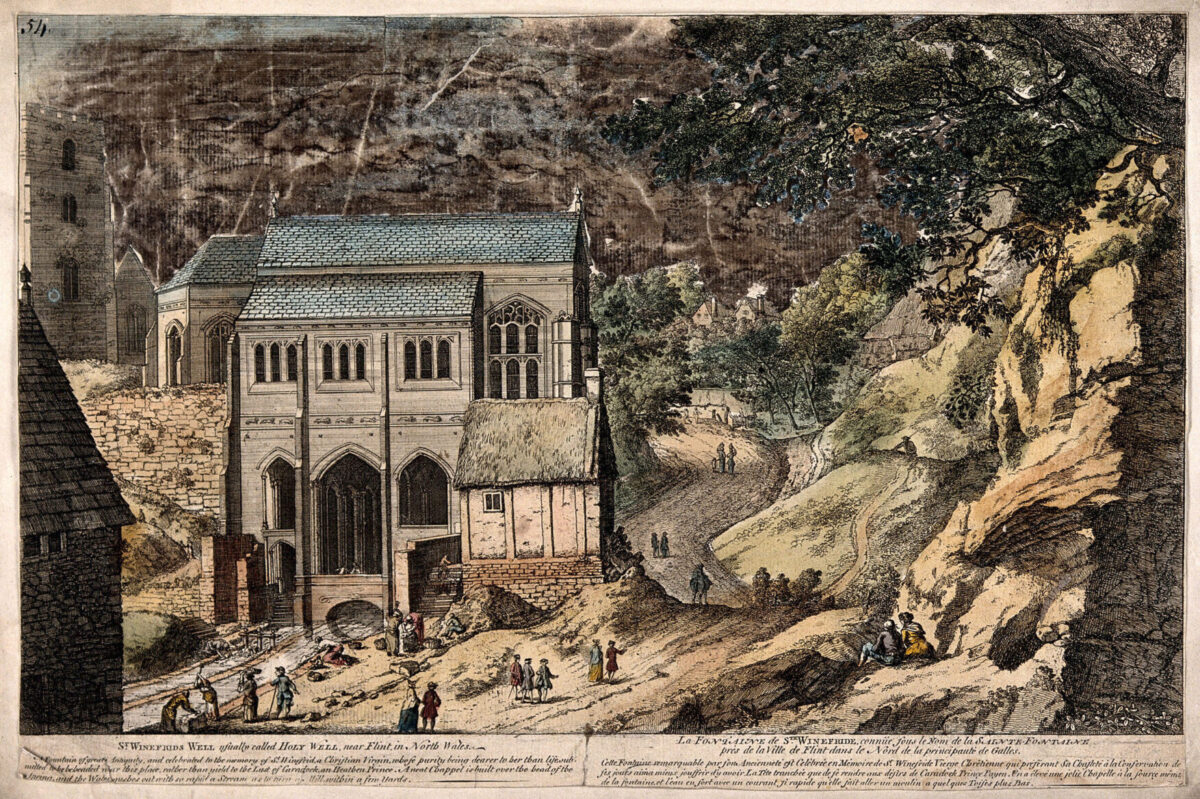
Anon., St. Winifred's Well (1713, with later colouring). Wellcome Collection.
Copper Kings
Thomas Patten (1690–1772), who had inherited his father’s copper business interests in Warrington, leased during 1743 the site of an iron forge and adjacent lands: his plans were delayed by the outbreak of hostilities between Britain and Spain. When peace was declared in 1748, Patten reappraised the situation and set up a Copper Battery Mill and other buildings for working copper-plate on the site. In 1755 he created the Warrington Company to operate these works. During 1764–65 Patten leased several plots of land near Bryn Celyn in the Greenfield Valley in order to build a larger battery and wire works (this included four lines of tilt hammers and a reservoir) and a site near Basingwerk Abbey for a new brass works. These were in full operation by October 1766. In 1769 Sir Nicholas Bayley contracted to supply his share of copper ore from Parys Mountain in Anglesey to Patten.
When Patten died in 1772 his son, also Thomas (1720–1806), continued the Warrington and Cheadle partnerships and on behalf of the Warrington Company built the Stanley copper smeltery at St Helens to supply the Warrington Company works at Greenfield. The Warrington Company was the first to supply copper sheets and nails for sheathing merchant ships at Liverpool in 1778. These included ships involved in the slave trade, such as The Vulture, which made ten trips carrying enslaved people from Bonny to Jamaica.

John Ingleby, engraved by W. C. Wilson, Greenfield Brass Mills (1792). Science Museum Group.
The Greenfield works soon attracted international attention. Reinhold Angerstein (1718–1760) visited the valley in 1754 and received a comprehensive guided tour. He subsequently provided a detailed report, including diagrams of products and processes, to the Swedish Trades Council. In 1760 the Swedish industrial specialists Bengt Ferrner (1724–1802) and Jean Lefebure (1736–1804) also came over. The Lefebure family was heavily involved in the copper and brass industry of Sweden. The Austrian Count Karl von Zinzendorf was another visitor in 1768. He was financed by the Habsburg monarch, Maria Theresa, and duly reported back to his government.
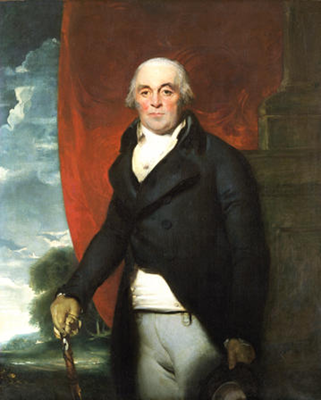
Thomas Lawrence, Thomas Williams of Llanidan (c. 1792). Amgueddfa Cymru / National Museums Wales.
Over in Anglesey, Thomas Williams (1737–1802), having successfully represented Rev Edward Hughes (1738–1816) in a lengthy legal dispute to stop Sir Nicholas Bayley and Charles Roe’s workmen mining copper ore on and beneath land owned by Hughes and his wife, formed a partnership—the Parys Mine Company—with Edward Hughes and John Dawes in 1774 to exploit the copper ores. In 1779 Williams leased a site at Ravenhead on the Sankey Canal to build a copper smelter and then went on to lease land in the Greenfield Valley for a copper forge, rolling mill and a copper wire mill. Michael Hughes (1752–1825), Edward Hughes’s younger brother, aided by local managers, oversaw the operation of all the Greenfield and Ravenhead works, the Liverpool sales office and a fleet of Mersey Flats.
With its opencast mining on Parys Mountain, the Ravenhead smeltery and the Greenfield Mills, the Parys Mine Company could undercut all its competitors including the Warrington Company. Further advantage was gained in 1783 when two employees (Westwood and Collins) patented processes to make copper bolts strong enough for use with copper sheathing on ships. The iron bolts previously used corroded when in contact with copper. Consequently there was a substantial demand from the Royal Navy, merchant ship builders and from foreign navies. In 1784 a group of French metallurgic specialists visited the Greenfield copper rolling works.
Following a bitter price war with other copper companies the Parys Mine Company gained a monopoly of the Liverpool market for all copper products in 1785–1792. The Warrington Company leases to sites in the Greenfield Valley terminated in 1785, giving Williams the opportunity to take over the Greenfield Valley works of the Warrington Company in the name of the Greenfield Copper & Brass Company (a partnership including Thomas Williams, his son Owen, Michael Hughes, John Wilkinson and Pascoe Grenfell). The Battery Works was greatly expanded, and in 1788 a new rolling mill was constructed with three large iron waterwheels. The manufacture of copper cylinders for printing on textiles and copper discs for coinage and tokens, including the initial Druid coinage and the Wilkinson penny tokens, were located adjacent to the rolling mill. Williams claimed he expended over £70,000 on works to produce products ‘solely for the African market’—the transatlantic slave trade. His Liverpool agent reported in 1800 that he was still sheathing 105 ships a year. These would be almost entirely ships associated with the slave trade.
Contentious beginnings: Greenfield Cotton Mills
The entrepreneurs involved in the cotton mills of the Greenfield Valley also had a significant influence on the development of the national industry. John Smalley had been an initial partner with Richard Arkwright in financing and patenting the first working model of the cotton spinning frame, and established the first Arkwright mill. Smalley came to Holywell in 1777 following a series of disputes initiated by Arkwright and erected a three-storey cotton mill financed with money he received, following arbitration, in compensation for withdrawing from the partnership (a total of £10,750: approximately £2.2 million today).
Peter Atherton, who had helped Arkwright to construct an initial working model of the spinning frame, had probably advised William and Thomas Douglas in the building of a cotton mill at Pendleton in 1780. When they formed a partnership with Elizabeth Smalley (John Smalley’s widow), Atherton advised them on the erection and equipping of the Upper Cotton Mill at Holywell in 1782. He became the senior partner and designed two further mills in the Valley. His designs—generally six storeys with a central broad waterwheel—were copied in other mills erected throughout England.

W.N. Gardiner, View near St Winifred’s Well, as in the Year 1785, of the Cotton Manufactory. From an extra-illustrated copy of Thomas Pennant’s Tours in Wales, National Library of Wales.
Arkwright aggressively sought to uphold his patent rights and planned to take legal action against the ‘Holywell mills’ and several other cotton companies in 1782 for infringements of his 1769 and 1775 patents. However, following a series of court hearings in 1783–85, an extension to the spinning frame patent of 1769 was not allowed, and the 1775 carding and roving patent was also disallowed because the descriptions of the machinery in the filed patent were deemed inadequate. William Harrison, who with John Dumbell financed the construction of the Lower Cotton Mill in Greenfield, was an important witness against Arkwright. The final results of these court cases initiated a major expansion of cotton spinning in Britain.
Owing to the economic conditions of 1787–88 and the competition of cotton imports from India, William Douglas became extremely concerned about the future of the British cotton industry. In a curious development he wrote to D’Aragon, the secretary of the French ambassador in London, including pamphlets describing his cotton factories and two samples of finely spun cotton from Holywell. Douglas boasted that he and his partner, Atherton, had created new machinery which produced yarn finer than any Indian-spun cotton. Douglas suggested that a French representative should tour the factories and view all the processes and machinery. He also indicated that he was interested in transferring his business to France! Such a move would have been completely illegal. Although D’Aragon apparently considered Douglas to be the greatest capitalist in the cotton world, the outbreak of the French Revolution prevented any follow-up.

Lower Cotton Mill, Greenfield Valley (1792). From Davies and Williams, The Greenfield Valley, p. 33.
Because Atherton and William Harrison had connections with the London Foundling Hospital, the Holywell partnership also pioneered the practice of sending children from the London parishes as indentured parish apprentices to the northern cotton mills. The first clearly documented group were sent from St Martin in the Fields to Pendleton in 1785, with further groups to Pendleton and Holywell in 1786. By 1795, Thomas Pennant reports that there were ‘above 300’ such apprentices in Greenfield: as Paul Evans has noted, his glowing account of the working conditions of these children may have been somewhat biased by his sources.
By 1800 there were an astonishing six copper and brass mills and four cotton mills operating in the Greenfield Valley. However, the death of Thomas Williams in 1802 instigated a major re-organisation of the copper works. The introduction of steam power coupled with technological changes in processes dramatically altered the industrial location factors. The Greenfield Valley was now at a disadvantage. The cotton mills closed in 1839. The remaining copper mills continued to 1894. New industries including woollen, paper and flour manufacture sought to utilise the vacated buildings, but by 1983 all had closed, leaving dramatic ruins as memorials to this period of intense change.
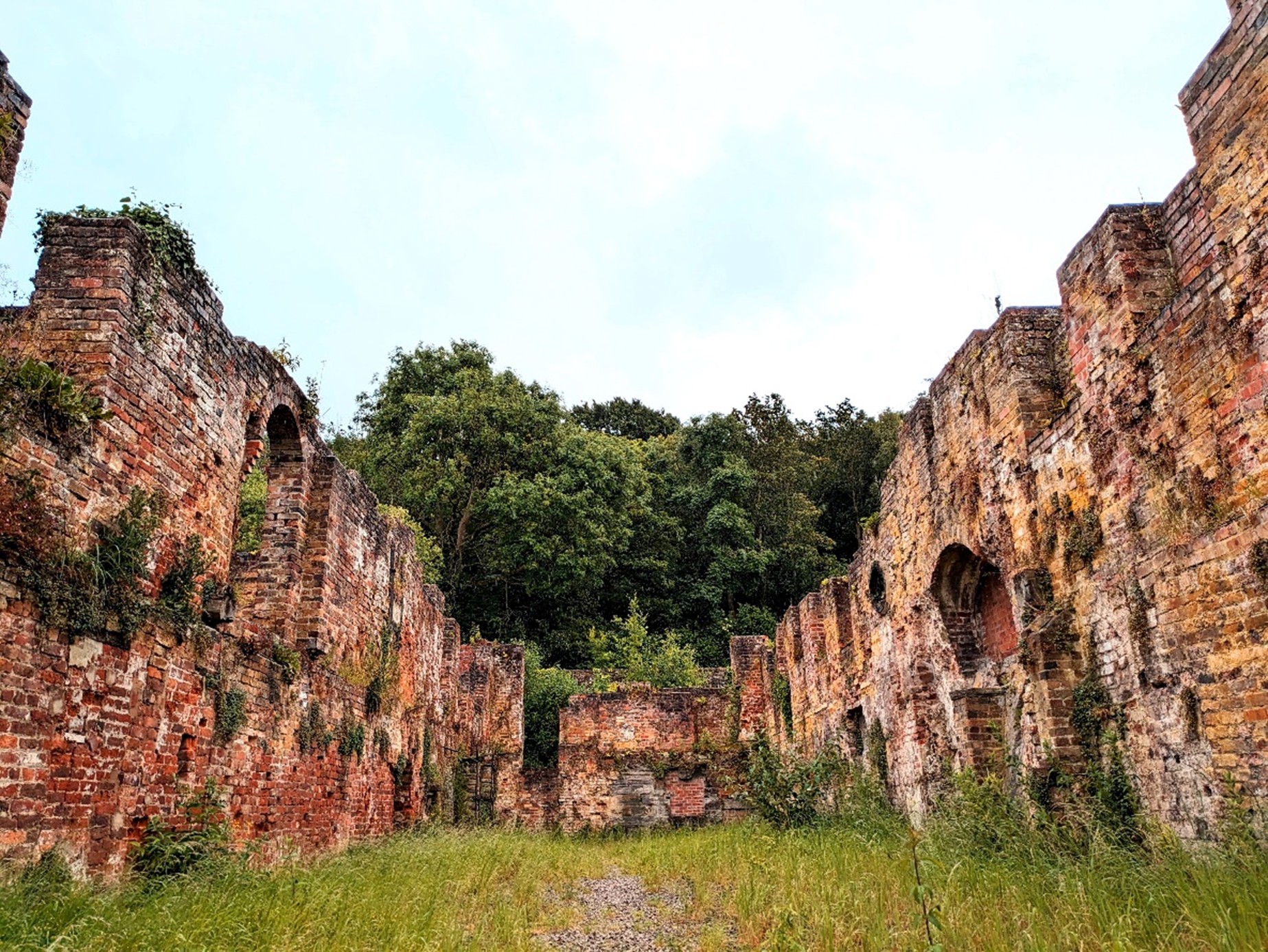
Former cotton mill, Greenfield Valley, 2024
Further Reading
- Ken Davies with CJ Williams, The Greenfield Valley, 2nd edn (Holywell Town Council, 1986)
- Ken Davies, ‘Holywell and the Transatlantic Slave Trade,’ Flintshire Historical Society Journal 40 (2015) 109–40
- Paul Evans, ‘Thomas Pennant and the Composition of his History of the Parishes of Whiteford and Holywell (1796),’ Flintshire Historical Society Journal 42 (2022), 125–89