
The Wasteman and the Carboniferous
Fredrik Albritton Jonsson, University of Chicago
The industrial revolution saw the birth of the first fossil fuel economy and the emergence of a cornucopian ideology of fossil growth. At the same time, geologists transformed the public understanding of the Earth’s interior and deep past. These developments—fossil growth, fossil ideology, and fossil science—were much more closely intertwined than scholars of capitalism and science have usually recognized. We can track the formation of a grand alliance between different fossil interest groups from the early 1780s, including coalmine proprietors, canal builders, and iron forgers. The British state blessed the new iron-coal complex by supporting the iron industry with tariffs and refraining from taxing coal at the national level.

Trade card of Richard Adams, coal merchant (c. 1808). British Museum.
Canal surveyors like William Smith played a critical role in the formation of the fossil alliance by mapping and publicizing the extent of the British mineral endowment. In 1822, geologists William Daniel Conybeare and William Philips introduced the term ‘Carboniferous’ to name the coal bearing strata and the geological age that had produced them. Fossil collecting marked out the Carboniferous strata of the coal seams in five dimensions—length, breadth, depth, geological origin and future duration. Geological maps helped synthesize local knowledge into a new vision of Britain as a fossil nation, linking present prosperity and future progress to the coal supply.
The deep coal mine was the principal source of Carboniferous fossils. Some clues about the process of collection can be gleaned from the records of the Newcastle natural historian William Hutton, who co-authored the first British flora of fossil plants with John Lindley between 1831 and 1837. We know that Hutton relied on the mining engineer John Buddle, but that the practical work of collecting specimens was carried out by Buddle’s subordinate Robert Fairley. Most of Hutton’s coal fossils came from a single location: the shale in the roof of the Bensham coal seam at Jarrow. Out of 285 recorded specimens, two thirds came from that source. Hutton’s other main supply was collected by William Pearson at the Low-main Seam at Felling colliery.
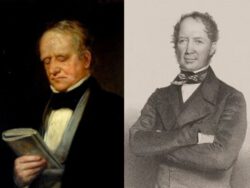
James Shotton, William Hutton (1853). North Tyneside Council; Thomas Herbert Maguire, John Lindley (1849). National Portrait Gallery.
Fairley served as master wasteman in the Bensham seam at Jarrow from 1830 onwards. Pearson held the same position at Felling colliery. The task of the wasteman was to walk the pits to survey the air courses and keep them in good repair. The wastemen also took stock of the stability of pillars and old workings. Collapsed and abandoned workings produced lethal gas in the form of ‘choke damp’—a mixture of carbon dioxide and nitrogen. Another threat came from the shale roof of the workings. On occasion, workers were crushed when whole slabs, so called ‘cauldron bottoms,’ fell down on them from the roof. This risk was compounded by the profusion of fossil ‘stems’ in the shale, which made the roof infirm and prone to shattering. Sigillaria fossils posed a particular risk to colliers. Their heavy trunks frequently slipped out of the roof, leaving gaping holes, sometimes as wide as five feet in diameter.
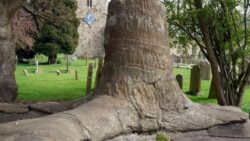
The ‘Stanhope Tree’: fossil Sigillaria, Stanhope, County Durham. This is Durham.
The social and material world of the wasteman appears only at the margins of geological science. William Witham began his Observations on Fossil Vegetables with an account of the dangers posed to workers by shale fossils and cauldron bottoms. But references of this kind were very rare in geological texts. In natural theology, the divine work of the Creator often took precedence and erased the social world of the collier. Fossils were seen as emblems of providential time, not products of the wasteman’s working day.
The fossils of the deep coal mine produced a new cosmology. Mining engineers and geologists looked to natural theology to understand their place in the universe. God had arranged the earth’s strata in such a way as to predestine the nation for manufacturing greatness. Drawing on the fossils collected at Bensham and Jarrow, Lindley and Hutton suggested that the first land plants had emerged in the Coal formation in an atmosphere supercharged with carbonic acid that produced an ‘inconceivably rich and luxuriant’ vegetation at the same time as it prevented the emergence of animal life. They counted 200–300 species of the Coal Formation, two thirds of which were ferns.
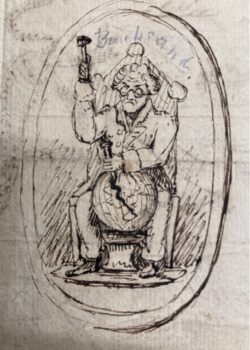
Henry De la Beche, A Geologist Examining the Structure of the World, from a letter of 13 June 13 1825. Oxford University Museum of Natural History Archive, Buckland Papers, 138M/F73.
In the northeastern collieries, Calamites were the most common fossils. These appeared to be branching plants with hollow stems, resembling reeds to a certain degree, though Lindley and Hutton doubted that there was a true analogy between them. The second most frequent fossil was the Lepidodendron, the scale tree, sometimes 20 or 40 feet tall. Another frequent fossil of the coal formation was the Sigillaria. Lindley and Hutton witnessed the excavation of a specimen of Sigillaria pachyderma in Killingworth colliery. It had four feet roots embedded in the shale and a trunk two feet in diameter marked by longitudinal flutings. During the dig, workers uncovered a whole grove of the same species growing within a space of fifty square yards.
Of all the fossils in the northeast, none seemed more significant to Lindley and Hutton than the Stigmaria ficoides. They described it as a prostrate, succulent land plant, with forked branches, and possibly a domed centre. (Richard Brown later argued that Stigmaria constituted the roots of Sigillaria. We now identify it as the root of Carboniferous Lycophodes).

Stigmaria ficoides, from Lindley and Hutton, The Fossil Flora of Great Britain, vol. 1, part 1, plate 31 (1831)
For Lindley and Hutton (pp. xxii–xxiii), wherever one travelled in the ‘Carboniferous formation’ a ‘practised eye’ could always detect signs of Stigmaria. ‘Coal, which rarely bears any outward vegetable form, presents that of Stigmaria oftener than any other.’
The growth of plants of this class was one of the great means made use of by the Almighty Architect of the globe, in absorbing and rendering solid that excess of Carbon, which, it is believed, must, at the period of the formation of the Coal-measures, have existed in the atmosphere.
By moving surplus carbon from the air, the labour of the Stigmaria plant at the same time purified the atmosphere and created the Carboniferous strata, making the planet ‘fit for the support of animal life, and, at last, a proper habitation for man.’ Coal was not just the fuel of British wealth but also the life-giving force that had made the planet habitable.
In this way, the erasure of the colliery worker from geology paved the way for a cosmology of carbon. At the same time as mining engineers and wastemen traced the gas flows inside the coalmine, geologists began to imagine God as the wasteman of the carbon cycle, regulating the atmosphere, channelling carbon back and forth through plants, earth, and air.
Further reading
- John P. Leifchild, Our Coal and Our Coalpits: The People in Them and the Scenes Around Them (Longman, Brown, Green, and Longmans, 1853)
- Martin Rudwick, Bursting the Limits of Time: The Reconstruction of Geohistory in the Age of Revolution (University of Chicago Press, 2005)
- Naomi Yuval-Naeh, ‘Cultivating the Carboniferous: Coal as a Botanical Curiosity in Victorian Culture,’ Victorian Studies 61:3 (2019), 419–45